
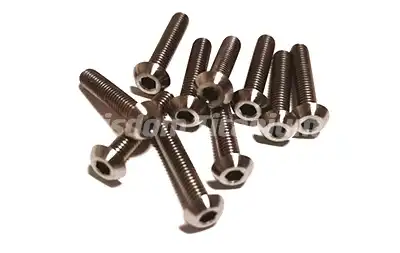
Mini titanium screws are increasingly a must for fastening applications in the medical, automotive, and precision manufacturing sectors. The grade of titanium used has an influence on the mechanical performance, durability, and safety of these critical goods. Most of the high-performance micro titanium screw goods are manufactured of Grade 5 titanium alloy (Ti-6Al-4V) with a tensile strength over 900 MPa and outstanding corrosion resistance and the best strength-to-weight ratio. This article will review the different grades of titanium to help procurement managers, vehicle mod shops, racing teams, and OEM customers make informed sourcing decisions to meet application-specific performance targets and regulatory compliance.
Understanding Titanium Grades Used in Mini Screws
Mini titanium screws are obtainable in various grades. Each grade has unique mechanical properties that dictate how well that grade will perform under certain conditions. Commercially pure titanium (grades 1, 2, and 4) offers excellent corrosion resistance and moderate strength, which is useful under low-stress situations. Grade 1 is the most ductile. Tensile Strength: About 240 megapascals (345 MPa), and yet flexible Grade 2 pure titanium is just 550 MPa strong. Not too frequent, though, grade 4.
This superb combination of characteristics results in Grade 5 titanium alloy (Ti-6Al-4V) dominating the small titanium screw industry. The alloy has a tensile strength of 900 MPa or more, which is more than twice the strength of Grade 2. It's got 6 percent aluminum and 4 percent vanadium. The aluminum component reduces density and increases resistance to oxidation. It also makes the vanadium constituent more robust at room temperature and more stable over time. Grade 5 is exceptionally robust and is suitable for temperatures from -200° C to +450° C, making it perfect for severe automotive and motorcycle applications.
Why Does Grade 5 Dominate Medical and Industrial Applications?
Grade 5 is used by medical device and precision equipment manufacturers for load-bearing fasteners and implanted mini-titanium screws because it satisfies the rigorous biocompatibility criteria defined by ASTM F136. The passive oxide layer of the alloy is very compatible with human bone tissue, favoring osseointegration in dental and orthopedic applications. Grade 5 is the optimum material for wheel hub bolts, brake calliper fasteners, and suspension components since it doesn’t degrade when subjected to intense vibrations, fluctuating temperatures, and chemicals that degrade road surfaces.
Commercially pure grades are nevertheless relevant for applications where great strength is not a requirement. Grade 2 mini titanium screws are suitable for maritime environments, chemical processing equipment, and the construction of bicycle frames where corrosion resistance is more essential than ultimate tensile strength. The choice of material is a compromise between performance and cost, with Grade 5 generally costing 20-30 percent more than commercially pure.
Material Composition and Mechanical Properties
Buyers may verify that the materials they are purchasing are authentic by knowing what’s in an alloy. Grade 5 titanium contains aluminum (5.5-6.75%) and vanadium (3.5-4.5%). The remainder is trace elements such as iron (up to 0.25%) and oxygen (up to 0.20%). Spectrographic examination during quality control verifies these ratios. This is what separates true Grade 5 from lesser counterfeits. Ti-6Al-4V has a density of around 4.43 g/cm³, which is almost 40% less than that of 316L stainless steel, 7.99 g/cm³. Hence, performance cars and aircraft applications may save a lot of weight.
Key Properties and Benefits of Mini Titanium Screws Based on Titanium Grade
The choosing of the right grade of titanium is very important for the performance of small titanium screws in different applications. Biocompatibility is especially important for those working in medicine. Titanium is nonpoisonous and may osseointegrate, i.e., it connects directly to screw threads of bone tissue without fibrous encapsulation. Mini titanium screws of grade 5 are ISO 5832-3 and ASTM F136 approved and hence suitable for use in physiological settings and for cleaning procedures such as autoclaving at 134°C.
The grades show a great scatter in mechanical strengths. Grade 2 titanium has a yield strength of around 275 MPa. This is good enough for bicycle parts that are not heavily weighted and cosmetic car parts. Grade 5 bumps the yield strength to roughly 880 MPa so that Mini titanium screws can hold brake callipers even in the face of loads of more than 10,000 cycles of thermal expansion and vibration. In motorcycle racing, resistance to fatigue is very important, since a damaged part at high speed might result in a catastrophic tragedy.
Corrosion Resistance Across Operating Environments
Titanium of all grades forms a protective covering of TiO₂ oxide on contact with oxygen. This layer is especially resistant to salt water, acidic chemicals, and moisture in the air. Even if the Grade 5 is scratched or damaged, this passive layer persists, and the protective covering rebounds in milliseconds. like modification businesses such as this property since it has specific wheel lug bolts and exposed chassis fasteners that won't rust after years of use on salty roads, dirty brakes, and hard temps.
Mini titanium screws are non-magnetic and do not interfere with medical imaging and sensitive equipment. MRI-compatible orthopedic screws should not be ferromagnetic since ferromagnetic material might cause artifacts or hazardous heating during scanning. Race tracking systems and electronic control units also benefit from nonmagnetic fasteners since they do not interfere with communications in high-frequency conditions.
Surface Treatment Enhancement Options
Current small titanium screws feature surface treatments, which improve the qualities of the base material. Anodizing enhances surface hardness to 200-300 HV (Vickers hardness) and hence decreases galling and thread wear during installation. You may also color code (blue, gold, purple, or black) to make it easier to see torque parameters or component batching using this electrochemical approach. The PVD (Physical Vapour Deposition) treatment is used to apply ceramic layers such as titanium nitride to increase wear resistance and minimize the coefficients of friction for precision assembly operations.
Sandblasting provides micro-textured surfaces, which help the paint to grab onto exposed areas of the car and make them seem more homogenous. The treatment removes surface impurities without changing size tolerances such that thread tolerances are maintained to ISO 4759 for M0.6 to M3.0 fasteners. Length may be customized from 1 mm up to 20 mm for a wide range of applications, from small electronic enclosures to structural support for motorcycle engine mounts.
Comparison: Mini Titanium Screws vs. Other Material Screws
Stainless steel has for a long time been the standard material for fasteners since it is inexpensive and performs well in most circumstances. Most sites do not rust; however, 316L stainless steel screws have about 580 MPa tensile strength. This is exceeded by Titanium Grade 5, which has 55% greater tensile strength and weighs 43% less. That means speed vehicles may shed weight, and that’s critical since every gram counts in terms of acceleration and handling.
Aluminum fasteners are even lighter than titanium fasteners, but they aren’t as robust or as durable. Aluminum screws have a low tensile strength (< 400 MPa) and galle when overtightened or vibrated. Exposed components rust when the substance oxidizes and, in time, become less able to support weight. Racing teams are first drawn to aluminum since it is lighter, but many may convert to a Mini titanium screw when they have issues with aluminum while racing.
Cost-Benefit Analysis for Procurement Decisions
Material costs are only one aspect of the equation in determining total cost of ownership. Mini titanium screws are highly costly. Grade 5 fasteners are something like three to five times the price of stainless parts that are the same. This investment up front will save money in the long term by prolonging the service life, reducing time between maintenance visits, and eliminating the need for replacements due to rust. Car businesses that employ tiny titanium screws and wheel bolts had 30% fewer warranty claims for fastener corrosion or fatigue failure than those using steel bolts.
Changes made to racing vehicles that provide them actual advantages in the race come at a great cost—titanium. Grade 5 mini titanium screws instead of steel for brake calliper bolts reduce the unsprung weight by 60 to 80 grams per wheel. This helps the suspension feel better and the brakes feel better. Custom bike builders are opting for mini titanium screw frame bolts to maintain the brand in high-end markets, where real materials help $5,000–$15,000 items differentiate themselves from mass-market choices.
Installation Considerations and Tool Compatibility
Because the elastic modulus of titanium is lower than that of steel, the torque requirements are different when installing titanium. Mini titanium screws of grade 5 need force values that are about 10 to 15 percent lower than identical steel fasteners to achieve the correct preload without exceeding the material’s yield strength. When installers used too many steel fasteners and applied too much power on titanium threads, they often caused them to fail. This issue is avoided in professional vehicle and motorcycle assembly settings using torque wrenches that are calibrated and following installation processes that are created for each material.
The material will galleys while being tapped into titanium or stainless steel; therefore, the correct measures of lubrication are necessary. Anti-seize additives with copper or nickel particles minimize friction during installation and maintain clamp load stability throughout heat cycling. Racing teams record torque values and re-torque schedules to ensure critical fasteners maintain their correct preload during competitive events, including several heat cycles and vibrations.
Conclusion
The appropriate grade of mini titanium screw is selected based on the purchasing cost, supply chain stability, mechanical performance, and environmental durability. Grade 5 titanium alloy (Ti-6Al-4V) is the most popular high-performance material for automobiles, motorcycles, and hospitals owing to its tensile strength of more than 900 MPa, better corrosion resistance, and biocompatibility. The commercially pure grades are used when cost is an issue but extremely high strength is not needed. They do very well at lower material costs. Procurement professionals know how to create value by vetting suppliers thoroughly, evaluating samples to confirm that they are what they say they are, and making sure that standards are met so that each batch of mini titanium screw operates the same way at all production volumes.
FAQ
1. What is the difference between Grade 4 and Grade 5 titanium for mini screws?
Grade 4 titanium is commercially pure and has a tensile strength of about 550 MPa. It has good resistance to corrosion and average mechanical properties. Grade 5 (Ti-6Al-4V) is an alloy made of aluminum and vanadium. It has a tensile strength of over 900 MPa, which is almost twice as high as Grade 4, and it also has better wear resistance. Grade 5 is best for high-stress uses like racing parts and brake systems for cars, while Grade 4 is better for moderately loaded assemblies that need to protect against corrosion over strength.
2. Can mini titanium screws be used in automotive brake caliper applications?
Grade 5 mini titanium screws are great for fixing brake calipers because they have a high tensile strength, can handle temperatures up to 450°C, and don't rust when exposed to brake dust and road chemicals. The material can handle being heated and cooled many times and being hit by vibrations without wearing out. When installing something, galling can be avoided by using the right torque specifications and anti-seize lubrication. Racing teams and shops that make performance modifications often choose Mini titanium screw brake hardware over steel fasteners because it is lighter and more reliable.
3. How do I verify the titanium grade and quality before bulk purchase?
Ask for material test records (MTRs) that show the chemical make-up through spectrographic analysis and prove that the amount of aluminum and vanadium meets Grade 5 requirements (Al 5.5–6.75%, V 3.5–4.5%). Test samples by measuring their dimensions according to ISO 4759, checking their strength with Vickers tests, and measuring how much force they can handle before breaking. Certification from a third-party lab adds credibility. Check that the seller has ISO 9001 approval and controls for the production process. Corrosion protection for tough uses is proven by salt spray tests according to ASTM B117.
Source Premium Mini Titanium Screws from Wisdom Titanium.
Customizers of cars, racing teams, and original equipment manufacturers (OEMs) need to be able to rely on getting certified Grade 5 titanium fasteners that meet high performance standards. Wisdom Titanium is an ISO 9001-certified company in Baoji Titanium Valley, which is China's most important titanium industry cluster. They make high-quality Mini titanium screws from Ti-6Al-4V alloy that is used in aerospace. We can make threads from M0.6 to M3.0 and unique lengths from 1mm to 20mm. We can also treat the surfaces in a number of ways, such as anodizing, sandblasting, and PVD finishing. Each batch goes through strict quality control measures, such as spectrographic composition analysis and torque-to-failure testing, to make sure that the tensile strength is higher than 900 MPa at temperatures ranging from -200°C to +450°C.
Wisdom Titanium has been in business since 2016 and makes standard and custom CNC titanium parts for the car, motorcycle, bicycle, and precise machinery industries. Our skilled engineers can help you with custom specifications and make sure that the fastener designs you need fit your exact needs. We keep a large stock of raw materials and run our production efficiently so that we can ensure stable prices and on-time delivery for large orders. To talk about your Mini titanium screw needs, get technical specs, or set up sample shipments, email our procurement specialists at sales@wisdomtitanium.com. As you go through the buying process, make sure you work with a reliable titanium screw provider that is dedicated to quality, reasonable pricing, and quick customer service.
References
1. American Society for Testing and Materials. (2021). ASTM F136-13: Standard Specification for Wrought Titanium-6 Aluminum-4 Vanadium ELI Alloy for Surgical Implant Applications. West Conshohocken, PA: ASTM International.
2. International Organization for Standardization. (2018). ISO 5832-3: Implants for Surgery — Metallic Materials — Part 3: Wrought Titanium 6-Aluminum 4-Vanadium Alloy. Geneva: ISO.
3. Lutjering, G., & Williams, J.C. (2007). Titanium: Engineering Materials and Processes (2nd ed.). Berlin: Springer-Verlag.
4. Boyer, R., Welsch, G., & Collings, E.W. (Eds.). (1994). Materials Properties Handbook: Titanium Alloys. Materials Park, OH: ASM International.
5. Donachie, M.J. (2000). Titanium: A Technical Guide (2nd ed.). Materials Park, OH: ASM International.
6. Peters, M., Kumpfert, J., Ward, C.H., & Leyens, C. (2003). Titanium Alloys for Aerospace Applications. Advanced Engineering Materials, 5(6), 419-427.