
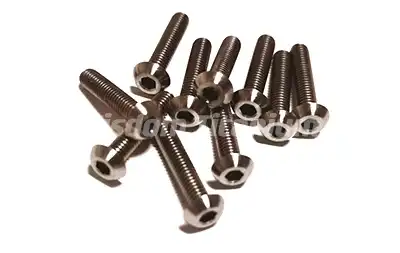
Mini titanium screws are important fasteners in the medical, automotive, motorcycle, bicycle, and precision industrial areas. These unique components must have high strength-to-weight ratios, corrosion resistance, and biocompatibility. Mini titanium screws are composed of titanium alloys, such as Ti-6Al-4V Grade 5, with a tensile strength of more than 900 MPa and are around 40% lighter than stainless steel. They may be found in anything from orthopedic implants to high-performance automotive enhancements, enabling industries to develop lightweight structures that nonetheless retain their resilience and integrity.
Understanding Mini Titanium Screws: Properties and Uses
Material Composition and Core Properties
The small titanium screws are produced with aviation titanium alloys, with considerable care. More specifically, the alloy utilized is Ti-6Al-4V Grade 5, which is doped with aluminum (5.5-6.75%) and vanadium (3.5-4.5%) to improve its mechanical performance. This metal has a density of around 4.43 g/cm³, which is substantially lower than the density of 316L stainless steel (7.99 g/cm³). This gives a helpful reduction in rotational friction and acceleration of movement in weight-sensitive situations. The surface is spontaneously covered with a durable coating of titanium dioxide (TiO₂) that provides it with excellent corrosion resistance. It is resistant to oxidation in acid, basic, and saline environments. Excellent strength and creep resistance are maintained in the temperature range from -200°C (cryogenic) to +450°C (high operational temperatures) without loss of characteristics.
The grade 5 titanium alloy has a tensile strength up to 900 MPa and a yield strength of approximately 880 MPa. So that implies it can hold a lot of weight in a little area. Titanium alloys are non-magnetic, do not interact with MRI rooms, and decrease signal noise in high-frequency circuits. This fastener is ideal for fragile devices and medical imaging systems. Surface treatments such as anodizing, sandblasting, and PVD coating may harden goods and reduce the coefficient of friction. You can also apply color codes to something. All items do not change the thread tolerances for the standard ISO metric class 6g.
Industrial and Medical Applications
Mini titanium screws are specialty fasteners used in the automobile industry for brake calliper assemblies, wheel hub connectors, and light body panel fixings. The racing team's machine is these sections to reduce the unsprung weight. This has direct implications on the suspension responsiveness and the stability of the automobile in turn. Sizes range from M0.6 to M3.0 and lengths from 1 mm to 20 mm that custom auto shops add to supercars and builds designed to be driven on the track for performance increases.
Motorcycle manufacturers utilize titanium fasteners in brake disc mounts, sprocket assemblies, engine covers, and other applications because they are not quickly worn out in a high-vibration environment. It has high damping properties and is thus less prone to break away under cyclic loads, which is a common failure scenario for aluminum or mild steel choices. Titanium alloy grade 5 is used in motocross and road racing teams since they can take a beating and temperature.
Most bicycle applications are in manufacturing frames and assembling components for high-end road and mountain bikes. For the saddle post, derailleur hanger, and bottle cage attachment, we use titanium screws from custom bike stores. These screws are good. They look good. Dealers who work with assembly manufacturers emphasize batch stability and precision of measurement to assure their goods fulfill a variety of frame forms and fitting specifications.
Medical businesses are using the little titanium screws in bone damage repair plates, orthodontic temporary anchoring devices (TADs), and spine fusion hardware. Titanium metals are biocompatible and do not elicit hypersensitivity responses, as may be found with nickel-containing alloys. Furthermore, these implants have osseointegration properties that enable direct contact between the bone tissue and the surface of the screw, without the formation of fibrous encapsulation. Medical implants are compliant with ASTM F136 and ISO 5832-3, traceable, and regulatory compliant.
Technical Specifications and Size Ranges
Standard sizes from M0.6 to M3.0 Available for a broad variety of applications with thread sizes and lengths from 1mm to 20mm. The thread geometry conforms to the ISO 4759 standards, making it compatible with the usual speed clips, plastic bosses, and threaded plugs used in various industries. Drive choices available include Torx, hex socket, and slotted head. The drive socket is checked on a Vickers or Rockwell C machine so that it will not round off on the application of the installation torque.
Available Finishes: Natural mill finish, Type II anodizing for improved corrosion resistance and color separation Sandblasting for a rougher surface, which gives greater support for mechanical bonding, or PVD coatings for wear resistance in demanding environments. The anodized pieces are color-tagged to make finding the relevant parts during assembly simpler and quicker. This prevents errors while building complex systems with several components.
How Mini Titanium Screws Work: Installation and Performance?
Installation Procedures and Tooling Requirements
For Mini titanium screws to be installed correctly, torque drivers must be calibrated and set to the manufacturer's recommended values, which can be anywhere from 0.5 Nm to 5 Nm depending on the thread diameter and the material of the substrate. Because titanium has a lower modulus of elasticity than steel, over-torquing is a common way for it to fail. This can cause the thread to deform or the head to shear before the optimal clamping force is reached. During quality control, torque-to-failure tests are used to make sure that head shear doesn't happen until the threads are fully engaged. These tests model installation into Delrin, aluminum, and composite surfaces.
To keep the thread engagement depth and insertion force in balance, pre-drilling processes must keep accurate sample hole sizes. Self-tapping versions have cutting flutes that make threads during installation, so they don't need to be tapped in softer materials. Thread-locking compounds that work with titanium alloys stop vibration-induced loosening without causing galvanic corrosion. This is especially important in mixed-metal assemblies with magnesium or aluminum parts.
Performance Benefits in Demanding Environments
In automotive and motorcycle applications, the weight reduction that comes from replacing steel with a Mini titanium screw directly leads to better power-to-weight ratios. When you cut the rotating mass by 40% compared to steel versions, you lower the angular momentum. This lets you accelerate and decelerate more quickly, which is useful in competitive race situations. Bicycle companies use this edge to sell high-end models that focus on how well they climb and how quickly they can turn.
Corrosion resistance makes things last longer in marine settings, on tools used in chemical processing, and outside, where they might be exposed to pitting and crevice corrosion. According to ASTM B117, salt spray tests show that PVD-coated titanium screws keep their color and coating adhesion for more than 1,000 hours of constant exposure. This is longer than the usual service life standards for coastal car setups.
In systems that are prone to shaking, fatigue resistance under cyclic loading conditions keeps fasteners from failing in a catastrophic way. Titanium has a high endurance limit compared to its yield strength, which means that motorcycle suspension parts and car brake systems that are constantly expanding and contracting can go longer between repairs.
Mitigating Post-Installation Complications
When driver types don't meet, stress builds up on the drive socket walls, which raises the risk of thread breaking. Using precision-ground bits that match the exact drive geometry spreads torque out evenly, which stops cam-out and keeps the bits usable. Anti-seize lubricants made for titanium alloys stop galling during insertion. This is especially important in blind-hole applications where it's hard to pull out fasteners that are stripped.
For cold welding to work between titanium bolts and titanium supports, the two materials must have different interfaces or surface processes. Anodized surfaces make oxide barriers that stop molecules from sticking together during high-pressure contact. This keeps the ability to remove the surface for maintenance tasks.
Comparing Mini Titanium Screws with Alternatives: Making the Right Choice
Titanium Versus Stainless Steel Fasteners
Stainless steel screws are cheaper to make and easier to find through established distribution networks. This makes them a good choice for non-critical applications where cost is an issue. Grade 316 stainless steel is good at resisting rust in many situations, but it can crack from chloride-induced stress corrosion, which doesn't happen with titanium metals. Because stainless steel is magnetic, it can't be used in medical imaging equipment or guidance systems that need hardware that isn't magnetic.
Mini titanium screws are more expensive than other screws, but they last longer, need less upkeep, and work better in designs that are sensitive to weight. Total cost of ownership calculations that favor titanium include not having to replace things because they rust and saving time and money on labor because they don't need to be put together as often because they are stronger for their weight.
Titanium Screws Versus Mini Dental Implants
Mini dental implants are permanent fixtures that are fused to the bone and hold false teeth in place. Mini titanium screws, on the other hand, are used as temporary orthodontic anchors that will be taken out when the treatment is over. To achieve primary stability in cancellous bone, implants need larger diameters (usually 1.8mm to 3.0mm) and longer lengths. Orthodontic screws, on the other hand, use smaller profiles that cause less irritation to soft tissues.
Surface treatments are very different. Dental implants have sanded and acid-etched textures that help the bone adhere quickly, while orthodontic screws usually have smooth machine finishes that make them easy to remove without causing bone loss. The differences in function are reflected in the prices. Implants are more expensive per unit because they need to be placed surgically and integrated for a long time.
Evaluating Manufacturer Credibility
Leading medical device makers like Stryker, Zimmer Biomet, DePuy Synthes, and Medtronic have quality control systems that are approved by ISO 13485. These systems make sure that everything can be tracked, from where the raw materials come from to how they are sterilized at the end. According to FDA 510(k) rules, third-party lot testing gives certificates of conformance that list the chemical composition, mechanical properties, and biocompatibility validation.
Suppliers of industrial fasteners set themselves apart by offering material approvals that can be tracked back to mill test reports, measurement inspection reports that prove thread geometry limits, and data on the torque performance of each batch. When purchasing managers look at providers, they should make sure that they are certified to ISO 9001 quality standards and ask for proof of the statistical process control measures that rule operations like thread rolling, heat treatment, and surface finishing.
Procurement Guide: How to Buy Mini Titanium Screws for B2B Clients?
Sourcing Channels and Supplier Evaluation
Direct connections with manufacturers are better for large orders because they allow for more customization, make wait times more predictable, and make prices clear. Regional distributors can quickly fill orders for standard sizes with lower minimum order quantities, which is helpful for prototyping and keeping service parts on hand after the sale.
Online business-to-business (B2B) sites let you compare suppliers based on price, certifications, and customer reviews. However, you should still look at a real example to make sure the thread quality and surface finish are consistent. By asking for material certifications that say the alloy meets ASTM B348 or ASTM F136 standards, you can be sure that it is real and tell the difference between aerospace-grade titanium and cheaper, less pure grades that aren't strong enough.
Cost Drivers and Budget Planning
For normal sizes, volume price usually kicks in when you buy more than 1,000 pieces. For custom thread geometries or proprietary head styles, tooling costs can be anywhere from $500 to $2,000, based on how complicated the design is. Customizing lengths within standard diameters usually doesn't require extra tooling costs, so project-specific improvement can happen without breaking the bank.
The choice of surface treatment has a 15% to 40% effect on unit price. Type III hard anodizing and multi-layer PVD coatings command higher prices than natural mill finishes. When purchasing things, managers should weigh the need for better performance against higher costs. They should only use advanced finishes for tasks that can clearly show they improve wear resistance or rust protection.
Order Processing and After-Sales Support
Standard inventory items usually have lead times between 5 and 15 working days for shipments within the United States. For international exports, lead times can be longer depending on when the goods are cleared through customs and when they are consolidated with other shipments. Lead times can go up to 4 to 8 weeks for custom specifications that require dedicated production runs. This means that project launch deadlines need to be planned ahead of time.
The warranty should cover flaws in the material, problems with the dimensions, and early failure due to problems with the production process. Reliable suppliers offer technical support to help with optimizing installation parameters, failure analysis services for returns from the field, and material traceability documentation to help with regulatory audits.
Conclusion
Mini titanium screws are designed solutions that meet important needs in the medical, automobile, motorbike, and bicycle industries, where strength, weight, and resistance to corrosion all come together. Ti-6Al-4V Grade 5 titanium alloy has a tensile strength of more than 900 MPa, is stable at temperatures ranging from -200°C to +450°C, and is biocompatible to the highest regulatory standards. To get the best total cost of ownership, procurement managers who are looking at these fasteners should focus on source certifications, material tracking, and the ability to customize them for specific uses. Strategic relationships with ISO 9001-certified makers guarantee consistent quality, regular lead times, and the technical support needed for execution to go smoothly in a wide range of business settings.
FAQ
1. What thread sizes are available for mini titanium screws?
Standard thread diameters range from M0.6 to M3.0, and lengths can be changed from 1 mm to 20 mm. Through special production runs, thread pitches and widths that aren't standard can be made. Depending on the complexity, the minimum order quantity is usually between 500 and 1,000 pieces.
2. How does lead time vary for bulk orders versus custom specifications?
Standard items in stock usually ship within 5 to 15 business days for orders within the United States. However, wait times can be as long as 4 to 8 weeks for special orders that need dedicated machining operations. International shipments take an extra one to three weeks, depending on the type of freight and how long it takes to clear customs.
3. What factors keep threads from coming off during installation?
Using torque drivers that are calibrated and set to the manufacturer's specifications, precision-ground bits that fit the drive socket geometry, and anti-seize lubricants that work with titanium all lower the risk of stripping. The accuracy of the pilot hole diameter and the hardness of the substrate material have a big effect on the quality of the thread engagement and the amount of torque needed for installation.
Partner with Wisdom Titanium for Precision Mini Titanium Screw Solutions.
Wisdom Titanium is a reliable company that makes Mini titanium screws. They focus on making aerospace-grade Ti-6Al-4V Grade 5 fasteners that are designed for use in cars, motorcycles, bicycles, and precise industrial settings. We are in the Baoji Titanium Valley in Shaanxi Province, which is China's largest and most important titanium production area. Our fully integrated supply chain includes titanium powder, ingots, bars, and high-performance alloys. Our factory is ISO 9001-certified and makes custom CNC parts with thread diameters from M0.6 to M3.0, lengths from 1mm to 20mm, and surface treatments like sandblasting, anodizing, and PVD coating. We promise a tensile strength of at least 900 MPa and temperature resistance from -200°C to +450°C. This is possible because we keep full stocks of all the raw materials we need, use advanced production methods, and check the quality of the whole process. Our skilled research and development (R&D) team creates custom solutions from models or ideas, making sure they work with your exact needs. Email our team at sales@wisdomtitanium.com to talk about pricing for bulk orders, technical details, and how our wide range of fasteners can help you make the best decisions about your purchases.
References
1. ASTM International. (2020). ASTM F136-13: Standard Specification for Wrought Titanium-6 Aluminum-4 Vanadium ELI Alloy for Surgical Implant Applications. West Conshohocken, PA: ASTM International.
2. ISO Technical Committee 150. (2016). ISO 5832-3: Implants for Surgery – Metallic Materials – Part 3: Wrought Titanium 6-Aluminum 4-Vanadium Alloy. Geneva: International Organization for Standardization.
3. Donachie, M. J. (2000). Titanium: A Technical Guide (2nd Edition). Materials Park, OH: ASM International.
4. Rack, H. J., & Qazi, J. I. (2006). Titanium Alloys for Biomedical Applications. Materials Science and Engineering C, 26(8), 1269-1277.
5. Boyer, R., Welsch, G., & Collings, E. W. (1994). Materials Properties Handbook: Titanium Alloys. Materials Park, OH: ASM International.
6. Lutjering, G., & Williams, J. C. (2007). Titanium (2nd Edition). Berlin: Springer-Verlag.