
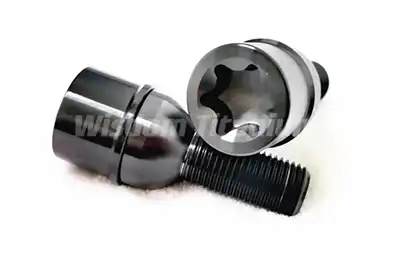
A titanium wheel bolt needs to match the seat shape of the wheel therefore if you choose ball seat or cone seat depends on the wheel and not the bolt. A ball seat uses a curved contact surface with a fixed radius. A cone seat has a tapered surface, normally 60 degrees. The two designs are not interchangeable and a bad fit might result in poor centering, uneven clamping and damage to the wheel. This guide was written for buyers, engineers, racers and distributors who wish to verify seat, thread, length and paperwork before they approve samples or place a bulk order.
Titanium brings low weight and strong corrosion resistance, but the metal alone does not decide fitment or safety. The seat does. Below, I walk through how each design works, how to check compatibility, and how to move from sample to bulk order.
Ball Seat vs. Cone Seat: Understanding the Two Main Designs
How a Ball Seat Works?
The ball seat (or spherical seat) forces a round bolt face against a round hole in the wheel. The titanium wheel bolt has to be to the radius the wheel builder specified it. If the radius is correct the contact point produces a round ring and when the bolt is tightened the wheel hits the center. If the radius is wrong the bolt will only touch a tiny band. That is where the clamping load will be most concentrated. That can create impressions on the wheel seat over time. Many wheels in Europe have ball seats, thus individuals who buy cars imported from Europe run against them often in the U.S.
How a Cone Seat Works?
A tapered seat, which is another name for a cone seat, has a bolt face that is shaped like a cone and fits into a matched cone-shaped slot. Number of degrees is important, and 60 degrees is a common number. As the bolt gets tighter, the curve pulls the wheel toward the middle of the hub. Length of contact is also important. When it's being put in, a bolt with a different taper may feel tight, but it's only touching an edge. I never think a cone seat will fit until I see a drawing of the wheel. This is because angles are different for each design.
Why Brand and Color Do Not Decide the Seat?
The color, form, and car badge of a bolt don't tell you much about its seat. One model of car may come with more than one set of wheels, and the seat on aftermarket wheels is often different from the one that came with the car. The only safe source is the wheel manufacturer's specs. To make sure a design is good, I need to see a drawing of the wheel, a profile of the seat that has been measured, or a sample wheel. The match is then confirmed by measuring the bolt's radius or angle. That long check would have cost a lot more than this short one.
Technical Comparison and Compatibility Checks
Clamping Force and Centering Compared
Both seats let pressing force go through the contact area. A sphere bumps into the wheel along a ring that is set by its radius. A cone bumps into the wheel along a band that is set by its length and angle. It's stable to touch, easy to center, and the load is spread evenly across the wheel interface when both match their recesses. If either one doesn't match, those perks go away. I think that special wheel programs should be fit tested on a real wheel before they are made available to the public.
Why Grade 5 Titanium Suits Wheel Hardware?
Grade 5 titanium (Ti-6Al-4V) is around 44 % lighter than steel (7.85 g/cm3 vs. 4.43 g/cm3) , therefore 44 % less weight of titanium. Our Grade 5 titanium wheel bolts can tear apart between 900 and 1050 MPa (130,000 and 152,000 psi). Titanium is impervious to road salt or brake dust. Aluminum wheels are lighter but they are not as sturdy or wear-resistant in tough situations. Steel costs less and has been used for a long time. Titanium threads gall more quickly thus it is crucial to use the correct oil and maintain the pressure under control.
Thread, Length, and Fit Checks
A designation like M12 or M14 is not enough. Check the thread pitch it might be M12 x 1.5, M12 x 1.25 or M14 x 1.5. Then verify the length and contact of hub thread. Consider wheel recess depth, socket or spline-drive clearance and what kind of lock you need. Even the smaller sizes need to be treated with care: our PVD gold M7×24.5 bolt has a defined diameter and length that needs to match the wheel drawing. For BMW, Porsche, Audi and Volkswagen usage, wheel papers are more important than general fitment tables.
Installation, Torque, and Performance Use
Installation Steps That Protect the Wheel and Bolt
A good installation will lock the wheel and fastener together. Clean the face and seat of the hub first. Then check the threads for dirt, damage or galling. Always start each bolt by hand. This way you can feel any cross-threading before it does any damage. Tighten in phases with Star or crisscross pattern and finish with Torque wrench. If that’s what the wheel maker or race team says, after the first drive, check the titanium wheel bolts again. Log that inspection.
Torque and Anti-Seize Without Guesswork
There is no single torque number that applies to all titanium wheel bolts. That number depends on the grade, thread condition, seat shape, wheel material and surface treatment. When you vary the friction you change the clamp load you get for a given force . Use anti-seize where the wheel manufacturer and bolt provider indicate it's OK and make sure you use the proper power value for the job. Fleet, OEM and motorsport users can seek support from the provider, carry out engineering tests or measure the clamp load to be sure of a technique. In the U.S., torque is commonly expressed in lb-ft, therefore be careful when converting units.
Racing and Performance Use
Racing teams and performance car owners employ titanium to reduce unsprung mass and rotating mass. Even with all the wheel changes the bolts still have to hold the clamp load. When replacing parts, it’s crucial to be informed on how to clean, lube and torque titanium threads. Steel is still available , and inexpensive . Aluminum may be light , but does not have the strength , or wear resistance . Before you decide on titanium, you should consider series rules, brake heat, wheel material, repair frequency and the weight savings.
Buying Guide: From Sample Approval to Bulk Procurement
What to Put in Your Purchase Specification
Every request I make has three sets of details:
- Fit details: Please include the type of seat, the exact ball radius or cone angle, the length, the head style, the drive pattern, and the thread diameter and pitch. Send the supplier a picture or drawing of the wheel so they can compare your seat profile to the bolt drawing before they start making it. Add any error limits that the wheel maker gives you.
- Material and process details: What to know about the material and process: The grade of titanium, the range of tensile strength, the casting procedure, the method of thread making and the material certificates that should accompany each lot. Want a hot forged head with rolled threads? Let us know. The manner the metal is created will effect the pricing, the way the grain flows, and how it wears over time. Write this down and your order will not show a cut thread substitution.
- Finish and delivery details: completion and delivery information: color, packing, number, inspection checks and the date you want the items to be delivered. For PVD gold agree a color reference sample that may be used by all to compare each batch against. Then you can look at the sample, clear any differences. With set samples, you know exactly when shipments are coming to your warehouse.
Every seller can offer the same part if you give them written specs. This way, you can compare price and capability fairly without finding out about extra costs later.
Our Grade 5 Wheel Bolt Specifications
Our titanium wheel bolts are made from Grade 5 titanium (Ti-6Al-4V), which has a tensile strength of 900 to 1050 MPa (130,000 to 152,000 psi). The threads are rolled instead of being cut, and the head is hot-forged. The head is shaped by hot forging along the grain flow, and rolled threads keep that flow going, which helps the fatigue life. We also have a PVD gold finish, like M7×24.5. The minimum order quantity is 200 items. With your order, ask for a color check against a sample that has been accepted, and make sure you get the material test proof.
Common Mistakes and a Simple Decision Guide
Mistakes I See Most Often
Most mistakes come from treating a bolt for a titanium wheel like any other accessory. Some people think the brand of the automobile affects the seat or that all cone seats have the same angle. Some folks use both ball bolts and cone bolts since they both thread in. Some people utilize bolts with loose threads, signs of seizure, or seats that are no longer round. Another typical mistake is to apply the torque value for a steel bolt on titanium without taking friction, lubrication, and thread condition into account. Checking the dimensions, fitting a sample, writing down the power steps and making the replacement limits obvious can eliminate most of these problems.
When to Choose a Ball Seat or a Cone Seat?
Use a titanium wheel bolt only if the wheel manufacturer says it has a spherical interface that matches, and you can measure the radius. If the wheel has a known matching taper, as in a 60-degree design that has been certified, and the contact dimensions are correct, go for a cone seat. In both cases the wheel makes the choice, and the bolt follows. Make sure you know the size recess the wheel has! Measure it, or send it in for evaluation before you order anything.
When to Ask for Engineering Review?
If you don’t know where the wheel seat is, if the wheels are custom, if the car has a lot of power, or if you plan to use it for track driving, ask for a technical study. If you need to change wheels frequently or check OEM paperwork, review might also be helpful. Before placing your purchase check the seat geometry, thread size and pitch, length, grade, torque and anti-seize technique, sample fitment, inspection requirements, traceability, packaging and delivery time. If you agree to these in writing, the first order will be speedier, and you can use the same record for future orders.
Conclusion
A titanium wheel bolt will only work if the wheel's seat fits the bolt. Round seats are called ball seats, and cone seats are called cone seats. The two do not switch. The color and name of the car don't prove the seat, so wheel drawings, measurements, and practice fits are what prove it. Grade 5 titanium is lighter and doesn't rust, but it needs to be oiled properly and with controlled torque to avoid galling. A clear specification that includes seat, thread, length, material, process, finish, and documents makes it easier to compare quotes and cuts down on mistakes that cost a lot of money. Before ordering in bulk, engineering review should be done if the seat is unknown or if it will be used in a tough way.
FAQ
Can I use a cone-seat bolt in a ball-seat wheel?
Not at all. The shapes don't match, so the contact gets smaller to a thin line or ring, and the clamping load is spread out unevenly. Pair the seat with the right wheel size.
Is titanium always better than steel for wheel bolts?
No. Titanium is lighter and doesn't rust, but steel is cheaper and has been used for a long time. Pick a titanium wheel bolt when the weight, corrosion resistance, or look are worth the extra cost.
Do I need anti-seize on a titanium wheel bolt?
Do what the wheel maker and the bolt provider tell you to do. Anti-seize cuts friction and changes the clamp load at a certain torque, so the torque number needs to take this into account.
What are your specs and MOQ for a gold M7 bolt?
You can pull on our Grade 5 (Ti-6Al-4V) bolts with 900–1050 MPa of force. The heads are hot-forged, and the threads are rolled. The PVD gold M7 24.5 starts at 200 pieces. Send your picture so that a seat can look it over.
Request a Titanium Wheel Bolt Fitment Review from Wisdom Titanium
E-mail sales@wisdomtitanium.com your wheel drawing, seat type, thread size, length, and number of wheels. Wisdom Titanium is a company that makes and sells titanium wheel bolts. They have Grade 5 (Ti-6Al-4V) bolts with hot-forged heads, rolled threads, and PVD gold finishes that start at 200 pieces. Before we look at private-label projects, we sign an NDA. When you get back to us, we'll give you a fitting review, a sample plan, or a quote. For more information, go to wisdomtitanium.com.
References
- Introduction to the Design and Behavior of Bolted Joints, Fourth Edition, 2007
- Machinery's Handbook, 2020
- ASTM B348 Standard Specification for Titanium and Titanium Alloy Bars and Billets, 2019
- Titanium: A Technical Guide, Second Edition, 2000
- Materials Properties Handbook: Titanium Alloys, 1994
- Shigley's Mechanical Engineering Design, 2020