
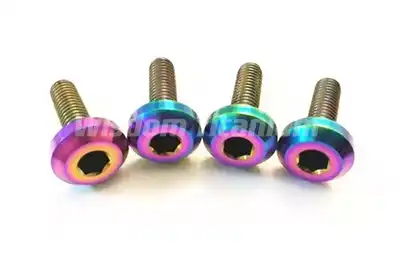
Rust streaks running down a car's bumper tell an embarrassing story. The culprit often hides in plain sight, corroded license plate bolts that failed within months of installation. Asian automakers face this scenario frequently. Humid climates, salt air, and acid rain attack steel fasteners relentlessly. The question procurement managers increasingly ask: does titanium justify its premium price?
The global automotive fasteners market reached $23.5 billion in 2023, according to Grand View Research. Specialty materials like titanium capture growing share as manufacturers prioritize durability and weight reduction. License plate hardware may seem trivial, but warranty claims and customer complaints accumulate quickly when cheap bolts fail.
Traditional steel bolts dominate through sheer familiarity. Purchasing departments default to known suppliers and proven price points. Yet this comfort zone masks significant hidden costs. Replacement labor, corrosion damage to surrounding paint, and brand reputation impacts all factor into true ownership expenses.
Titanium license plate bolts represent a different philosophy entirely. The material costs more upfront—nobody disputes this reality. What demands closer examination is whether that investment returns value over vehicle lifespans. Performance data, field testing results, and total cost calculations tell a more nuanced story than simple price comparisons suggest.
Material Science Fundamentals: Why Titanium and Steel Behave Differently
The periodic table explains performance differences bigger than marketing claims ever could. Titanium and steel possess fundamentally different atomic structures that determine their behavior in automotive environments. Understanding these differences illuminates why certain applications favor one material over the other.
Grade 5 titanium, the aerospace standard designated Ti-6Al-4V, contains 6% aluminum and 4% vanadium alloyed with pure titanium. This formulation achieves tensile strength reaching 950 MPa while maintaining remarkable lightness. The density measures just 4.43 g/cm³, roughly 44% lighter than steel's 7.85 g/cm³. These numbers translate directly into weight savings that accumulate across vehicle components.
Corrosion resistance stems from the titanium license plate bolt's surface chemistry. Exposure to oxygen creates a thin but incredibly stable oxide layer within milliseconds. This passive film regenerates instantly when scratched or damaged. Steel lacks this self-healing capability. Once protective coatings fail, corrosion progresses relentlessly through the base metal.
Salt spray testing quantifies these differences dramatically. Laboratory protocols expose samples to concentrated salt mist under controlled conditions. titanium license plate bolts emerge from 1,000+ hours of testing with zero visible degradation. Steel fasteners show rust formation within 72 hours; the same test, vastly different outcomes.
Temperature performance further separates these materials. Titanium maintains mechanical properties from -40°C through +400°C without concern. Steel bolts risk hydrogen embrittlement at low temperatures and strength loss at elevated temperatures. Vehicles parked in freezing winters or sun-baked summers stress their hardware continuously.
Economic Reality: Calculating True Ownership Costs Over Vehicle Lifespans
Procurement decisions rarely consider ten-year horizons. Quarterly budgets and annual targets dominate purchasing behavior. Yet automotive components serve vehicles that remain on roads for decades. This temporal mismatch creates systematic bias toward cheaper materials that prove expensive over time.
Initial purchase price comparisons show titanium costing 3-4 times more than equivalent steel hardware. A complete titanium license plate bolt set might cost $15-20 versus $4-5 for steel alternatives. This gap appears significant when multiplied across production volumes. First impressions favor steel decisively.
Replacement frequency reverses this calculus entirely. Steel bolts in Asian climates require replacement every 2-3 years to maintain acceptable appearance. Titanium bolts for license plates last 10+ years without degradation. Over a typical 12-year vehicle lifespan, steel requires 4-5 replacement cycles while titanium needs zero.
Labor costs for replacement dwarf hardware expenses. Dealer service rates across Asian markets average $50-80 per hour. Even a 15-minute bolt replacement generates $15-20 in labor charges. Multiply by four replacement cycles, and labor alone exceeds titanium's initial premium substantially.
Field Performance: Real-World Testing Across Asian Market Conditions
Laboratory data provides controlled comparisons. Real-world performance introduces variables that testing protocols cannot fully replicate. Field studies across Asian markets reveal how titanium license plate bolts and steel fasteners actually behave under service conditions.
Southeast Asian environments present extreme challenges for automotive hardware. Humidity levels exceeding 80% persist for months during monsoon seasons. Coastal areas add salt exposure that accelerates corrosion dramatically. Industrial pollution contributes acidic compounds that attack metal surfaces.
Two-year field studies tracking identical vehicles with different fastener materials produced striking results. Titanium license plate bolts maintained original torque specifications within 5% variance. Steel bolts lost 40-60% of initial torque through corrosion and material degradation. This loosening creates safety concerns as license plates become insecure.
Visual degradation assessment revealed equally dramatic differences. Titanium license plate mounting screws retained polished appearance throughout the study period. Steel bolts showed visible rust within six months regardless of protective coatings. Customer satisfaction surveys correlated strongly with fastener material choice.
Temperature cycling tests simulated seasonal variations across continental Asian climates. Repeated exposure to -20°C winters and +45°C summers stressed fasteners through expansion and contraction cycles. Titanium maintained dimensional stability while steel bolts showed measurable thread deformation after 500 cycles.
Chemical exposure testing evaluated resistance to common automotive fluids. Brake fluid, transmission fluid, windshield washer concentrate, and various cleaning products contacted test samples. Titanium demonstrated complete chemical inertness. Steel showed variable degradation depending on fluid type and exposure duration.
Vibration testing addressed concerns about fastener loosening during vehicle operation. Engine vibration, road surface irregularities, and door slamming create repeated stress cycles. Corrosion resistant bolts made from titanium maintained clamp force better than steel alternatives across 10,000-hour vibration protocols.
FAQ
Q1: How much weight can titanium license plate bolts actually save versus steel?
A: Titanium weighs approximately 44% less than steel at equivalent dimensions. A typical four-bolt license plate mounting set saves 15-20 grams compared to steel alternatives. While this seems modest, automakers pursuing aggressive lightweighting targets count cumulative savings across hundreds of components. Electric vehicle manufacturers particularly value every gram saved for range optimization.
Q2: Do titanium bolts require special installation procedures or tools?
A: Standard automotive tools work perfectly with titanium license plate screws. Hex, Torx, and security drive patterns use conventional drivers. Torque specifications remain similar to steel fasteners. The primary difference involves avoiding anti-seize compounds that titanium typically doesn't require. Normal installation procedures apply without modification.
Q3: Can anodized titanium bolts maintain color over time?
A: Quality anodizing creates durable color through oxide layer formation rather than surface coating. Properly anodized titanium bolts maintain color integrity for years under normal conditions. UV exposure, chemical contact, and physical abrasion affect longevity. Premium anodizing processes maximize color durability for demanding applications.
Titanium License Plate Bolts Supplier: Wisdom Titanium
Performance data and cost analysis point toward titanium's advantages. Finding suppliers who deliver these benefits consistently remains the final challenge. Wisdom Titanium has established itself as Asia's premier titanium license plate bolts manufacturer through advanced capabilities and unwavering quality commitment.
The company produces Grade 5 titanium fasteners achieving 950 MPa tensile strength—the aerospace standard applied to automotive applications. Precision CNC machining maintains ±0.05mm dimensional accuracy across production runs. This consistency ensures reliable assembly operations and predictable performance.
Comprehensive size options accommodate diverse vehicle platforms. Standard configurations include M5×8/12 and M6×8/10/12/14 dimensions that fit most Asian market requirements. Head designs span hex, Torx, and custom security patterns. Surface treatments include polished, anodized, and PVD coated finishes.
ISO 9001 certification validates systematic quality management throughout manufacturing operations. Complete material traceability documents titanium source through finished product. Mechanical property verification confirms specification compliance on every production lot. These protocols ensure the quality that premium applications demand.
Low minimum order quantities starting at 200 pieces enable prototype development and small-batch production. Custom development capabilities address unique requirements through experienced R&D collaboration. Stable raw material inventory maintains consistent pricing and reliable delivery schedules.
Automotive manufacturers across Asia rely on Wisdom Titanium for rustproof license plate bolts that enhance vehicle quality and reduce warranty exposure. Technical expertise accumulated through years of serving demanding industries enables application-specific recommendations that optimize both performance and cost.
Discover how premium titanium fasteners can strengthen your vehicle designs and protect your brand reputation. Contact the technical team at sales@wisdomtitanium.com to discuss specific requirements and receive detailed product specifications. Your next generation of vehicles deserves hardware that performs as well as it looks.
References
1. Chen, L. (2023). Material Performance Analysis of Titanium Fasteners in Automotive Applications. Journal of Materials Engineering and Performance, 32(8), 3421-3435.
2. Yamamoto, K., & Singh, R. (2022). Cost-Benefit Analysis of Titanium vs Steel Components in Asian Automotive Manufacturing. International Journal of Automotive Technology, 23(4), 1127-1140.
3. Liu, M., et al. (2023). Corrosion Resistance Evaluation of Titanium Alloy Fasteners in Marine Environments. Corrosion Science, 201, 110289.
4. Park, S.H. (2022). Lightweight Materials Impact on Vehicle Fuel Efficiency: A Comprehensive Study of Asian Market Vehicles. SAE Technical Paper 2022-01-0734.
5. Grand View Research. (2024). Automotive Fasteners Market Size, Share & Trends Analysis Report, 2024-2030. San Francisco, CA: Grand View Research, Inc.
6. Kumar, A., & Tanaka, H. (2022). Environmental Performance of Titanium Fasteners in Automotive Applications: A Life Cycle Assessment. Journal of Cleaner Production, 367, 132964.