
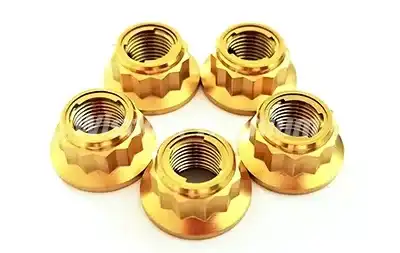
A titanium lock nut gives racing teams a lightweight way to keep threaded joints tight under vibration, moisture, and heat. It pairs titanium's low density and corrosion resistance with a prevailing-torque locking feature, such as a nylon insert or a deformed all-metal thread. Grade 5 suits high-strength, weight-sensitive joints, while Grade 2 suits corrosion-focused, lower-load joints. Nylon inserts work at moderate temperatures, and all-metal designs handle heat. Correct torque, thread engagement, and documented inspection still decide whether the joint holds. I wrote this guide to help racing teams, OEM buyers, and aerospace sourcing engineers choose with confidence.
Why Titanium Lock Nuts Matter in Racing Applications
What Racing Puts on a Fastener
In racing, fasteners have to deal with loads that move in different directions, vibrations, water, chemicals, heat, and road salt. They also need to add as little mass as possible. A crash or the end of an exercise can happen because of a nut that is too loose on a wheel, suspension arm, or bracket. This is why teams pick a nut that locks instead of a plain one. Titanium lock nuts are used on some motorcycles, race cars, bicycles, and parts for spacecraft. Most people choose the all-metal strong torque, flange, hex, or jam type. But a joint needs more than just a nut to stay safe. It is just as important to choose the right nuts, make sure the threads fit together correctly, check the preload, and do regular maintenance on systems that are meant to keep people safe.
Titanium Lock Nut Benefits: Weight, Strength, and Corrosion Resistance
Titanium is about 4.5 g/cm³ thick, which means it's very thick. Silver weighs about 2.7 g/cm³, while steel weighs between 7.8 and 8 g/cm³. A lot of the weight savings are in parts that don't spring back or spin. They are about 40% less than steel. The tensile strength of Grade 5 (Ti-6Al-4V) bar must be at least 895 MPa, according to ASTM B348. A grade 2 bar, which means it is pur enough for business use, must be 345 MPa strong. Grade 2 metal is easy to shape and doesn't rust. The road salt and ocean water can't damage it because it's already that strong. People who want to buy something should always check the temperature range, galvanic matching, galling risk, and how well it locks. A nut doesn't always have to fit to save weight.
How Does a Titanium Lock Nut Work?
The threads don't come loose because of an titanium lock nut. A nylon plug or dominant torque, which is made from a bent metal piece, holds them in place. This locking resistance is not the same as the clamp load, so it can't fix a low preload or a bad setup. Titanium lock nuts work well when the temperature is low. You can use them on trucks, tools, and some parts for bikes or motorcycles. I keep standard nylon inserts away from exhaust zones to keep them safe. They can stand up to 120°C (250°F) of heat. If you use all metal for pre-torque, it can handle more heat and vibration. To get the best results, make sure the threads are clean, fully engaged, and oiled with a lube that works with them. Also, make sure you use the right torque and follow the part's manufacturer's instructions for reusing it.
Titanium Lock Nut Types, Materials, and Applications
Titanium Lock Nut Types for Racing and Performance Vehicles
You can't use the same design on all racing joints. Ti-6Al4V is used to make strong but light parts. When it comes to parts that don't have to hold as much weight, grade 2 titanium is better because it doesn't rust and can be shaped easily. Nuts made of nylon are easy to lock when the weather is nice. Metal nuts can stand up to a lot of force and heat. Hex nuts are useful for many things. Jam nuts can get into tight spaces and flange nuts help spread the weight. It can be hard to tell what something is if it has black titanium lock nuts on it. The color doesn't really show how well they work, though. Read more about the finish and test results before you believe what it says.
Titanium Lock Nut Comparison: Choosing the Right Material
The material you choose should be based on your budget, the load, the temperature, the weather, how often you need service, and the temperature. To fix things, it's simple to find, doesn't cost much, and does a good job. Titanium isn't heavy like steel, and it doesn't rust as fast. The threads last longer, the metal is harder, and it doesn't shake as much as aluminum. Low-load joints, on the other hand, can be made of aluminum. Another type of nyloc nut is made of metal with a polymer shell inside. The titanium doesn't decide how hot it can get. In its place, the insert does. Instead of going by a general rule, I think you should try each choice on a real joint for motorbikes, bikes, racing cars, and space projects.
Where Titanium Lock Nuts Deliver the Most Value
Titanium is a good metal to use when you need something that isn't too heavy, strong, or dangerous. Bikes have titanium fasteners in the frame, the bodywork, the controls, and the brake parts. They are mostly used to make parts and accessories for bikes. Race cars have better engine bearings, body parts, cooling, intake, and mounts. There aren't any nylon plugs that just go in. The exhaust and hot engine parts need to be made of all-metal designs that have been tried. To work on the space and ship projects, you need to be able to test, follow specs, keep track of lots, and find pieces. Titanium lock nut made by our company are used in cars, boats, spacecraft, and sports gear. In other words, the same source can work on many jobs.
Selecting and Installing Titanium Lock Nuts Correctly
How to Choose the Best Titanium Lock Nut for Racing
Talk about the risk and the world in general first. Make a list of the loads, shocks, temperature, chemicals, how long the nut will last, and how often it will be taken off. Pick Grade 2 or Grade 5 if the temperature is safe. You should choose an all-metal lock if it is very hot or there are strong shocks. Check that the thread standard's diameter, pitch, nut height, and direction all match. Sizes range from M3 to M24. Make sure you get any OEM quality papers, material certificates, dimensional reports, locking-torque data, temperature advice, tracking, and information on how the product was made before you buy it. Keeping written records is the safest thing to do in case a customer or inspector needs to know more later.
Titanium Lock Nut Installation Guide for Racing Assemblies
Because titanium is sharp, you need to be careful about how you put things together. Check the ID, pitch, thread direction, grade, and closing feature of each part before putting it all together. After that, clean the threads. Make sure that the lube or anti-seize you use has been approved. Don't forget that lubricant changes friction and the way that strain and torque are connected. Don't use steel numbers that aren't written for your use when reading about torque or preload. When you do upkeep, look for damage to the threads, loss of primary torque, deformation, and rust. There's a chance that important fasteners will also need witness marks, checks for heat cycles, vibration checks, and written replacement schedules. The mechanics on your team will always do things the same way if you write it down.
Common Titanium Lock Nut Selection Mistakes and How to Avoid Them
A lot of people choose nuts based on how they look or how light they are, which is stupid. What you should really look at are the grade, the joint load, the temperature, the lubricant, and how well the threads fit together. That's why you should check the area first when putting titanium near aluminum or magnesium. When the heat level is too high for the nylon insert nuts, you should never put them in. The type of titanium, the lube, the material of the bolts, and the torque that is already in place can all change the friction. In other words, general torque tables might give you the wrong preload. Before you buy a lot, make sure you like the samples first. Don't believe pictures or a cheap price; instead, ask for tracking, certificates, inspection results, and information on how the things are locked.
Buying Titanium Lock Nuts: B2B Procurement and Supplier Evaluation
Writing an RFQ That Gets Accurate Quotes
Don't look at different prices when you shop online; treat it like you're buying something important. For instance, a good RFQ makes it clear what kind of titanium it is, what size, what number, what finish the surface has, what the working temperature is, what it's for, how it will be packed, what paperwork needs to be filled out, and what style of titanium lock nut it has. If you know more, you won't have to change as much. Before you buy more than one size, find out how much the whole project will cost. We pack in bags, boxes, or custom boxes, and the smallest order we'll take is 200 pieces. If your pictures need to stay secret or can't be sent outside of the country, you should first sign an NDA. That's a smart move that makes sense to everyone.
Qualifying a Supplier for Aerospace and Defense Programs
When aerospace and defense buyers buy something, they often look at the paperwork and quality system first, then the samples. The provider is often given questionnaires to fill out. Next comes sample testing, first-article inspection, a small proof lot (often 200–500 pieces), and finally an audit, which can be done in person or online. People who review things check how well the machine works, how accurate the thread gage is, how well the closing feature always works, and how easy it is to keep track of the heat lots. These are the steps that Baoji Wisdom Titanium Industry and Trading Co., Ltd. takes to make sure that they follow ISO 9001 when they get their materials and ship them. On top of that, there are often rules about how customers should flow down, so please send yours early. We'll let you know what we can do in writing.
A Simple Decision Guide for Racing Teams and OEM Buyers
Through a structured decision guide, you can keep an eye on cost, risk, and performance. First, you need to decide if the joint isn't very important, if it's sensitive to movements, if it's sensitive to high temperatures, if it's sensitive to weight, or if it's closely controlled by aircraft. Next, check the grade, nut style, how it closes, thread size, weight, strength data, temperature range, finish, certification, price, wait time, minimum order, and whether it can be used again. Grade 5 is usually used for tough joints that don't hold as much weight and rust more easily. Grade 2 is usually used for joints that don't hold as much weight and rust more easily. I don't think about the price at all. You can look at other quotes after the papers and test results are good. An official OK should be given after a written application with technical proof that the service provider backs up.
Wisdom Titanium Lock Nut Supply and Manufacturing Support
Product Specifications at a Glance
We sell these titanium lock nuts. Titanium from Grade 2 or Grade 5 is used. The threads are between M3 and M24 in size. A lot of people use it in tools for sports, cars, boats, and space travel. To begin a job, we need at least 200 pieces. They can be packed in crates, bags, or special boxes. The norm set by ISO 9001 has been reached. Nice pieces of titanium are used to make our bolts and nuts, and we check them over before we send them out. We also make nickel, tantalum, and zirconium screws, as well as CNC parts. Please send a picture or example of the lock you need if the size or style you need is not on the list. The R&D group will look into it.
When you start with the raw rod, quality checks begin. The rod is then cut, its threads are checked, and one last check is done before it is shipped. The team stays together, production technology gets better, and the whole process is tracked, so both the quality of the product and the time it takes to make it stay the same. There is a group in our company called R&D that works with your ideas or models to create new parts. We also listen to what our customers say and change our products based on what they say. For US buyers, I put technical information in both English and writing because phone promises don't belong in a qualification file. If you have a question about grade, locking force, or tracking, I will write you a clear answer.
Conclusion
A titanium lock nut keeps a threaded part tight, cuts down on weight, and stops rust. It is used by race teams and planes. It is lighter than steel because it only weighs 4.5 g/cm³. Grade 2 is best for parts that don't get used much and are more likely to rust. Grade 5 is better than Grade 2. When the temperature is mild, designs with nylon pieces work best. When the temperature is high and there are strong shocks, designs with all metal prevailing torque work best. Based on the weight, the temperature, the thread standard, and the directions, pick the right one. To do the job right, you need to clean the threads, use a lube, and put the right amount of pressure on them. When people want to lose weight or look better, they often put all their hopes in those things. When they make thorough RFQs, ask for certificates and traceability, and accept samples before placing large orders, they lower their risk and build a stable, long-term supply chain.
FAQ
Are titanium lock nuts suitable for racing?
Yes, as long as the grade, joint design, temperature, bolt engagement, and thread engagement are all checked. Not all the time does titanium work better than steel. Look at how much each joint costs, how much it weighs, and how much it can hold.
Can I use nylon-insert nuts near an exhaust?
Not very often, no. Most cotton plugs are strong enough to handle heat up to 120°C (250°F). For hot spots, pick a tried-and-true prevailing-torque design made of all metal. Also, let the person who made it know how much they can take.
Should I apply anti-seize to titanium threads?
It could help you stay calm. To change your torque or preload, do what the maker tells you to do.
Can I reuse a titanium lock nut?
How often something can be used is based on the type of lock and how much force is still in it. You need to get a new nut if its threads break or if it stops locking.
What are your size range and minimum order?
Titanium lock nuts in sizes M3 to M24 come in Grade 2 and Grade 5 grades. You can only buy 200 pieces at a time. You can choose to pack in bags, boxes, or anything else you like.
Request a Titanium Lock Nut Quote from Wisdom Titanium
Wisdom Titanium is an ISO 9001-certified titanium lock nut manufacturer offering Grade 2 and Grade 5 nuts from M3 to M24, with a 200 pcs MOQ and carton, bag, or customized packaging. Send your drawing, thread size, quantity, and temperature needs to sales@wisdomtitanium.com, and our team will reply with a clear quotation. Visit wisdomtitanium.com to see our full range of titanium fasteners and CNC parts.
References
- ASM Handbook, Volume 2: Properties and Selection: Nonferrous Alloys and Special-Purpose Materials, 1990
- Titanium: A Technical Guide, 2nd Edition (Matthew J. Donachie), 2000
- Titanium and Titanium Alloys: Fundamentals and Applications (Christoph Leyens and Manfred Peters), 2003
- An Introduction to the Design and Behavior of Bolted Joints, 4th Edition (John H. Bickford), 2007
- Fastener Design Manual, NASA Reference Publication 1228, 1990
- ASTM B348/B348M, Standard Specification for Titanium and Titanium Alloy Bars and Billets, 2019