
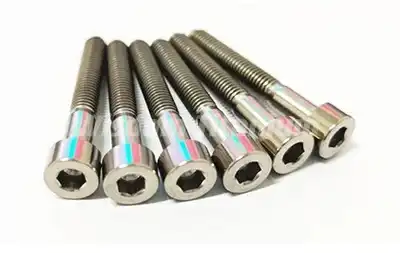
Allen head bolts, which are actually socket head cap screws that meet DIN 912 or ISO 4762 standards, are made using a precise process that includes picking the right material, cold heading, thread making, heat treatment, and finishing the surface. titanium allen head bolts are made from approved Ti-6Al-4V (Grade 5) or commercially pure titanium (Grade 2). The cylindrical head and hexagonal socket hole are then shaped using advanced cold forging methods. When threads are rolled instead of cut, they become stronger and less likely to wear out. This makes these fasteners essential in aircraft, automotive, and naval uses where weight reduction and corrosion protection are essential.
Allen Head Bolts and Titanium Material
Allen head bolts are unique among fasteners because they have a hexagonal internal drive. This lets techs use more force without having to worry about cam-out issues like with Phillips or slotted screws. Because of this, they work great in small areas that are hard to get to, which is common in robots, high-performance vehicles, and industrial machines.
Why Titanium Outperforms Traditional Materials
Titanium has a reputation for being an amazing piece of tech. Titanium metals are much stronger than stainless steel, aluminum, and carbon steel, but they weigh about 45% less than steel bolts that are the same size. This measure of strength to weight solves a problem that has been around for a long time in fields where weight is important. When aircraft builders replace standard steel bolts with titanium ones throughout the body, for example, they save a lot of fuel.
Another clear benefit is resistance to corrosion. In chloride-rich environments, stainless steel pits and crevices corrode, but titanium makes a protective oxide layer that heals itself when it gets hurt. This natural resilience is used to extend the time between upkeep and lower the overall cost of ownership in chemical processing plants that work with acidic solutions and offshore platforms that are exposed to saltwater spray.
Comparing Titanium Grades: Grade 5 vs. Grade 2
Grade 5 titanium (Ti-6Al-4V) has a tensile strength of about 950 MPa, which is about the same as Grade 8.8 medium-carbon steel. It is made up of 6% aluminum and 4% vanadium. In situations where tension is important, like in aircraft landing gear systems and car suspension parts, this alpha-beta alloy can be used directly instead of steel.
Grade 2 commercially pure titanium has a lower tensile strength (about 340 MPa), but it is easier to shape and resists rust a little better. Manufacturers of chemical equipment like Grade 2 for connecting reactor vessels and pipeline joints because it is easier to shape and weld than Grade 1. The procurement teams need to know these differences in order to choose the right grade for their needs.
The Manufacturing Process of Titanium Allen Head Bolts
Every step of the process of making high-quality titanium allen head bolts needs to be done with great care. If manufacturers try to save money, they might end up with fasteners that break under heavy loads or get stuck during installation. Understanding this process helps people who work in buying figure out what suppliers can do and how committed they are to quality.
Material Sourcing and Quality Verification
Premium makers only get titanium alloys from certified mills that can provide material test results that list the alloy's chemical make-up and mechanical qualities. Spectrographic analysis is done on each run to make sure that the amount of metal meets the requirements of ASTM B348 or AMS 4928. Traceability is still very important—every bolt should be able to be tracked back to its original ingot heat number. This makes sure that everyone in the supply chain is responsible.
The Baoji Titanium Valley in Shaanxi Province, China, is the largest titanium industry area in the world. It makes everything from titanium sponge to finished aircraft parts. Vertical integration is good for businesses in this area because they can easily get to raw materials, forging facilities, and testing labs all in one place. When compared to makers who get their goods from far away, this closeness cuts down on lead times and improves quality control.
Cold Heading: Forming the Head and Socket
Without melting the titanium, cold heading can shape bar stock into bolt shapes that are easy to recognize. Automated multi-station headers gradually shape the cylinder head while also pushing in the hexagonal socket hole. This cold working method makes the material denser and work-hardens the titanium, which makes it stronger than it was when it was heated.
The hexagonal socket's width and wall thickness must be within the exact ranges set out in DIN 912. Not enough socket depth keeps the Allen key from engaging properly, and thin walls make the socket more likely to strip under pressure. Manufacturers of high-quality goods use optical inspection systems to check that each bolt has these measurements and reject any parts that are out of range before they get to the supply chain.
Thread Rolling vs. Thread Cutting
For making threads on titanium allen head bolts, thread rolling is the best way to do it. Rolling dies change the shape of the bolt shank by pushing material around to make thread profiles without taking away any metal. When this process is done, the grain structure along the thread sides is compressed. This creates continuous grain flow, which is much better at resisting wear than cut threads.
Cut threads, which are made by cutting material with threading dies or CNC lathes, break up the structure of the grains and make stress points where cracks start. Cutting allows for more custom thread shapes, but rolled threads have about 30% more tensile strength and a lot more resistance to vibration loosening, which are important qualities for car and aircraft uses.
The titanium metal is also work-hardened when it is thread-rolled. This makes the surface harder and more resistant to wear. This is especially helpful in situations where parts need to be put together and taken apart a lot, like on airplane repair access panels or chemical reactor inspection ports.
Heat Treatment and Stress Relief
Controlled heat treatment improves the mechanical qualities of titanium allen head bolts, despite the fact that they benefit from cold working. Stress relief annealing is usually done on Grade 5 bolts at temperatures between 540°C and 650°C for 30 to 120 minutes, based on the size of the piece. This heating method gets rid of the stresses that were there after cold heading and thread rolling without weakening the material too much.
The conditions of heat treatment must be carefully managed. Titanium easily takes in oxygen, nitrogen, and hydrogen when it is hot, which makes the top layers rigid and less flexible. To keep things from getting dirty, manufacturers use vacuum ovens or neutral gas atmospheres (such as argon or helium). After being heated, nuts are slowly cooled to avoid thermal shock and changes in size.
Surface Finishing and Coating Options
Preparing the surface affects both how it looks and how well it works. Using tumbling or mechanical finishing gets rid of rough edges and surface oxides, giving the item a uniform matte look. For some uses, grinding is needed to get the surface roughness down to less than 0.8 μm Ra. This lowers friction and makes the wear performance better in situations with dynamic loading.
Titanium already has great qualities, but new coating methods make them even better. Diamond-like carbon (DLC) coats lower the coefficient of friction, which stops titanium from galling when it's put into stainless steel or titanium parts. Molybdenum disulfide (MoS₂) coats do the same thing when used in high-temperature situations where organic lubricants break down.
Anodizing makes pretty colored finishes like red, blue, gold, or purple that are popular on motorcycles and bicycles where looks are important. Anodizing doesn't really make titanium more resistant to rust (its natural oxide layer is already very good at that), but it does make the name stand out and make the metal look better.
Final Inspection and Quality Assurance
Before being sent out, each batch is tested thoroughly to make sure it meets the requirements. Tensile testing makes sure that the final tensile strength and yield strength meet the standards that are in place. A statistically valid sample from each production lot is put through destructive testing on standardized universal testing tools. Certificates of approval show the results.
Using the Rockwell C or Vickers scales to test for hardness proves that the heat treatment was done correctly. Coordinate measuring tools (CMM) and optical comparators are used for dimensional inspection to make sure that the total length, head diameter, socket size, and thread pitch are all within the acceptable ranges.
Both "go" and "no-go" thread sizes show that the thread is of good quality. The "go" gauge should fit onto the bolt easily, while the "no-go" gauge shouldn't fit past the allowed thread tolerance. This easy-to-use check finds mistakes in the cutting that could lead to issues with assembly on the job site.
Key Specifications and Selection Criteria for Titanium Allen Head Bolts
When picking the right titanium allen head bolt, you have to think about a lot of things, including technical needs, weather conditions, size limitations, and your budget. Engineers and people who work in buying need clear instructions on how to deal with these factors.
Available Sizes and Custom Solutions
Standard metric sizes go from M3 (3 mm diameter) to M24, and lengths from 6 mm to 150 mm cover most industry uses. M6×20mm, M8×25mm, and M10×30mm are common sizes that are easy to find in stock. Imperial sizes, which are less popular in titanium, come with #10-32, 1/4"-20, and 5/16"-18 threads so they can work with American tools.
Custom manufacturing meets specific needs that can't be met by normal catalog things. For security reasons, aerospace OEMs often ask for lengths that aren't standard, head shapes that aren't standard, or their own socket drives. CNC-machined manufacturers can make these variations from titanium bar stock, but they usually need at least 100 pieces to cover the costs of setting up the machine.
You should give careful thought to the thread attachment length. When threading into titanium, the threaded contact should be 1.5 times the diameter of the bolt. When threading into steel, it should be 1.0 times the diameter. Not enough contact increases the risk of thread breaking, and too much length adds weight and cost that aren't needed.
Performance Benchmarks: Titanium vs. Steel and Aluminum
Direct studies of performance help to figure out how much better titanium is. The tensile strength of a Grade 5 titanium M8×1.25mm bolt with a 24mm threaded length is about 950 MPa, which is about the same as Grade 8.8 steel. The titanium bolt, on the other hand, weighs about 7.2 grams, while the steel bolt weighs 13.1 grams. This is a 45% weight decrease.
Even though aluminum alloy 7075-T6 bolts are lighter, they have a tensile strength of only 500 to 540 MPa, so they need bigger sizes to match titanium's load capacity. This size increase takes away a lot of aluminum's weight benefit and makes units take up more room.
Titanium is much better at fatigue performance, which means it can handle being loaded and unloaded many times. Grade 5 metal can withstand up to 10 rounds of stress amplitudes up to 40% of its ultimate tensile strength. It does this better than most aluminum alloys and as well as or better than heat-treated steels. Titanium is great for machinery that turns, suspension links, and places where vibrations are common because it lasts a long time.
Corrosion Resistance in Demanding Environments
Titanium is very resistant to rust in a wide range of media. It doesn't break down much when exposed to strong nitric acid, chlorine gas, seawater, and most organic liquids. Because they are chemically neutral, they don't need the protective coatings or cathodic protection systems that are usually used on steel bolts.
When combining different kinds of materials, galvanic interaction is important. Carbon fiber reinforced polymer (CFRP) and titanium go well together. This is a mix that is often used in aircraft and high-performance automobile structures. Titanium doesn't corrode like aluminum does when it comes into touch with carbon fiber. It stays stable, so the structure stays strong even after decades of use.
Titanium's resistance to seawater is very useful in marine uses. Titanium is the only material that can permanently stop rust on offshore drilling platforms, desalination plants, and military ships. Even though titanium costs more at first than stainless steel alternatives, lifetime cost analysis always favors titanium because it doesn't need to be replaced and doesn't need as much upkeep.
Conclusion
Knowing how titanium allen head bolts are made, from choosing the materials to doing the final inspection, helps engineers and procurement workers make choices that improve performance, cost, and dependability. Premium fasteners are different from cheaper ones because of the cold heading process, thread rolling methods, and strict quality controls. Titanium's superior strength-to-weight ratio and resistance to corrosion make it a better choice than other materials in a wide range of industries, including aircraft, automobile, chemical, and marine. To source things well, you need to look at the certifications, production skills, and commitment to quality of the suppliers you're considering, all while keeping costs, lead times, and customization needs in mind. Partnering with well-known makers in densely populated industrial areas gives you access to supply chains that are fully integrated from top to bottom and technical know-how.
Partner with a Trusted Titanium Allen Head Bolt Manufacturer
If you don't choose the right fastener provider, your projects will fail or have problems with quality and shipping times. Baoji Wisdom Titanium Industry and Trading Co., Ltd is located in Baoji Titanium Valley, which is China's largest titanium industry cluster and has manufacturing facilities that are ISO 9001 approved. We can find the materials, precisely cold head them, roll the threads, heat treat them, and do a thorough final check on every titanium allen head bolt to make sure it meets or beats international standards.
OEMs in the aerospace industry, automakers, chemical processors, and naval equipment builders use both standard stock items and solutions that are made just for them. Whether you need 100 custom screws or 10,000 standard bolts, our engineering team can help you with technical questions, choosing the right materials, and making suggestions based on your unique needs.
To talk about your needs, email our buying experts at sales@wisdomtitanium.com. To see how committed we are to quality, ask for thorough prices, material certifications, and sample packages. We are a full-service titanium allen head bolt supplier.
FAQs
Are titanium allen head bolts a straight replacement for Grade 12.9 steel bolts?
The tensile strength of Grade 5 titanium is about 950 MPa, while the tensile strength of Grade 12.9 steel is 1,200 MPa. In shear-load situations, direct replacement works well, but in tension-critical joints, bigger titanium allen head bolts may be needed or design changes may need to be made to keep the same safety factors.
How can I keep the process from galling?
Titanium has a high coefficient of friction when it comes to other metals and itself. Before putting the parts together, use molybdenum disulfide or copper-based anti-seize chemicals on the threads. DLC finishes offer long-lasting resistance to galling for uses that require frequent removal.
Can titanium screws be used with carbon fiber composites?
Of course. Titanium is the best material for fasteners in composite structures because it works well with carbon fiber reinforced plastics. Titanium is electrochemically stable, so it doesn't decay when it comes in touch with carbon fiber like aluminum does.
What rules should I follow for torque?
When fitting lubricated titanium screws, use 60 to 70% of the torque numbers for steel bolts. Use torque tools that have been properly calibrated and follow the manufacturer's instructions, making sure they are set for the anti-seize compound you are using. If you twist too much, the threads or bolt shanks could break.
How can I tell if nuts are Grade 2 or Grade 5?
It's hard to tell the difference between the grades because they both look silver-gray. Find marks on the head that say "Ti-6Al-4V" for Grade 5. For sure identification, it needs to be hardness tested (Grade 5 reads about HRC 35–40) or spectrographically analyzed to confirm the amount of aluminum and vanadium present.
References
- ASM International. (2015). Titanium: A Technical Guide, 2nd Edition. Materials Park, OH: ASM International.
- Boyer, R., Welsch, G., & Collings, E.W. (1994). Materials Properties Handbook: Titanium Alloys. Materials Park, OH: ASM International.
- Donachie, M.J. (2000). Titanium: A Technical Guide. Materials Park, OH: ASM International.
- German Institute for Standardization. (2010). DIN 912: Hexagon Socket Head Cap Screws. Berlin: Beuth Verlag.
- Schutz, R.W., & Watkins, H.B. (1998). "Recent developments in titanium alloy application in the energy industry." Materials Science and Engineering: A, 243(1-2), 305-315.
- International Organization for Standardization. (2004). ISO 4762: Hexagon Socket Head Cap Screws. Geneva: ISO Standards.