
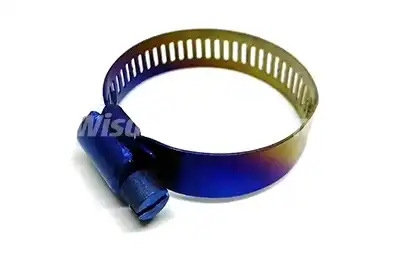
The best titanium hose clamp for marine use is made from Grade 1 commercially pure titanium, built to ASTM B265 material requirements, and fitted with T bolts for even clamping load. I recommend it for seawater, chloride, and chemical exposure, where stainless steel clamps corrode and need frequent replacement. A good titanium hose clamp stays light, handles temperatures from -50°C to 300°C, and should arrive with material certificates you can audit. In this guide, I explain how titanium compares with other metals, how to select and install a clamp, and how to choose a supplier whose paperwork matches the product.
Why Titanium Hose Clamps Work in Marine Systems?
Marine Conditions That Break Ordinary Clamps
Marine hardware is put under a lot of stress at the same time. Metal surfaces are damaged by saltwater and humidity. Vibrations and changes in pressure and temperature put stress on the band. Tight engine rooms also make it hard to check. Even though stainless steel can handle a lot of these conditions, chlorides can damage its protective film and lead to pitting and crevice corrosion. This usually happens under a clamp band, where water gets stuck. This is why stainless clamps are often changed on lines that go into salt water. Titanium has a different reaction. The metal doesn't get damaged by seawater or chloride because its oxide film forms on its own and heals itself when it gets scratched. This is true even in small cracks.
How a Titanium Hose Clamp Is Built?
There are four parts to most naval clamps: a band, a housing or bridge, a screw or bolt, and a nut or fastening set. The word "titanium" on a label can mean a lot of different things because each part can use a different metal. Every major part of a fully titanium design is made of titanium. A mix has a titanium band and stainless steel gear, which makes it cheaper but adds back a part that is sensitive to chloride. The titanium hose clamp we sell is made from Grade 1 titanium and has T-bolts that spread the clamping load around the hose and make it work with bigger diameters. I ask for the band, bolt, and nut materials to be listed separately in a specification when I look it over.
Why Grade 1 Titanium Suits Corrosion-Critical Work?
Titanium technical references say that Grade 1 is the softest and most malleable of the commercially pure grades. It also has the best resistance to corrosion. Because it is flexible, the band can be made into a tight loop without breaking. Titanium is also about 4.5 g/cm³ dense, while austenitic stainless steel is about 8 g/cm³ dense. This means that a clamp made of titanium weighs about 45% less for the same volume. That savings is important for marine engines, offshore equipment, and racing boats with long hose runs. The temperature range for our product is from -50°C to 300°C, and the minimum tensile strength is 950 MPa. I think that for each order, the strength values should be checked against the test report.
How Titanium Hose Clamps Compare with Other Materials?
Titanium vs. Stainless Steel
Stainless steel is what I usually compare to, so that's what I do first. While grades like 316 can handle a lot of different conditions, chlorides can damage the chromium oxide film that they are made of. Under a band of still water, pitting and crevice corrosion can begin. The failure usually shows up as a leak on the next inspection. Titanium's oxide film stays on top of chloride water, and normal sources on corrosion say that seawater doesn't have much rust. While stainless costs less at first, it weighs about 1.8 times as much. As long as the force is right, both metals hold well. After months of being exposed to salt, the real separation shows up.
Titanium vs. Aluminum
Since aluminum clamps are cheap and light, they are often used in dry, low-load situations. But aluminum rusts more quickly in saltwater, and it's not good when mixed with other metals. Titanium doesn't react badly with salt water, so touching an aluminum joint can make the aluminum part break down faster. I check for this galvanic effect every time a titanium clamp meets an aluminum housing. Like steel, aluminum loses strength as the temperature rises. The temperature range for Grade 1 is between -50°C and 300°C. If you use aluminum fittings, make sure they have good drainage and insulating sleeves so water doesn't build up in the joint.
Side-by-Side View and Lifecycle Cost
To give you a quick idea of how the three materials stack up, here are some facts about them:
| Factor | Grade 1 Titanium | Stainless Steel | Aluminum |
|---|---|---|---|
| Seawater corrosion | Very high resistance | Pitting and crevice risk | Corrodes without protection |
| Density | About 4.5 g/cm³ | About 8 g/cm³ | About 2.7 g/cm³ |
| Upfront cost | Highest | Moderate | Low |
| Expected replacement need | Lowest | Moderate | Highest |
Titanium is the most expensive metal to buy. But over the course of its life, that cost can be offset by fewer replacements, less work, and fewer stops because of leaks, especially if the dry-dock windows are fixed. I always look at the whole system because a weak spot is still made by a titanium hose clamp band and a steel bolt that is rusting.
Selecting and Applying the Best Titanium Hose Clamp
Measure Hose Size and Choose the Range
Never choose a clamp based on the size of the hose it has to fit. In order to find the outside width of the fitted hose, push the hose onto the fitting and measure it. Then pick a band that ranges close to the middle of that number, not at the very end. The width, thickness, sealing load, pressure, vibration, and temperature of the band should also be checked. Our titanium hose clamp comes in 20 sizes, each measured in millimeters: 14–27, 18–32, 21–44, 27–51, 33–57, 40–63, 52–76, 18–38, 46–70, 60–83, 65–89, 65–92, 78–101, 91–114, 105–127, 118–140, 130–152, 140–165, 155–180, and 165–190. Sizes can also be made to order. A mid-range choice gives you room for the line to expand and be adjusted later.
Check Compatibility and Galling Risk
How long a clamp lasts depends on how well it works with other things. Titanium and stainless steel both react similarly to salt water, so it's usually safe to touch them. However, titanium can corrode aluminum. Compounds of the hoses are also important, since silicone, rubber, and fuel-rated hoses can handle different band edges and clamping loads. Titanium threads can also gall, which means that when they are strengthened when they are dry, the surfaces can freeze up or tear. For less risk, I suggest using an anti-seize or lubricant that is approved for the system fluid, fixing slowly, and not using tools that have a high effect. Heavy-duty and constant-tension styles help when the thickness of the hose changes with temperature, and T-bolt styles are better for sealing heavier loads. Pick a design that goes with the hose.
Marine Applications That Fit Best
Most of the time, a titanium hose clamp is best when it comes to corrosion, weight, and sealing. Common uses include cooling lines for raw water, closed-loop coolant, fuel and oil, bilge and HVAC connections, silicone turbo hoses, and some exhaust-related parts. Our Grade 1 clamp can handle temperatures up to 300°C. Systems that are very hot or under a lot of pressure may need a different clamp, so I suggest you check those limits first. Chloride is always present in offshore equipment, chemical processing, and desalination, which is why repair teams look to titanium for changes that need to be done more than once. Because they have to order the same sizes on a regular basis, commercial fleets and OEM programs also value consistent sizes and paperwork.
Installation and Common Buying Mistakes
Installing Step by Step
The rust resistance you paid for is kept safe by good fitting. First, check the fitting for burrs and the hose for cracks. Then, clean both of them. Next, push the hose all the way past the barb or bead. The clamp should be square to the hose and centered over the sealing area. It should be placed as far away from the end of the hose as the manufacturer recommends. With a measured tool, tighten the T bolt evenly to the force that was given. Finally, test the pressure and temperature and tighten again if the manufacturer's instructions say to. In the work order, I write down the torque value, which helps the next crew.
Preventing Overtightening and Loosening
The most common installation mistake is overtightening. When you use too much force, you can damage the hose, the band, and the threads. If there isn't enough, the hose can move around and leak. If you bend the band, one side of the hose isn't squeezed enough, and over time, shaking can pull a fastener off. As a safety measure, I use a torque wrench, paint the bolt head, and check again after the first heat cycle. After testing, I set inspection times based on how the room was being used: longer for protected spaces and shorter for engine rooms with strong vibration or constant spray. Findings that are written down help patterns show up early.
Buying Mistakes That Cut Titanium's Value
There were a few mistakes made when buying titanium hose clamps that made it less useful. The first is believing what it says on the package, since a "titanium" clamp might only have a titanium band and no other parts. The second mistake is mixing up Grade 1 and Grade 2, which look the same but are not the same strength. Compare the grade on the award to the picture to find the correct grade. Some others are using the wrong size, running the band at the very end of its range, not caring about temperature or chemical exposure, and picking a standard design for a tough job. Using unit price alone can also be wrong. Traceability, consistent sizes, packaging, how often things need to be replaced, and labor should all be included in the cost comparison.
Choosing a Titanium Hose Clamp Supplier
What to Ask a Supplier?
A good provider gives you more than just a page from their catalog and a cheap price quote. Ask for certificates that show the grade of the material and that it meets ASTM B265, which is the standard for titanium strip, sheet, and plate. Need to know how the heat or batch was made, production records, and the results of dimensional and torque inspections. Make sure the company has ISO 9001 certification, can form and machine parts, has good surface quality, works with OEMs, and has experience exporting. Write down the minimum order quantity, lead time, packaging, and shipping terms. Also, ask if you can mix sizes in the same order. Before making a big purchase, ask for samples so that your team can compare the fit, finish, and sealing to the accepted drawing.
About Wisdom Titanium and Baoji Titanium Valley
Baoji Wisdom Titanium Industry and Trading Co., Ltd was established in 2016 and is an ISO 9001-certified company that makes and sells standard and special CNC parts. We are in Shaanxi Province's Baoji Titanium Valley, which is China's biggest and most full titanium industry center and one of the most important places in the world to make titanium. Titanium material, ingots, bars, plates, tubes, forgings, and high-performance titanium alloys are all part of the local industry chain. We work with companies in the aerospace, oil and gas, chemical, marine, and other fields. Our in-house R&D team makes custom parts from sketches or samples, and we keep standard parts and raw materials in stock to keep prices stable and lead times short.
A Simple Decision Checklist for Marine Buyers
I think that naval buying should be done in stages. First, look at how the current titanium hose clamp fails, and then list the materials and sizes that are available. Get a spec sheet and a sample certificate, and then order a small batch, like 5–20 pieces, to test the installation. First, do a pilot batch. Then, watch how well the clamp works for six to twelve months before adding it to your list of regular maintenance items. Check the hose's size, material, pressure, temperature, fluids, galvanic compatibility, documents, minimum order, cost, wait time, packaging, and expert help at each step. This way of doing things makes decisions consistent across projects and gives your quality team the proof it needs.
Conclusion
Marine titanium hose clamps made of Grade 1 titanium work well because its oxide film protects against attack by seawater and salt, as well as the kind of crevice rust that hurts stainless steel under a band. Titanium is about 45% lighter than stainless steel and lasts longer than aluminum when exposed to salt. The product data lists a temperature range of -50°C to 300°C, but it costs more. To pick the right clamp, you need to measure the width of the hose that is already in place, make sure that the design works with the pressure and vibration, and check the whole system for galvanic and galling risks. Controlled torque and regular inspections keep the performance of the seals safe. Buyers should check the material of each part, look at the certificates and traceability, and think about cost over service life instead of unit price. These checks become proof before a repeat order through sampling and pilot use.
FAQ
Is titanium better than stainless steel for marine hose clamps?
In saltwater, most of the time. It is lighter and doesn't get chloride pitting or crevice corrosion. Since stainless steel is cheaper at first, I look at how long both titanium hose clamps and stainless ones will last.
Can a titanium hose clamp be used in saltwater?
You can use our clamp from -50°C to 300°C, and grade 1 titanium can handle seawater. Check the other parts and fittings as well, because the corrosion performance of the whole system depends on it.
How do I measure a hose clamp correctly?
Once the hose is on the fitting, measure its outside diameter. Then, pick a range that covers that number close to the middle. There are 20 different sizes of our clamps, ranging from 14 to 27 mm to 165 to 190 mm.
Do you offer custom or OEM titanium hose clamps?
Yes. Our own R&D team can work with drawings or samples to make custom sizes and help OEMs develop new products. Send us the size of your hose, the fluid, its temperature, pressure, and amount so that we can suggest a configuration.
Request Marine Titanium Hose Clamps from Wisdom Titanium
Wisdom Titanium makes Grade 1 titanium hose clamps with T bolts that come in 20 different sizes and can also be made to order. Send your hose diameter, fluid, temperature, pressure, quantity, and delivery location to sales@wisdomtitanium.com as you look for a titanium hose clamp supplier for your next maintenance window. Make sure to include any mixed-size or privacy needs when you ask for samples, plans, and material papers. For more information, go to wisdomtitanium.com.
References
- ASTM International, Standard Specification for Titanium and Titanium Alloy Strip, Sheet, and Plate (ASTM B265), 2020
- ASM Handbook, Volume 13B: Corrosion: Materials, ASM International, 2005
- Titanium: A Technical Guide, 2nd Edition, ASM International, 2000
- Titanium and Titanium Alloys: Fundamentals and Applications, Wiley-VCH, 2003
- Shreir's Corrosion, Elsevier, 2010
- ISO 9001 Quality Management Systems – Requirements, International Organization for Standardization, 2015