
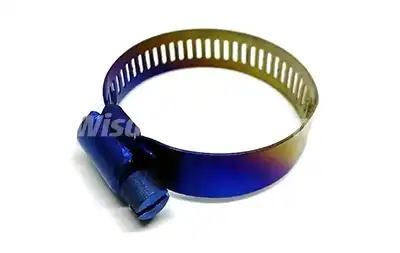
The difference between an all titanium hose clamp and a titanium-coated clamp is simply where the titanium is placed. The hose clamp is completely titanium, including titanium band, housing and fasteners, therefore corrosion resistance is inherent in the whole item. A titanium-coated clamp is a different metal that has a tiny layer of titanium color or titanium nitride wrapped around it, and that base metal still regulates strength and heat behavior. For seawater, chlorides and lengthy service intervals I advocate all-titanium construction. A covered clamp can stand mild exposure and quick replacement. This guide will show you how to tell them apart and what to look for before you buy.
What Is the Difference Between an All-Titanium Hose Clamp and a Titanium-Coated Clamp?
How an All-Titanium Hose Clamp Is Built?
A titanium hose clamp made of only titanium has a band, a housing, a bolt, a nut, and sometimes washers. Grade 1 titanium is used to make our hose clamp. This is the most flexible grade of titanium you can buy. It's also made with T-bolts that spread the tightening force around the hose. The standard for titanium plate, sheet, and strip is ASTM B265, which is used to make this grade 1 material. Since the band edge and thread are both made of the same metal, corrosion doesn't change much between them. But style is still important. How strong the clamp is and how long it can hold that strength depend on the thickness and width of the band, the shape of the housing, and how well the band was formed.
What Titanium-Coated Clamps Really Are?
A clamp is manufactured on a basis of aluminum or carbon steel, with a titanium covering. A layer of titanium is then added on top. It might be TiN, a hard coating which appears like gold, or a plain titanium coloured finish. TiN films are normally only a few micrometers thick. Mostly they influence how difficult it is, how old it looks and how it feels. The base still dictates how strong and hard it is and how it reacts to heat. If it's gold or gray finished you can't see any of the metal underneath. I don't think color demonstrates anything, it's a matter of preference. If the seller just gives you a photo, ask for this information in writing before you compare prices.
What to Verify Before You Compare Prices?
“Paperwork can tell you real titanium versus things that look like titanium. If a bill of materials is available, request it to determine the finish on each part. Ask for a material certificate with the standard, such ASTM B265, and heat or lot numbers so you can monitor the item. Ensure that the quote, photo and award are all of the correct grade. varied grades put together will have varied strengths and forms . Finally, check at the supplier’s quality process. We adhere to ISO 9001 and all parts manufactured by Wisdom Titanium are inspected prior to shipment. Good records will mean the quality team can sign off on the part faster.
All-Titanium vs. Titanium-Coated Clamps: Performance Comparison
Corrosion Resistance in Seawater and Chemical Service
When oxygen or water is present, a scratch on titanium shows new metal, and the oxide film that forms is thin and stable. The metal heals quickly. To remove salt from water, titanium is often used in pipes and tools for saltwater because the film doesn't let chloride pitting happen. If you put warm, chloride-filled water in Type 316 stainless steel, it can pit and rust in the holes. A clamp with a cover keeps things safe, and the cover stays on. Rusty edges and small holes in thin coats can let chlorides get to the base metal. Bending the band and tightening it over and over again can also do this. Another metal can't get through a scratch in an all-titanium clamp because it doesn't have a secret base metal.
Strength, Torque Retention, and Fatigue
We know that the tensile strength of our titanium hose clamp is at least 950 MPa. It's not always true that steel is stronger. The strength of a covered clamp comes from the material it's made of. A steel band can also be strong. The real question is whether or not the clamp can handle torque. Steel and titanium both have the same elastic modulus. It's about 105 GPa for commercially pure types and about 195 GPa for stainless steel. In other words, the housing and torque value need to be right for titanium. Any clamp can become loose over time due to vibrations and changes in temperature. Ask each supplier for the torque, load, and fatigue test results for both the raw material and the finished clamp.
Temperature Range and Weight
Our clamp can handle temperatures from -50°C to 300°C. Coated clamps need to be looked at more closely because the substrate, coating, fasteners, and lubricant all have their own limits. The pipe usually sets the lowest level. Check the steady and highest temperatures of the whole assembly all the time. Weight is another clear difference. Titanium is only about 4.5 g/cm³ dense, while 316 stainless steel is about 8 g/cm³ dense. In other words, titanium is about 44% lighter in weight. On one clamp, the savings don't seem like much. When you see how many clamps are on a ship, base, or race car, it adds up. When the ship is lighter, it's also easier for people who work above or in small engine rooms to get around.
Advantages and Limitations of All-Titanium Hose Clamps
Where All-Titanium Clamps Earn Their Cost
Not only does it not rust, but it's also very light and always works the same way because it doesn't have a thin covering that goes off. Because they are hard to get to or cost a lot to shut down, these traits are most important for offshore equipment, chemical processing lines, and desalination plants. It costs less to run your business when you don't have to replace things as often. The unit price is higher, so I think you should look at the total cost of ownership instead. This includes the purchase price plus the cost of new work, review time, and lost production. If a steel clamp rusts every season, you might want to get a titanium hose clamp instead. I also keep track of how much weight I save by putting big things together.
Limits Buyers Should Weigh
People who want to buy titanium should know that it has some limits. Titanium is harder to get and costs more per unit than steel. It also needs special tools to be shaped. Threads made of titanium can gall, which means that when they are tightened, the surfaces that fit together can get stuck. Make sure you use the right amount of torque, that the threads are clean, and a lubricant that is made for that grade. Titanium is also not good for all chemicals. A rust table can help you decide if your fluid is right for you before you order it. This is because hot, strong reducing acids and dry chlorine gas can hurt it. The types of materials should be chosen based on how well they work, not on their image. A quick test run with your own tools is faster than reading a book to find the answer. Early on in the spec work stage, get ready for each limit.
When a Titanium-Coated Clamp Makes Sense?
A coated clamp might be the best choice. The less expensive choice might be better if there isn't a lot of exposure, the base is strong enough not to rust, and the clamp is easy to switch out. Surface wear or how something looks are two things that are very important. Coatings can also help in places where hardware can be seen, like on display builds. Being honest about the risk is key. Make sure to look at covered parts for scratches and signs of wear, and get new ones before the base metal rusts. When being down doesn't cost much, a covered clamp is a good trade-off. I believe that a metal tank or line should be used if something goes wrong and stops it.
How to Choose and Install the Right Titanium Hose Clamp?
Match the Clamp to the Application
Before you buy a machine there are few factors you should consider. Saltwater, chemicals, heat, shaking, pressure, humidity and how long you want it to last. The systems must be able to cope with salt water, work with galvanics and last a long time at sea and in the ocean. Fast automobiles and race cars like light and tiny connections for items like the intake, intercooler, coolant and turbo. Need to review specifications for exhaust joint for constant and peak temperatures again. Industrial machines monitor the clamping force and add it so that it can be reused. Then select the design type such as T-bolt, heavy duty or worm drive. Our titanium hose clamp incorporates T-bolts that uniformly distribute torque to keep the line in place. Don't forget to consider galvanic effects also. Titanium is exceedingly pure. If it contacts aluminum or carbon steel in saline water, it might cause those materials to corrode faster.
Size the Clamp Correctly
Don't take the hose size as a guide. Instead, measure the outside diameter of the hose with the fitting on it. Choose a clamp range in which that value is in the middle of the range. There are 20 mm size groups : 14-27, 18-32, 21-44, 27-51, 33-57, 40-63, 52-76, 18-38, 46-70, 60-83, 65-89, 65-92, 78-101, 91-114, 105-127, 118-140, 130-152, 140-165, 155-180, 165-190. You can alter the size range also. Also provide enough room around the hose to use a wrench. That’s what T-bolt housings need. If all your ranges are bought from the same manufacturer, the workers who take care of them only have to learn how to tighten one kind of material.
Install an All-Titanium Hose Clamp Correctly
If you put the cover on correctly it will operate properly and last as long as you paid for it. First of all, clean and inspect the clamp, connector, sealed surface and hose. Clean away any grease, dirt, burrs or overly-sharp edges. Follow the manufacturers directions or place the clamp directly behind the fitting bead. Take care not to damage the hose in any way. Gradually step down to the correct torque level. Do not pull all at once . Use anti seize only on titanium of the proper grade, temperature and fluid. When done examine the band for bends, lines sticking out, improper fitting, damaged bolts and leaks. Recheck force after first heat cycle or pressure test. Little checks now stop leaks and the need for further journeys to fix them.
Buying Guide: Mistakes, Custom Orders, and the Final Decision
Common Mistakes When Buying Titanium Hose Clamps
Most people err when they judge something by its color or price per unit. Titanium nitride doesn't have to be gold, bronze, or gray to be made. The different types of metal, band width and thickness, fastener material, diameter range, power capacity, tests, and tolerances should all be looked at. Do not just pick a hose based on its smallest size, and do not believe vague "high-temperature" claims without seeing the numbers for the whole assembly. Also, watch out for metals that aren't the same because they can cause galvanic rusting. Last, look at the certificate to see what grade it has. There is no way to tell the difference between Grade 1 and Grade 2 without the papers. You can avoid most of these issues with a short written specification, which also makes the approval process go faster.
Custom, Wholesale, and OEM Procurement
Not just the sizes, but also the use case should be used to start a bulk or custom order. A full RFQ should be sent out that lists the hose width, titanium hose clamp type, material grade, temperature, pressure, vibration, rust environment, number, needs for certification, and inspections. Wisdom Titanium was founded in 2016 in Baoji Titanium Valley, which is in the province of Shaanxi. This is China's biggest group of titanium businesses. The local chain includes titanium dust, ingots, bars, plates, tubes, and forgings. Standard parts and raw materials are always in stock, and our R&D team can help with unique parts, samples, and prototypes. Ask for samples before you say it's okay to start making it. We'll look over the number of items and mix of sizes you send us.
Final Decision: Which Is Better?
There is not a clear winner. If you want it to not fail, be light, keep the system from rusting or last a long period then go with an all-titanium clamp. If your base is robust enough and won’t corrode, get a titanium coated clamp. It should be easy to change, too. You have to define the climate. You have to make sure you fulfill the standards for temperature, pressure, vibration and corrosion. You have to compare all the parameters. You have to look at the source and work out the total cost of ownership to make a choice. Before the stock list is fully filled, the boat, oil rig and chemical maintenance teams can execute a test on a few lines to acquire genuine service data. Record the results and use them to help you understand why the next order should be approved.
Conclusion
One type of titanium hose clamp has titanium in one place, while another type has titanium on top of titanium. Grade 1 titanium, which doesn't rust, is used for the band, the case, and the fixings. On the other hand, a coated clamp is made of a thin layer of another metal that makes it strong and controls how it responds to heat. The design as a whole affects things like weight, wear, temperature range, and rust. This is why material records and standards at the component level are more important than color. Even though they cost more and are harder to work with, all-titanium clamps are good for places that are hard to get to or where failures would cost a lot of money. This type of clamp is good for light exposure and is easy to fix. Choose the best option based on the risk, the cost, and the environment.
FAQ
Is every titanium-colored clamp made of titanium?
No, steel can look gold or gray with a covering. Ask for the material certificate and the bill of materials to be sure of what's in the clamp.
Is titanium stronger than stainless steel?
Not all the time. It takes at least 950 MPa of force to pull our titanium hose clamp apart, but how well it works relies on the torque, the thickness of the band, and the shape of the housing. Find out how the clamp that is almost done tested.
What temperature range does your clamp cover?
Our Grade 1 titanium hose clamp can handle temperatures from -50°C to 300°C. It's important to check the limits of both the hose and any fuel or oil.
Can the sizes be customized?
Yes. From 14-27 mm to 165-190 mm, you can pick from 20 different size ranges. Email with your drawings and order amounts. All of them will be looked over by our team.
Does a coating last as long as solid titanium?
That's all it does to keep things safe: keep them whole. The base metal can be seen through the wear and scratches, but titanium doesn't rust on the outside. That means titanium that is solid is better for use in salt water.
Request a Titanium Hose Clamp Quote from Wisdom Titanium
Wisdom Titanium is a company that sells titanium hose clamps and has an ISO 9001 certification. They have 20 size ranges of Grade 1 clamps with T-bolts that can be changed to fit your needs. Email sales@wisdomtitanium.com with the hose's width, what it will be used for, the temperature, the location where it will corrode, and how many pieces you need. When they're done with their work, our team will send you a price. It's also possible to ask for samples, OEM options, or bulk rates. Wisdomtitanium.com is where you can find out more about the product.
References
- ASTM International, Standard Specification for Titanium and Titanium Alloy Strip, Sheet, and Plate (ASTM B265), 2020.
- ASM International, ASM Handbook, Volume 13B: Corrosion: Materials, 2005.
- Leyens, C. and Peters, M., Titanium and Titanium Alloys: Fundamentals and Applications, Wiley-VCH, 2003.
- Donachie, M.J., Titanium: A Technical Guide, 2nd Edition, ASM International, 2000.
- Holmberg, K. and Matthews, A., Coatings Tribology: Properties, Mechanisms, Techniques and Applications in Surface Engineering, 2nd Edition, Elsevier, 2009.
- International Organization for Standardization, ISO 9001: Quality Management Systems – Requirements, 2015.