
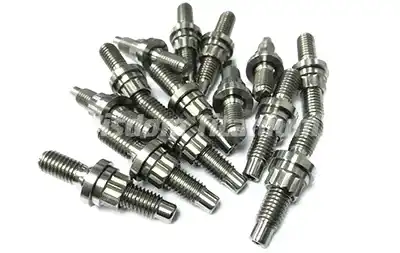
Thread integrity is still one of the most important things to look at when judging how well fasteners work in tough car and motorcycle uses. The main material used to make titanium exhaust bolts is Ti-6Al-4V (Grade 5), which makes them very resistant to thread bending in normal situations. Titanium's natural qualities, such as its high strength-to-weight ratio and resistance to corrosion, make thread degradation much less likely than with steel fasteners, which can seize and rust-weld in high-temperature exhaust settings. But using the wrong fitting methods, like over-torquing without the right oils, can cause thread galling or deformation no matter what material is used.
Understanding Thread Deformation in Titanium Exhaust Bolts
Thread deformation is when bolt threads become distorted or lose their structural integrity during placement or over an extended period of time. In exhaust systems, this condition weakens the integrity of joints, which could lead to leaks in the manifold, the separation of turbocharger flanges, or catastrophic component failure during high-stress operation.
Mechanical Properties of Titanium Grade 5
Ti-6Al-4V titanium metal, the material we use at Wisdom Titanium, has a tensile strength of 895 to 930 MPa and a yield strength of about 828 MPa. This material is strong enough to be used in aircraft applications and can handle temperatures above 400°C, which is common in exhaust manifolds. Extremely strong austenitic stainless steel fasteners (304/316 grades) are 45% heavier than titanium exhaust bolts of the same strength. Titanium has a modulus of elasticity of about 114 GPa, which is much lower than steel's modulus of 200 GPa. This means that titanium bolts can bend more before they break permanently.
Common Causes of Thread Deformation
Most thread warping in titanium exhaust bolts is caused by mistakes made during installation. When you over-torque something without lubricating it, the connecting threads rub against each other too much, creating heat and pressure that is higher than the material's break point. Thermal cycling, which is when exhaust systems heat and cool over and over again, causes things to expand and shrink. Titanium's temperature expansion coefficient (8.6 × 10⁻⁶ /°C) is very close to that of aluminum engine parts. However, using the wrong materials can cause stress to build up at the thread roots.
Corrosive environments speed up thread wear in steel fasteners through electrochemical processes. But titanium's passive oxide layer protects it from atmospheric rust and most of the results of exhaust gas combustion. Cross-threading during the initial installation damages thread profiles physically, no matter what material is used. This shows how important it is to use the right alignment and thread engagement methods.
Titanium Exhaust Bolts vs Steel and Stainless Steel: Thread Durability Comparison
In high-temperature fastening situations, the choice of material has a direct effect on how long the thread lasts. Knowing how titanium exhaust bolts, carbon steel, and stainless steel work differently helps you make smart decisions about what to buy.
Strength and Thermal Performance Analysis
Carbon steel Grade 8.8 bolts have a tensile strength of about 800 MPa and are great for making threads because they are more flexible (they can stretch 12 to 14%). But steel can oxidize at temperatures above 300°C, which damages thread surfaces and forms rust layers that attach threads to aluminum housings. This is what mechanics call "rust welding." Stainless steel 304 fasteners are resistant to corrosion, but they tend to gall when installed because of how they harden over time.
Titanium Grade 5 keeps its functional qualities even at high temperatures, where steel starts to weaken. When heated to 400°C, titanium keeps about 85% of its strength at room temperature, while carbon steel's failure point drops significantly. This thermal stability makes sure that the binding force stays the same as the temperature changes. This keeps the thread from coming loose or deforming from going through repeated rounds of expanding and contracting.
Corrosion Resistance and Thread Longevity
The titanium dioxide inactive layer forms naturally on surfaces that are uncovered. It protects against air moisture, road salt, and acidic exhaust condensates for a long time. This feature gets rid of the thread seizure problem that happens with steel bolts in salty seas or cold areas where chemicals used to melt snow speed up corrosion. When it's time for regular maintenance, like every 50,000 miles for passenger cars or between races for motorsports, titanium exhaust bolts come off easily and without damaging the threads or making it hard to get the part out.
Weight Considerations for Performance Applications
Racing teams and performance fans know that lowering the mass that rotates and moves back and forth makes the engine reaction and power better. A titanium exhaust bolt kit for installing a four-cylinder header weighs about 200 to 250 grams less than a steel kit of the same size. Even though it may not seem like much, reducing weight across multiple systems adds up to measured performance gains. Our screw kits with 12-point nuts and washers, which come in M8×1.25×45 and M10×1.25×45/54 sizes, show this benefit while still being strong even when subjected to high temperatures and vibrations.
Best Practices to Prevent Thread Deformation When Using Titanium Exhaust Bolts
When titanium exhaust bolts are installed correctly, they last longer and work more reliably, and thread damage is avoided.
Optimal Torque Specifications and Installation Tools
Because titanium is not as elastic as steel, force numbers need to be changed. When putting titanium exhaust bolts into aluminum or steel parts, we suggest lowering the normal steel torque requirements by about 15 to 20 percent. A M10×1.25 titanium exhaust stud usually needs 35–40 Nm of power, while the same-sized steel hardware needs 50 Nm. Over-tightening, which leads to thread yielding and lasting deformation, can be avoided by using measured torque tools.
The 12-point nut design we use in our systems spreads torque loads across more contact points than 6-point designs, which lowers the amount of stress that builds up at each thread crest. This function is especially useful in racing, where workers have to put things together and take them apart a lot during setup changes.
Thread Lubricants and Anti-Seize Compounds
Never put titanium exhaust bolts into metal parts that haven't been properly oiled first. We ask for anti-seize chemicals that are based on copper or nickel and can withstand high temperatures while keeping metals from galling against each other. Molybdenum disulfide lubricants work very well. They lower the coefficient of friction from about 0.6 (when titanium is dry) to 0.15 (when lubricated), which greatly reduces the amount of force needed for fitting while still ensuring the right preload.
Don't use anti-seize items made of stainless steel because they can cause galvanic rusting when mixed metals touch each other in wet conditions. Lubricant should be put on both the male threads and the bottom of the washers to make sure that the friction coefficients are the same all the way through the locking system.
Maintenance and Inspection Protocols
Set up review times based on how hard the operation is. For street cars, the exhaust system needs to be inspected about every 30,000 miles. For racing cars, it needs to be inspected visually before every race. Check for color changes around the bolt heads that could mean they've been exposed to too much heat, there are exhaust leaks, or the bolts are coming loose. If you look closely, you should see cracks coming out of the thread roots. These cracks are a sign of wear damage caused by shaking or incorrect preload.
Any bolts that have thread distortion, burnishing marks, or changes in size should be replaced. When put correctly, titanium exhaust bolts can be used more than once, but if the threads get damaged, the joint will not hold together properly. The natural finish on our titanium makes wear patterns easy to see, while the burnt blue finishes (achieved through controlled rusting) look great and are also resistant to corrosion.
Real-World Performance in Motorsport Applications
A regional race team that used our M10×1.25×54 titanium exhaust bolts on turbocharged engines had no fastener problems during the whole season, even though the turbo inlet flange was getting exhaust gas temperatures of over 980°C. The team used to have a lot of problems with stainless steel studs breaking when they were being taken off after three race weekends, which required expensive and time-consuming extraction operations. By switching to titanium Grade 5 studs and following the right fitting steps, these maintenance problems went away and each car lost 210 grams of weight.
Conclusion
Titanium exhaust bolts made from Grade 5 metal are very resistant to thread deformation when they are put correctly and with the right amount of force. The material's natural qualities—high strength-to-weight ratio, resistance to corrosion, and temperature stability—address the main ways steel bolts fail in exhaust uses. Thread damage risks are mostly caused by bad fitting methods, not by the limits of the material itself. This means that choosing the right material is just as important as knowing how to use it correctly and making sure it is made well. We looked at how it compares to steel and stainless steel options in terms of performance, came up with best practices for installation and upkeep, and listed things to think about when buying to make sure quality. These insights give engineering teams and buying staff the confidence to choose titanium screws that will work well in tough situations.
Partner with a Trusted Titanium Exhaust Bolts Manufacturer
When you need to buy titanium exhaust bolts, Wisdom Titanium can help. They have ISO 9001-certified manufacturing skills and full professional support. We provide uniform quality through vertically integrated supply chains and strict process controls. We are located in Baoji Titanium Valley, which is the world's most integrated titanium production center. Our titanium exhaust bolt systems are made of Grade 5 material and come in stud configurations with 12-point nuts and washers. They come in M8×1.25×45 and M10×1.25×45/54 sizes, but we can also make them to any size you need. Titanium's natural and dark blue colors look good and work well in a variety of settings, including cars, motorcycles, and racing.
Our experienced R&D team works with you to come up with unique solutions, whether you need a sample or a lot of products, with minimum orders of 100. Our full collection of raw materials and stable price structures make it easy to plan ahead for purchases, and our advanced production technology guarantees on-time delivery. We want sourcing managers, engineering teams, and OEM partners to learn more about how our titanium bolt solutions improve performance and provide long-term value. You can talk to our expert sales team at sales@wisdomtitanium.com or visit wisdomtitanium.com to talk about your application needs, get material certifications, or get bulk prices for your next project.
FAQ
Do titanium exhaust bolts deform under extreme thermal cycling?
Grade 5 titanium keeps its shape even after being heated and cooled many times, which is common in exhaust systems. At 400°C, the material still has about 85% of its strength at room temperature, so heat stress doesn't cause the thread to break. Using the right amount of pressure and anti-seize lubrication will make sure that titanium exhaust bolts can handle hundreds of rounds of heat expansion and contraction without permanently changing shape.
How can I verify titanium exhaust bolt quality before purchase?
Ask for test results on the material that show its chemical make-up and mechanical qualities. Check if the seller has an ISO 9001 or AS9100 approval that shows they have systematized quality control. Use go/no-go gauges to check the thread profiles and make sure the measures match the specs. Suppliers with a good reputation, like Wisdom Titanium, include full tracking paperwork and dimensional inspection reports with every order. This makes sure that each batch is the same for production uses.
What warranty coverage do manufacturers typically provide?
Manufacturers who make good products usually back their products with guarantees that cover material flaws and non-conforming dimensions for 12 to 24 months. Damage caused by incorrect fitting, over-torquing, or incorrect use is not covered. We stand behind the quality of our products by offering full support, answering technical questions, and replacing fasteners that break during normal use during guarantee times.
References
1. Boyer, R., Welsch, G., & Collings, E.W. (1994). Materials Properties Handbook: Titanium Alloys. ASM International, Materials Park, Ohio.
2. Budinski, K.G. (1991). "Tribological Properties of Titanium Alloys," Wear, Vol. 151, Issue 2, pp. 203-217.
3. Donachie, M.J. (2000). Titanium: A Technical Guide, 2nd Edition. ASM International, Materials Park, Ohio.
4. Farrahi, G.H., Lebrun, J.L., & Courtin, D. (1995). "Effect of Shot Peening on Residual Stress and Fatigue Life of a Spring Steel," Fatigue & Fracture of Engineering Materials & Structures, Vol. 18, Issue 2, pp. 211-220.
5. Lutjering, G. & Williams, J.C. (2007). Titanium: Engineering Materials and Processes, 2nd Edition. Springer-Verlag, Berlin.
6. Veiga, C., Davim, J.P., & Loureiro, A.J.R. (2012). "Properties and Applications of Titanium Alloys: A Brief Review," Reviews on Advanced Materials Science, Vol. 32, pp. 133-148.