
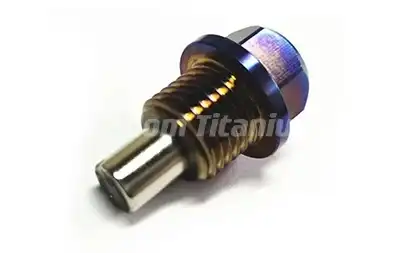
The short answer: a properly manufactured titanium magnetic bolt will not lose its magnetism under normal operating conditions. The embedded magnet component—typically a rare-earth element like neodymium or samarium-cobalt—is permanently encapsulated within the titanium alloy housing. Pure titanium itself is non-magnetic, but when combined with strategically embedded magnetic inserts, these fasteners retain consistent magnetic field strength over decades, provided they are not exposed to temperatures exceeding the Curie point of the magnet material (approximately 310°C for neodymium, 750°C for samarium-cobalt) or subjected to severe mechanical impacts that crack the embedded core.
Maintaining and Cleaning Titanium Magnetic Bolts to Preserve Magnetism
Regularly maintained titanium magnetic bolts survive longer and preserve their magnetic characteristics over rigorous operation cycles. Titanium parts don't need deep rust prevention like steel fasteners, although some methods boost performance.
Recommended Cleaning Procedures and Agents
Titanium's oxide layer protects it, thus mild cleaning procedures work on it but not steel. Warm water with 2% to 3% dish soap removes brake dust, oil residue, and road filth without damaging titanium or magnet seals. Procurement managers should instruct maintenance personnel to use this cleaning technique to reduce expenses and chemical harm.
Oil and grease from automotive parts may be removed off fasteners with 70–90% isopropyl alcohol. Acetone and methyl ethyl ketone harm magnet cement seals, whereas isopropyl alcohol does not. After wiping the bolt heads and threads with a moist, lint-free cloth, let them dry before reassembling.
Ultrasonic cleaning tanks at 40 kHz with pH-neutral chemicals clean high-value titanium magnetic bolts used in racing or flying best. This procedure removes small dirt particles from thread roots and knurled surfaces without mechanical cleaning, which might harm titanium's soft surface (Rockwell C hardness is 30–36, compared to 40+ for hardened steel).
Common Mistakes That Degrade Magnetic Functionality
Three forms of poor handling cause most titanium magnetic bolt failures in automobile repairs:
Chemical exposure errors: Mechanics assume all metals need strong solvents, therefore they use chlorine brake cleaners or muriatic acid rust removers on titanium bolts. Chemicals can enter microscopic magnet cover holes and consume neodymium cores, swiftly losing magnetic characteristics. Training materials should state that chlorinated liquids are prohibited and identify only permitted cleaning agents to avoid this failure scenario.
Thermal mismanagement: Rapid impact tool use generates frictional heat that can momentarily boost bolt temperatures over magnet-safe levels. Titanium's low heat transfer rate (7 W/m·K vs. 50 W/m·K for steel) helps retain heat, but prolonged high-speed operation causes heat buildup. In brake caliper applications requiring correct preload, utilize calibrated torque instruments at the indicated rotation rates for M12–M20 bolts.
Magnetic field interference: Titanium magnetic bolts near strong electromagnets or MRI equipment can shift magnetic domain directions, weakening the field by 10–15%. It usually affects hospitals and research facilities, not car shops. However, purchasing specs should include storage recommendations to minimize accidental demagnetization.
Inspection and Storage Best Practices
Regular inspections detect early warning indications before magnetic function becomes an issue. Maintenance crews should utilize portable gaussmeters to maintain magnetic flux density within 5% of the original standards during regular service intervals. A 0.8 Tesla neodymium-based magnetic bolt at room temperature should always read between 0.7 and 0.84 Tesla. Readings below this range indicate a cracked seal or heat-damaged bolt that needs replacement.
During visual inspection, look for fractures in the titanium shell around the magnets. These fractures let water in, accelerating magnet corrosion. Technicians use a 10x microscope to examine for splits or darkening where magnet caps and bolt bodies meet, which might indicate a seal failure. Fasteners used in vibration-prone areas like motorbike engine mounts or racing suspension parts must be checked for cracks.
Storage method affects magnetic security over time. Bolts should be stored in climate-controlled areas between 15°C and 25°C with relative humidity below 60% to avoid condensation. The magnets within each bolt can be protected from handling impacts by foam spacers. Aviation maintenance facilities encapsulate titanium magnetic bolts with desiccant packs. This is appropriate for high-value automobile inventories.
Procurement Insights for Titanium Magnetic Bolts
Finding titanium magnetic bolts requires knowledge of their technical standards and supply chain, which is distinct from buying steel screws. Global B2B customers must evaluate suppliers' quality and delivery beyond unit pricing.
Identifying Qualified Suppliers and Manufacturers
A quality management standard of ISO 9001 is required for titanium fastener manufacturers, but procurement teams should additionally check for magnetic component integration credentials. Reliable embedded-magnet bolt suppliers have AS9100 aerospace or IATF 16949 automobile quality certification. They satisfy rigorous magnetic flux and seal integrity criteria with their process controls.
Geographic concentration of titanium processing knowledge impacts seller choice. The Baoji Titanium Valley in Shaanxi Province, China, is the world's largest titanium business cluster. Specialized manufacturers create titanium sponges and completed fasteners. This focus reduces wait times and prices compared to Western vendors that import raw titanium. Baoji Wisdom Titanium Industry and Trading Co., Ltd. illustrates this regional advantage. The ISO 9001-certified plant features CNC equipment and convenient access to high-purity Ti-6Al-4V rod stock.
OEM interaction skills are crucial for automakers and modification shops that need non-M12–M20 thread sizes. To satisfy sensor alignment or clearance requirements, custom engineering service providers can adjust grip lengths, head shapes, and magnet location to accommodate certain automotive platforms. Ask for design validation reports and PPAP documentation to assess a supplier's technical expertise before placing large orders.
Pricing Benchmarks and Total Cost Analysis
Titanium magnetic bolt prices vary on quality, thread size, and magnet parameters. In quantity, respectable Chinese manufacturers sell M12 x 1.25 Grade 5 bolts with neodymium magnets in a natural finish for $8–$15 per unit. Premium PVD or burned titanium coatings cost $2–$4 per item. Samarium-cobalt magnet improvements cost 40% more than neodymium.
When compared to alternative solutions, titanium is cheaper over 5 years since stainless steel magnetic bolts that operate the same way cost $6–10 per unit but need to be replaced twice as often in hazardous environments. Carbon steel fasteners are cheaper at $3 to $5, but their weight hampers performance. Titanium is more expensive for competitive use because racing teams know that reducing 100 grams of unsprung weight increases lap speeds by 0.1 seconds per kilometer.
International shipping logistics affect landing costs. Air freight from China to North American automotive centers costs $8–$12 per kilogram and takes 5–7 days for urgent prototype orders. However, ocean freight costs $1–2 per kilogram and takes 30–40 days. Procurement managers should consider these considerations when planning inventories and purchase enough additional stock to accommodate for maritime shipping delays without compromising production plans.
Supplier Evaluation Criteria and Due Diligence
Before finalizing major purchases, procurement experts should thoroughly analyze suppliers using a structured evaluation process that goes beyond price:
Material traceability documentation: For material tracking, request mill test records (MTRs) to ensure titanium stock fulfills ASTM B348 chemical composition and mechanical qualities. Grade 5 Ti-6Al-4V demands 5.5–6.75% aluminum and 3.5–4.5% vanadium. If not, it's substandard and won't last as long.
Magnetic performance validation: Validate magnetic performance: Get third-party test findings on flux density, temperature stability, and vibration resistance of implanted magnets. Reliable vendors perform these tests regularly and offer certificates of compliance with every product, per ASTM A977.
Production capacity verification: Visit manufacturing plants to test quality control, CNC, and inventory management systems. In shops with 5-axis machining centers and coordinate measurement devices, magnet hole placement technology is advanced.
Conclusion
If constructed with the proper integrated magnet technology and utilized at particular temperatures, titanium magnetic bolts last long. In demanding automotive, motorcycling, and industrial situations, their low weight, corrosion resistance, and magnetism make them superior than steel. Choosing certified suppliers who can track their products, have the proper technical competence, and follow quality controls is key to procurement success. They last longer than normal fasteners because proper cleaning preserves the titanium surface and the magnet.
Partner With a Trusted Titanium Magnetic Bolt Manufacturer
Wisdom Titanium specializes in precision titanium magnetic bolts for manufacturers, race teams, and speed modification enthusiasts worldwide. Quality is consistent for M12–M20 sizes and custom OEM configurations at our ISO 9001-certified Baoji Titanium Valley production due to modern CNC machining and full vertical integration. Choose from natural titanium, excellent PVD coatings, and charred appearances. All of them are built of certified Grade 5 Ti-6Al-4V alloy with neodymium or samarium-cobalt magnets. Whether you need a few prototypes to create a car or a lot of parts to make a full production run, our expert staff provides fast technical assistance and reliable delivery. Contact our purchasing professionals at sales@wisdomtitanium.com to discuss your titanium magnetic bolt needs and receive customized rates. Wisdomtitanium.com has a wide range of fasteners, including magnetic bolts that increase performance and save weight.
FAQ
Do Titanium Magnetic Bolts Retain Magnetism Compared to Steel Bolts?
Titanium magnetic bolts with rare-earth magnets hold as well as steel magnetic rivets. Steel bolts are magnetized by the ferrous base material, while titanium bolts utilize magnet plugs. Neodymium-embedded titanium bolts yield 0.8 to 1.2 Tesla magnetic flux, comparable to ferromagnetic steel. If utilized within the authorized temperature ranges, titanium housings with sealed magnet inserts maintain their output for decades while steel steadily loses its magnetic qualities owing to corrosion and repeated heating cycles.
How Does Corrosion Affect Magnetic Bolt Performance?
The major reason steel magnetic bolts fail is corrosion, while titanium ones don't. Rust alters steel rivets' ferromagnetic crystal structure. In severe environments, this decreases magnetism by 30–50% over two to three years. Titanium's passive oxide coating inhibits deterioration altogether. The magnet inside keeps isolated from the outer world, so it can work after decades of chemical or salt spray exposure. In northern locales where steel equivalents rust through in 3–4 winter seasons, titanium magnetic sensor bolts endure more than 10 years in car braking system applications.
Can I Use Titanium Magnetic Bolts in High-Temperature Applications?
The magnet, not the titanium casing, determines temperature restrictions. Work continually at 80°C and neodymium magnets retain their strength. They may be utilized in most automobile applications excluding brake calipers that exceed 200°C while traveling forcefully. Samarium-cobalt alternatives can withstand 350°C on occasion and 300°C always, making them excellent for racing braking systems and speed exhaust parts. Since titanium can withstand temperatures exceeding 500°C without losing form, the magnet's material is the only temperature constraint. If you get the proper magnet grade, it will perform dependably in your desired temperature range.
What Thread Sizes Are Available for Titanium Magnetic Bolts?
M12, M14, M16, and M20 are popular car thread sizes. These sizes cover 85% of passenger automobile and motorbike wheel hub, brake caliper, and suspension mounting demands. These dimensions allow magnets to be placed while ensuring thread engagement to sustain structural loads. The firm makes M6 micro-fasteners for electronics and M24 heavy-duty nuts for factories. Lead times for non-standard sizes are 4–6 weeks for prototypes and 8–10 weeks for production runs above 1,000 pieces. OEM services allow grip length, head type, and drive combinations to be altered to meet certain automobile models without impacting magnetic operation.
References
1. Davis, J.R. (2006). Titanium: A Technical Guide. ASM International, Materials Park, Ohio.
2. Campbell, F.C. (2008). Elements of Metallurgy and Engineering Alloys. ASM International, Chapter 25: Titanium and Titanium Alloys.
3. Magnetic Materials Producers Association (2019). Permanent Magnet Guidelines: Performance Characteristics and Temperature Stability. Technical Bulletin MMPA 0100-19.
4. Society of Automotive Engineers (2021). Fastener Performance Requirements for Automotive Applications. SAE Standard J429 Revision D.
5. Peters, M., Kumpfert, J., Ward, C.H., and Leyens, C. (2003). "Titanium Alloys for Aerospace Applications." Advanced Engineering Materials, Vol. 5, pp. 419-427.
6. Zhang, L. and Chen, Y. (2020). "Corrosion Resistance and Fatigue Performance of Titanium Fasteners in Marine Environments." Journal of Materials Engineering and Performance, Vol. 29, pp. 4582-4591.