
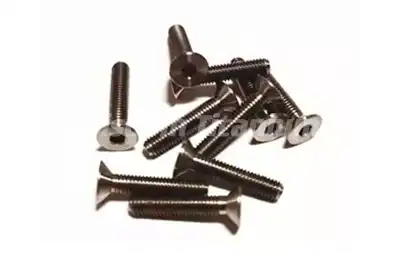
The superior fatigue strength of titanium m3 bolts is a result of their improved metallurgical qualities and distinctive crystalline structure. Titanium Grade 5 alloy's crystal lattice, which is hexagonal close-packed (HCP), offers exceptional resistance to crack propagation when subjected to cyclic loading. These fasteners are able to endure countless stress cycles without breaking because of this material's inherent properties and the precision of its manufacturing procedures, which involve machined heads and rolled threads. Grade 5 titanium's improved fatigue performance is a direct result of its refined microstructure, which is created by the aluminum-vanadium alloying elements. This microstructure allows the bolt to transfer stress more uniformly, which is a major improvement over its typical steel counterparts.
Exceptional Fatigue Strength of Titanium M3 Bolts
The Science of Fatigue Resistance in Small Diameter Fasteners
A material's fatigue strength indicates how well it can withstand repeated stress cycles without breaking or cracking. The smaller diameter of M3 titanium fasteners results in a reduced cross-sectional area, making this attribute all the more important in its context. Titanium Grade 5's exceptional resistance to fatigue crack initiation and propagation is a result of its unique metallurgical composition.
Test data demonstrating that titanium alloys can resist stress amplitudes up to 60% higher than comparable steel fasteners under same cyclic loading circumstances has been extensively documented by the aerospace industry, further demonstrating titanium's better fatigue properties. Titanium has a natural edge in performance because its crystalline structure allows it to disperse stress concentrations more efficiently.
Comparative Performance Analysis
Titanium m3 bolts consistently exceed their competitors in fatigue tests compared to more traditional fastening materials. Under identical testing conditions, Grade 5 titanium fasteners retain their structural integrity at stress levels above 400 MPa, in contrast to stainless steel 316 bolts, which usually show fatigue limits at 200-250 MPa. In demanding applications, this significant performance gap directly correlates to longer service life and less maintenance needs.
In addition to improving fatigue performance, titanium's corrosion resistant qualities shield it from surface degradation, a common precursor to fatigue failures in other materials. Despite prolonged exposure to extreme environments, titanium fasteners retain their smooth surface integrity and fatigue resistance, in contrast to steel fasteners that can form corrosion pits that act as stress concentration locations.
Material Science Behind Titanium M3 Bolts' High Fatigue Strength
Metallurgical Composition and Microstructure
The mechanical properties of grade 5 titanium alloy, also known as Ti-6Al-4V, are significantly affected by the carefully controlled amounts of aluminum (5.5-6.75%) and vanadium (3.5-4.5%). The combination of these alloying elements forms a microstructure with two distinct phases of titanium, alpha and beta, which improve fatigue performance in different ways.
Even at high temperatures, the mechanical properties of the alpha phase remain constant, while the beta phase makes the material more ductile and robust. Thanks to these complementary properties, the material may withstand stress changes without brittle microcracks, which are the usual culprits in homogenous materials' fatigue failures.
Manufacturing Process Impact on Fatigue Properties
How these specialist fasteners are made has a major impact on how well they will hold up during strain. Titanium m3 bolts are made using rolled thread methods, which work-harden the surface of the material without compromising the integrity of the underlying grain structure. Under cyclic loading, this surface treatment actively prevents crack development by creating compressive residual stresses.
By carefully controlling their dimensions, machined hexagon heads do away with stress hotspots that are typical of cast or molded parts. Premature fatigue failures can be avoided by distributing loads evenly and ensuring smooth transitions between the head and shank parts.
Stress Distribution Characteristics
Titanium's lower elastic modulus (around 114 GPa compared to steel's 200 GPa) permits more consistent stress distribution across the fastener when subjected to load, according to computer-aided finite element analysis. Because of this property, the bolt can bend slightly under stress without compromising its structural integrity, which reduces the likelihood of fatigue cracks caused by stress concentrations.
Practical Applications and Benefits of Using Titanium M3 Bolts
Aerospace and Defense Applications
For titanium fasteners with tiny diameters, the aerospace industry is the harshest possible application environment. Titanium m3 bolts are widely used in aviation electronic systems because to their fatigue resistance and non-magnetic properties. These qualities guarantee reliable operation even when subjected to persistent vibrations, which can interfere with delicate navigation equipment.
The capacity of these fasteners to preserve joint integrity even when subjected to intense G-force loading cycles makes them ideal for use in military aircraft. Improved fatigue performance and optimized aircraft performance are direct results of the lightweight design's conjunction with other benefits.
Automotive Performance Enhancement
Titanium fasteners are being used more and more in high-performance automotive applications for vital components that need to be lightweight and extremely durable. Brake caliper assemblies are fastened using M3 titanium bolts by racing teams since regular steel fasteners would be corroded by the constant mechanical stresses and heat cycling.
Because of their fatigue resilience, which protects against disastrous failures that may occur from using subpar fastening solutions, these fasteners have found widespread use in the automobile modification business for bespoke wheel assemblies and suspension components. Vehicles exposed to road salt and extreme climatic conditions can be assured of long-term durability because to the corrosion resistant qualities.
Medical Device Integration
When it comes to biocompatibility and total reliability, titanium m3 bolts are the go-to choice for producers of precision medical equipment. Titanium's fatigue resistance is crucial for surgical instruments to maintain their integrity over multiple sterilizing cycles, and its non-magnetic qualities are advantageous for MRI machine assembly.
How to Choose the Right Titanium M3 Bolts for Your Procurement Needs
Grade Selection Considerations
Thoroughly assessing the unique needs of each application is essential when deciding between titanium grades. Applications where resistance to environmental factors is more important than maximum mechanical performance might benefit from grade 2 titanium's moderate strength and excellent corrosion resistance.
Titanium grade 5, with its improved fatigue strength and other exceptional mechanical qualities, is the material of choice for demanding environments. Grade 5, with to its extra alloying elements, is able to endure more severe loading conditions and keep its dimensions stable for longer durations of service.
Dimensional and Threading Specifications
Accuracy required for dependable joint functioning and compatibility with current equipment designs are both provided by metric threading standards. Thread engagement is maximized without significant stress concentrations in the threaded regions due to the M3 thread pitch of 0.5mm, which allows the fastener to carry loads to their full potential.
Consistent diameter and threading specs are maintained throughout the length options, which range from 5mm to 30mm, to satisfy diverse assembly requirements. This uniformity guarantees interoperability across various applications in the same building and streamlines inventory management.
Quality Verification Protocols
Through material certification and dimensional inspection procedures, genuine titanium m3 bolts must be confirmed. Obtaining material test certifications from reputable suppliers is crucial for quality assurance programs. These certificates verify the chemical composition, mechanical qualities, and manufacturing traceability information.
It is important to visually check for accurate dimensions, a correct surface finish, and any manufacturing flaws that could affect fatigue performance. In order to avoid installation issues that could harm the fastener and the assembly, thread gauge verification is performed. This guarantees that the components fit properly with one another.
Procuring Titanium M3 Bolts: Best Practices for Bulk and Custom Orders
Supplier Evaluation Criteria
Assessing suppliers thoroughly, paying close attention to their production capacities, quality systems, and industry certifications, is the first step in effective procurement. Titanium fasteners must be consistently reliable to satisfy the rigorous needs of many applications, and ISO 9001 accreditation shows that the company is committed to quality management systems.
The extensive production capabilities required to produce high-quality titanium fasteners are exhibited by Baoji Wisdom Titanium Industry and Trading Co., Ltd. The firm has access to the whole titanium supply chain, from raw materials to finished products, thanks to its location in Baoji Titanium Valley in Shaanxi Province, China's biggest and most extensive titanium industry cluster.
The technical know-how required to manufacture customized fasteners satisfying varied performance requirements is demonstrated by manufacturing experience across numerous industries, including aerospace, automotive, and medical applications. Companies that have been around for a while in these tough industries usually have the quality control processes in place to make sure their products always work as expected.
Order Planning and Logistics Management
It is important to plan ahead to accommodate project timetables for custom titanium fasteners, as their production timescales usually range from 7 to 15 days. The meticulous manufacturing processes that are required to attain the precise dimensions and high-quality surface polish that are crucial for good fatigue performance are reflected in this lead time.
The ability to accept a variety of payment methods, such as PayPal and more conventional bank transfers, allows for more streamlined transaction processing and can adapt to various company procurement processes. Accurate project planning and budget management are made possible by transparent payment terms and delivery schedules throughout the procurement process.
Sample Evaluation and Testing Protocols
If you want to make sure the product is up to par before you commit to a larger order, ask for a sample. It is important to use the right testing procedures to check the material composition, verify the dimensions, and evaluate the surface polish of the sample.
To avoid installation issues that could harm the fastener and mating components, it is important to use gauge components for thread fit verification. This will guarantee that the assembly is compatible. Before problems affect manufacturing timelines or product quality, they are discovered in this preliminary testing.
Conclusion
The exceptional fatigue strength of titanium m3 bolts results from the sophisticated interaction between advanced metallurgy, precise manufacturing processes, and inherent material properties. Grade 5 titanium's dual-phase microstructure, combined with carefully controlled alloying elements, creates fasteners capable of withstanding millions of stress cycles while maintaining structural integrity. These performance advantages, coupled with superior corrosion resistance and lightweight characteristics, make titanium M3 bolts the optimal choice for demanding applications across aerospace, automotive, and medical industries where reliability cannot be compromised.
Partner with Wisdom Titanium for Premium Titanium M3 Bolt Solutions
Wisdom Titanium stands as your trusted titanium m3 bolts supplier for aerospace-grade fastening solutions that deliver uncompromising performance and reliability. Our ISO 9001-certified manufacturing facility in Baoji Titanium Valley leverages China's most comprehensive titanium industry ecosystem to produce precision-engineered Grade 5 titanium fasteners with machined heads and rolled threads. With production capabilities spanning M2 to M3 sizes and length options from 5mm to 30mm, we accommodate diverse industrial requirements while maintaining consistent 7-15 day delivery schedules. Our experienced engineering team provides customized solutions backed by comprehensive material certifications and rigorous quality control protocols. Contact our procurement specialists at sales@wisdomtitanium.com to discuss your specific requirements and experience the superior performance advantages that have made us a preferred partner for leading manufacturers worldwide.
FAQ
What makes titanium M3 bolts superior to steel alternatives in fatigue applications?
Titanium M3 bolts demonstrate superior fatigue performance due to their unique crystalline structure and lower elastic modulus, which distributes stress more evenly throughout the fastener. The Grade 5 titanium alloy's dual-phase microstructure provides enhanced crack resistance compared to homogeneous steel materials, resulting in significantly longer service life under cyclic loading conditions.
How do manufacturing processes affect the fatigue strength of titanium M3 bolts?
Rolled threading processes create beneficial compressive residual stresses on the fastener surface that actively resist crack initiation. Machined hexagon heads eliminate stress concentration points while providing smooth load transitions between head and shank sections. These manufacturing techniques optimize the material's inherent fatigue resistance properties.
Can titanium M3 bolts withstand high-temperature cycling applications?
Grade 5 titanium maintains excellent mechanical properties at elevated temperatures up to 400°C while demonstrating superior thermal cycling resistance. The material's low thermal expansion coefficient and stable microstructure prevent the dimensional changes and property degradation that affect other materials under repeated temperature variations.
What quality certifications should buyers expect from reputable titanium bolt suppliers?
Professional suppliers should provide material test certificates documenting chemical composition, mechanical properties, and manufacturing traceability. ISO 9001 certification indicates proper quality management systems, while industry-specific certifications demonstrate experience in demanding applications requiring consistent product performance.
How do procurement teams verify authentic titanium M3 bolt quality?
Verification includes material composition analysis through X-ray fluorescence testing, dimensional inspection using precision measurement tools, and thread gauge verification for proper fit. Visual inspection should confirm proper surface finish and absence of manufacturing defects that could compromise performance.
References
1. Boyer, R., Welsch, G., and Collings, E.W. "Materials Properties Handbook: Titanium Alloys." ASM International, Materials Park, OH, 1994.
2. Lutjering, G. and Williams, J.C. "Titanium: Engineering Materials and Processes." Springer-Verlag, Berlin, 2003.
3. Donachie, M.J. "Titanium: A Technical Guide, 2nd Edition." ASM International, Materials Park, OH, 2000.
4. Peters, M., Hemptenmacher, J., Kumpfert, J., and Leyens, C. "Structure and Properties of Titanium and Titanium Alloys." Titanium and Titanium Alloys: Fundamentals and Applications, Wiley-VCH, 2003.
5. Rack, H.J. and Qazi, J.I. "Titanium Alloys for Biomedical Applications." Materials Science and Engineering C, Volume 26, Issues 6-7, 2006.
6. Banerjee, D. and Williams, J.C. "Perspectives on Titanium Science and Technology." Acta Materialia, Volume 61, Issue 3, 2013.