
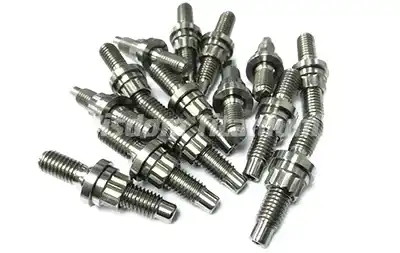
"Why not use titanium exhaust bolts?" doesn't mean you shouldn't use them at all; it just means you should think carefully about them before you buy them. While titanium exhaust bolts made from Grade 5 Ti-6Al-4V alloy have obvious benefits—corrosion resistance, 45% less weight than steel, and exceptional thermal stability—they also have some drawbacks that B2B buyers need to carefully consider.
Titanium Exhaust Bolts: Benefits and Drawbacks
Superior Material Properties That Solve Critical Problems
Titanium exhaust bolts made from Grade 5 titanium alloy (Ti-6Al-4V) solve the "seizing problem" that steel and stainless steel fasteners keep having. Standard exhaust bolts often weld themselves into manifold flanges due to high-temperature rust and galvanic corrosion, which causes the head to break when the bolt is tried to be removed. Titanium can't rust in the air, and its low temperature expansion rate stops this damaging bonding. The material stays strong even at temperatures above 400°C, which is where exhaust fumes focus heat. It's 45% lighter than steel versions, which makes a big difference in optimizing the unsprung mass of speed vehicles. This is especially true in racing, where every gram affects how the suspension moves and how quickly the vehicle accelerates.
Cost and Installation Complexities That Demand Assessment
Titanium exhaust bolts are expensive because the raw materials are expensive and they need to be machined in a particular way. Grade 5 titanium alloy costs about five to seven times as much as 304 stainless steel, which has a direct effect on budgets for buying things. It is very important to pay close attention to the torque specs during installation. Because titanium has a lower friction coefficient than steel, normal torque values cause over-tightening, which could lead to thread galling or stress fractures. Compounds that stop seizing that are made for titanium uses have to be bought. Adoption has hidden costs because procurement teams have to teach workers how to handle materials in a certain way. These things are good reasons to be hesitant, especially for projects where limited funds outweigh small improvements in performance or where support staff don't have much experience with unusual fastener materials.
Durability Considerations Across Operating Environments
Titanium does live up to its image for being strong in some situations, but only when certain conditions are met. In settings with salt water or chemicals, titanium lasts longer than any ferrous metal option. But in dry exhaust systems that work below 300°C and don't come into contact with salt, high-grade stainless steel bolts may last just as long for a lot less money. The work-hardening properties of Grade 5 titanium during fitting can leave weak spots if the pressure is not applied correctly. The material is more sensitive to notch damage, which means that thread damage during cross-threading is worse than with steel. When buying in bulk for a variety of clients, business-to-business buyers need to think about whether the uses they have in mind support titanium's strengths or whether strong stainless steel alternatives meet the needs for sturdiness while leaving budget room for other performance investments.
Practical Considerations for Using Titanium Exhaust Bolts
Installation Protocols That Prevent Costly Failures
To place a titanium exhaust bolt correctly, you must follow the manufacturer's torque recommendations, which are usually 15 to 20 percent less than for steel bolts because titanium has less thread friction. It is necessary to use a precise torque wrench because impact tools create uneven tightening loads that either weaken joints or cause galling. Using nickel-based anti-seize to prepare the threads stops cold welding between titanium bolts and different metal flanges, which is an important step that workers who work with steel often forget. When purchasing titanium screws, procurement teams should also set aside money for the right lubricants and torque testing tools. Initial orders should come with installation training paperwork to make sure that repair teams know how to handle the material properly. These small but important details make the difference between successful titanium acceptance and installations that go wrong, lead to warranty claims, and hurt the material's image within companies.
Supply Chain Realities Affecting Procurement Decisions
The characteristics of global supply chains for titanium are different from those for common fasteners. Lead times for custom titanium exhaust bolt specs are usually 4 to 8 weeks, while lead times for stainless steel options are only days. This means that you need to plan ahead and keep more bolts on hand just in case. The minimum order quantity (MOQ) for standard sizes is usually 100 pieces, but for special specs, it could be 500 or more pieces. This is because buying in bulk saves money on raw materials. Price changes in the titanium sponge market can sometimes lead to mid-contract cost adjustments, which should be taken into account when discussing long-term supply deals. Geographically, most titanium is made in a few places: the Baoji Titanium Valley in China, the VSMPO-AVISMA complex in Russia, and specialty mills in North America. Strategic procurement teams build ties with multiple providers to make sure there is continuity. They know that relying on a single source can cause output delays when capacity is limited or there are international problems.
When Alternative Materials Prove More Strategic
When used in certain situations, titanium exhaust bolt choices are not the best choice, despite their technical advantages. Titanium fasteners don't improve the performance of street cars built by casual fans on a budget; the money would be better spent on performance tires or suspension changes. Agricultural or industry equipment that works in exhaust settings with low pressure and reasonable temperature can get a good service life from regular stainless steel at a much lower cost. Steel's installation forgiveness is helpful for projects that need to be serviceable in the field in remote areas without special tools. In emergency replacement situations where wait times are more important than optimization, stainless steel options that are easy to get are better. Smart procurement pros know that sometimes the best way to choose materials is to choose "adequate" over "ultimate." This way, they can keep their budgets flexible for parts where performance gaps have a big effect on the end-user experience or their ability to compete.
How to Make the Right Choice for Your Exhaust Bolt Procurement?
Decision Framework Aligning Materials With Project Priorities
To choose the right exhaust fasteners, you must first list the features that you must have and the ones that you would like to have. In racing, where rules allow for unusual materials and where advantages of a few hundredths of a second make the prices worth it, titanium exhaust bolt specifications are definitely the best choice. When cost control and supply chain security are important for high-volume OEM production, stainless steel is usually the material of choice, unless specific engineering mistakes call for upgrades. Custom motorbike makers who work with wealthy customers who want to stand out in terms of style say that titanium's burnt blue anodized finishes make powerful visual statements that are worth the extra cost. Teams in charge of buying things should make scoring systems that take into account things like the range of working temperatures, the amount of vibration, the intensity of the corrosion environment, the budget, and the ease of upkeep. This organized method turns subjective discussions about materials into measurable comparisons. This way, buying managers can explain their choices to finance departments while making sure that engineering needs are met.
Evaluating Suppliers Beyond Price Quotations
When buying titanium exhaust bolt units, you have to look at more than just the unit cost when judging a seller. ISO 9001 approval means that the quality control system can keep the same sizes across production runs, which is very important when connecting fasteners to precision-machined flanges. Suppliers who offer material certificates and third-party test results make it possible to track products, which is important for avoiding liability and following the rules. Lead time reliability is what sets professional suppliers apart from opportunistic ones. Before signing a large-scale contract, check references or place a trial order to see how well the supplier meets deadlines. Technical support is very important. Suppliers like Wisdom Titanium that offer fitting help, unique sizing advice, and quick contact can avoid making mistakes that cost a lot of money. Flexibility in the minimum order number allows for sample builds and changes in seasonal demand. Before committing to a seller, people in charge of buying things should ask for samples to check the thread quality, surface finish, and packing.
Product Specifications Matching Diverse Applications
Our titanium exhaust bolt products are made from Grade 5 titanium alloy and come in natural titanium or burnt blue anodized styles. They have stud configurations with 12-point nuts and built-in washers. Standard sizes include M8 (1.25 x 45 mm) and M10 (1.25 x 45 mm) or 54 mm lengths. For non-standard uses that need specific grip lengths or thread pitches, they can be fully customized. When compared to hex setups, the 12-point nut design makes fitting easier by spreading torque loads across more engagement surfaces. For proper load distribution across flange sides, integrated washers get rid of the need for extra steps in the building process. Burnt blue anodizing gives Type III color-coding labeling while keeping the material's corrosion resistance. This is especially useful for multi-fastener systems that need to be checked visually for installation. Starting at 100 pieces, the minimum order quantity can be used for both testing prototypes and making small batches. Volume price is available for OEM and reseller partnerships.
Conclusion
The choice of titanium exhaust bolt is not a usual material upgrade but rather a smart purchase decision. These high-quality screws have measurable benefits in high-performance uses, such as resistance to corrosion that stops damaging seizing, lighter weight that improves the dynamic behavior of vehicles, and thermal stability in harsh circumstances. But their value offer is completely different depending on the situation. Racing teams, high-end carmakers, and custom motorbike builders who work in harsh conditions get benefits that make the extra cost of titanium worth it through longer service intervals and better performance. Instead, high-grade stainless steel is often a better choice for moderate-duty uses, projects with limited budgets, and situations where keeping the supply chain simple is the most important thing. To be successful at procurement, you need to match the properties of materials to real practical needs instead of chasing after strange specs just for the sake of it. Purchasing professionals get the most out of their investments in exhaust fasteners by using organized decision models that let them weigh performance needs against actual costs.
Partner With Wisdom Titanium for Strategic Fastener Sourcing
Wisdom Titanium has the specialized knowledge to solve the titanium exhaust bolt sourcing problems that automakers, motorcycle builders, and shops that make performance modifications face. In the Baoji Titanium Valley in Shaanxi Province, which is China's main titanium production hub and includes the whole supply chain from the sponge to the finished parts, we keep a wide range of products in stock and can make changes quickly, which is something that general fastener sellers can't do. Our ISO 9001-certified manufacturing methods make sure that the dimensions stay the same from one production run to the next. We also have in-house CNC machines that can handle unique requirements like thread pitches, grip lengths, and head configurations that aren't standard. As a provider of titanium fasteners with a lot of experience, we offer expert advice to help procurement teams choose the best materials for each job instead of automatically choosing high-end options when cheaper ones will do. Our sales team at sales@wisdomtitanium.com is responsive and honest when it comes to price, whether you're looking for 100 prototypes or a large amount of supplies. Visit wisdomtitanium.com to look through our full collection of fasteners and get quotes that are tailored to your needs.
FAQ
Do titanium exhaust bolts always outperform stainless steel alternatives?
Performance is better depending on the details of the application, not on the exact rankings of the materials. titanium exhaust bolt products work really well in places with a lot of heat, pressure, and corrosion because its qualities keep it from seizing up and make it last longer than stainless steel can. But for moderate-duty exhaust systems that don't have to work in sea conditions or at temperatures above 300°C, there may not be a big difference in performance. This means that stainless steel's lower cost is a better strategy choice. Titanium is usually a good choice for racing and high-end cars, but not for fleet vehicles or cheap builds.
What is the typical lifespan of titanium exhaust bolts under operational conditions?
Service life changes a lot depending on how it is used. Extreme thermal cycling and vibration are common in racing applications, which record replacement times of 12 to 18 months before protective changes are made. When used by enthusiasts, street speed cars usually last three to five years before they need to be taken apart for upgrades instead of breaking down. In toxic conditions, industrial or marine equipment may last for 8 to 10 years without breaking down. No matter what the base setting is, the right fitting torque and anti-seize application have a big effect on how long something lasts.
Are titanium fasteners compatible across various vehicle types?
Standard metric or SAE thread compatibility means that titanium exhaust bolt options can be used in place of steel bolts of the same size. But it's important to pay attention to how well the materials work together. For example, titanium against aluminum flanges without separation can cause galvanic cells in wet places. Different metal responses can be avoided by choosing the right anti-seize. Titanium's properties are most useful for high-performance cars. However, farming or utility equipment rarely makes the purchase worthwhile, even though they are technically compatible.
References
1. Boyer, R., Welsch, G., & Collings, E.W. (2007). Materials Properties Handbook: Titanium Alloys. ASM International, Materials Park, Ohio.
2. Donachie, M.J. (2000). Titanium: A Technical Guide, 2nd Edition. ASM International, Materials Park, Ohio.
3. Society of Automotive Engineers (2019). SAE J429 – Mechanical and Material Requirements for Externally Threaded Fasteners. SAE International Standards.
4. Schutz, R.W. & Watkins, H.B. (1998). "Recent Developments in Titanium Alloy Application in the Energy Industry," Materials Science and Engineering A, Volume 243, Issues 1-2, Pages 305-315.
5. Threadgill, P.L. (1995). "The Prospects for Joining Titanium Alloys," Materials Science Forum, Volumes 189-190, Pages 327-340.
6. Zhang, X.C., Chen, Y.L., & Hu, J.K. (2018). "High-Temperature Oxidation Behavior of Titanium Alloy Fasteners in Automotive Exhaust Systems," Journal of Materials Engineering and Performance, Volume 27, Pages 4382-4391.