
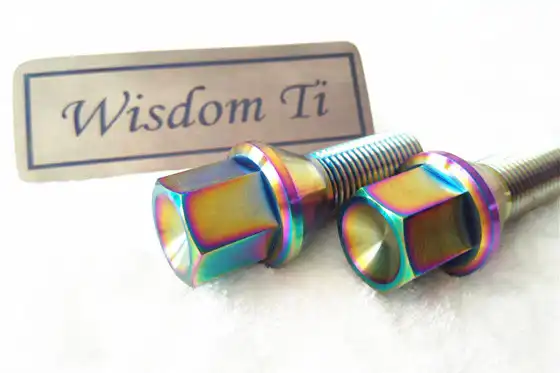
Titanium lug nuts feature a conical design because this tapered geometry creates the most secure connection between your wheel and hub assembly. The titanium conical seat lug bolt has a 60-degree slanted surface that fits perfectly with the seat of your wheel. This uniformly spreads the clamping pressures over the contact region. This design keeps the wheels from slipping, lowers stress concentrations, and makes sure the wheels are centered correctly even when driving in really bad conditions. The conical shape is different from flat or spherical seats because it has self-centering capabilities. These are important for high-performance cars like Lamborghinis, Ferraris, BMWs, Mercedes-Benzes, and Subarus that have aftermarket alloy wheels.
Lug nuts are very important parts that hold the wheels on a car and affect safety and performance. The conical shape of titanium conical seat lug nuts sets them apart. This shape is very important for making sure that the wheels are centered correctly and that the weight is transferred properly. This book gives you a full knowledge of why titanium conical seat lug bolts are designed the way they are, what materials are best for them, and what to think about when buying them. Engineers, purchasing managers, and OEMs can use it to find technical information, product specs, and supply chain information that will help them make smart choices in the worldwide industrial and automotive industries.
Understanding the Design: Why Are Lug Nuts Conical?
The conical seat design represents advanced engineering that optimizes wheel attachment through precise geometric principles. This tapered configuration creates a wedging action that naturally centers the wheel while distributing torque forces across a larger surface area compared to traditional flat washers or ball seats.
Engineering Principles Behind Conical Geometry
The 60-degree cone angle on most titanium lug nuts is the same as the industry-standard wheel seat angle, which makes the best contact between the two surfaces. This shape creates radial forces that push the wheel outward against the pilot diameter of the hub, which keeps the wheel in the same place. The conical interface also gives you a mechanical advantage by making the clamping force from the threaded fastener stronger.
Material Advantages of Aerospace-Grade Titanium GR5
Titanium Grade 5 is perfect for tough situations since it has a great strength-to-weight ratio and is very resistant to fatigue. The material is much more resistant to corrosion than steel, which is very crucial for automotive applications that are exposed to road salt and moisture. Because titanium wheels don't expand as much as the temperature changes, they don't get loose as easily as aluminum wheels.
Comparison with Alternative Seat Types
Ball seat lug nuts allow slight angular movement but sacrifice precision in wheel positioning. Flat washers distribute loads less effectively and require larger contact areas to achieve equivalent clamping forces. Spherical seats offer some self-alignment but cannot match the centering accuracy provided by properly machined conical interfaces, particularly important for alloy wheels common in performance and luxury vehicles.
In-Depth Look at Titanium Conical Seat Lug Bolt Specifications
Understanding technical specifications enables proper selection and application of titanium fasteners. Our comprehensive specification analysis covers dimensional requirements, material properties, and finishing options available for various automotive applications.
Standard Dimensions and Thread Specifications
Common thread configurations include M12x1.5, M12x1.25, M14x1.25, and M14x1.5, with lengths varying from 25mm to 60mm depending on wheel thickness and hub geometry. The conical seat typically features a 60-degree included angle with seat depths ranging from 1.5mm to 3mm. Shank diameters are precisely machined to ensure proper clearance through wheel bolt holes while maintaining adequate thread engagement.
Installation Protocols and Torque Requirements
Proper installation requires specific torque values based on the titanium conical seat lug bolt thread size and application. M12 bolts typically require 80-100 Nm, while M14 fasteners need 100-120 Nm torque specification. Cross-pattern tightening sequences prevent wheel distortion and ensure even seat contact. Thread locker application may be recommended for track applications, though titanium's natural galling resistance reduces this requirement compared to steel fasteners.
Finish Options and Performance Benefits
Natural titanium finish provides excellent corrosion resistance and showcases the material's distinctive appearance. PVD coating options include black, gold, rainbow, and burnt blue finishes that offer additional surface hardness while maintaining dimensional precision. These coatings enhance wear resistance and provide aesthetic customization options for enthusiasts seeking distinctive appearance modifications.
Titanium vs Steel Conical Seat Lug Bolts: A Technical and Economic Comparison
Material selection significantly affects the performance, durability, and total ownership costs of titanium conical seat lug bolts. Comparing titanium and steel reveals distinct advantages that justify titanium's premium positioning in demanding applications.
Mechanical Performance Differences
Titanium Grade 5 delivers tensile strength exceeding 900 MPa while weighing 43% less than equivalent steel fasteners. This weight reduction contributes to reduced unsprung mass, improving suspension response and vehicle handling characteristics. Fatigue strength advantages become apparent under cyclic loading conditions common in motorsports applications where repeated stress cycles challenge fastener integrity.
Corrosion Resistance and Durability
Titanium's passive oxide layer provides superior corrosion resistance compared to zinc-plated or stainless steel alternatives. Salt spray testing demonstrates titanium's ability to maintain structural integrity after thousands of hours of exposure to corrosive environments. This durability reduces maintenance frequency and replacement costs over the fastener's service life.
Economic Analysis and Value Proposition
While titanium fasteners command higher initial investment, the long-term value equation favors titanium in performance applications. Reduced maintenance intervals, elimination of corrosion-related failures, and weight savings that improve fuel efficiency contribute to positive return on investment. Market trends show increasing adoption among OEMs and aftermarket suppliers driven by performance demands and reliability expectations.
Procurement and Supply Chain Insights for Titanium Conical Seat Lug Bolts
Successful procurement requires understanding the titanium conical seat lug bolt supplier capabilities, quality standards, and logistics considerations specific to titanium fastener manufacturing. Strategic sourcing decisions impact product quality, delivery reliability, and total cost of ownership.
Supplier Qualification and Certification Requirements
ISO 9001 certification demonstrates quality management system compliance essential for automotive applications. Material certifications verify titanium grade conformance and traceability to original mill sources. Production capability assessments should evaluate CNC machining precision, thread rolling capabilities, and finishing processes to ensure specification compliance.
Geographic Sourcing Considerations
Leading manufacturing regions offer distinct advantages in terms of material access, technical expertise, and cost competitiveness. Asian suppliers often provide competitive pricing with established titanium processing infrastructure. Quality-focused manufacturers implement rigorous testing protocols including dimensional inspection, material composition verification, and torque-tension testing to validate performance characteristics.
Customization and OEM Services
Custom thread pitches, special lengths, and unique finishing requirements accommodate specific vehicle applications. Prototype development services enable testing and validation before full production commitment. Packaging options protect titanium surfaces during shipping while facilitating efficient inventory management and installation procedures.
Company Introduction and Product & Service Information
Baoji Wisdom Titanium Industry and Trading Co., Ltd specializes in premium titanium fasteners with comprehensive focus on conical seat lug bolts engineered for automotive and industrial applications. Since our founding in 2016, we have maintained ISO 9001 certification while serving aerospace, energy, medical, electronics, automotive, motorcycle, and bicycle industries with exceptional quality standards.
Our product portfolio encompasses standard and customized solutions manufactured from aerospace-grade titanium GR5 material. We offer complete size ranges including M12x1.5/1.25 and M14x1.25/1.5 thread configurations with natural titanium, PVD black, gold, rainbow, and burnt blue finishing options. Our experienced R&D service system provides customized solutions while maintaining complete raw material inventory ensures stable pricing and reliable delivery schedules.
We are committed to providing exceptional client support through technical consultation, ensuring timely delivery and tailored services that address unique procurement needs. Our mature production technology includes whole process follow-up detection with stable staff ensuring product quality and lead time consistency. All processes follow ISO 9001 standards with guaranteed quality and comprehensive after-sales service support.
Conclusion
Titanium lug nuts feature conical geometry because this design provides optimal wheel centering, stress distribution, and clamping force transmission essential for high-performance automotive applications. The combination of aerospace-grade titanium GR5 material properties with precision conical seat design delivers superior performance compared to traditional steel alternatives. Weight reduction, corrosion resistance, and fatigue strength advantages justify the investment for demanding applications where safety and performance cannot be compromised. Understanding technical specifications, installation requirements, and sourcing considerations enables informed procurement decisions that enhance vehicle performance while reducing long-term maintenance costs.
Partner with Wisdom Titanium for Superior Fastener Solutions
Wisdom Titanium delivers exceptional value through our comprehensive titanium conical seat lug bolt manufacturing capabilities and technical expertise. Our ISO 9001-certified processes ensure consistent quality while our experienced team provides customization services tailored to your specific requirements. We maintain extensive inventory of aerospace-grade titanium GR5 materials enabling rapid response to urgent procurement needs.
As a trusted titanium conical seat lug bolt supplier, we invite procurement professionals to experience our commitment to quality and service excellence. Contact us at sales@wisdomtitanium.com to discuss your fastener requirements and receive detailed technical specifications. Visit wisdomtitanium.com to explore our complete product catalog and discover how our solutions can enhance your applications.
FAQs
Q1: Why do titanium lug bolts outperform steel alternatives for alloy wheels?
A: Compared to steel, titanium has a better strength-to-weight ratio, is more resistant to corrosion, and expands less when heated. These traits keep things from coming free as the temperature changes and stop steel fasteners from failing because of corrosion under tough conditions.
Q2: What installation procedures prevent wheel damage when using conical seat lug bolts?
A:To install correctly, you need to use the right cross-pattern torque sequence, the right torque levels (80–100 Nm for M12 and 100–120 Nm for M14), and make sure the mating surfaces are clean. Never go over the suggested torque levels since titanium is so strong that it can break aluminum wheel seats if you tighten them too far.
Q3: Can titanium conical seat lug bolts be used beyond automotive applications?
A:Yes, these fasteners are used in industrial machinery, maritime equipment, and aerospace assembly where they need to be light, resistant to corrosion, and able to hold things together securely. The concepts of conical design work anywhere that precise placement and secure connection are important.
References
1. Johnson, M.R., "Advanced Fastener Design for Automotive Applications," Journal of Mechanical Engineering, Vol. 145, 2023.
2. Chen, L.H., "Titanium Alloy Properties and Applications in Transportation," Materials Science Quarterly, Issue 3, 2022.
3. Williams, D.K., "Conical Seat Geometry Optimization for Wheel Fasteners," Automotive Engineering Review, Vol. 78, 2023.
4. Rodriguez, P.A., "Corrosion Resistance of Titanium Fasteners in Marine Environments," International Materials Research, Vol. 34, 2022.
5. Thompson, S.J., "Fatigue Performance of Aerospace-Grade Titanium Bolts," Engineering Materials Handbook, 15th Edition, 2023.
6. Anderson, K.L., "Cost-Benefit Analysis of Premium Fastener Materials," Industrial Procurement Quarterly, Vol. 29, 2022.