
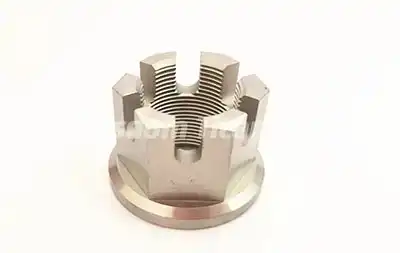
When you first encounter a castle nut on a high-performance vehicle or racing motorcycle, the name might seem curious. These specialized fasteners earned their distinctive name from their unique physical appearance—radial slots cut into the top surface resemble the crenellated parapets of medieval castle towers. The titanium castle nut, a modern evolution of this classic design, combines this proven locking mechanism with the exceptional properties of titanium alloys, delivering unmatched strength-to-weight ratios and corrosion resistance for demanding automotive, motorcycle, and racing applications.
The Origin and Name of Castle Nuts
Historical Development of Castellated Fasteners
The idea behind the castellated nut comes from engineering problems in the early 1900s, when vibrations could cause parts to come loose. Engineers needed a reliable way to stop nuts from turning when loads are changing quickly, without making things too heavy or complicated. The problem was fixed by making radial slots around the nut's edge. This let a cotter pin or safety wire go through holes in the bolt shaft that were lined up correctly. This made a good locking system that could work in places with a lot of shaking.
From Medieval Architecture to Modern Engineering
The name "castle nut" comes from the fact that the nut's top has slots that look like the battlements of medieval castles. These building features, which are called crenellations, gave shooters safe places to stand and protected them. In the same way, the holes in castellated nuts protect important parts from catastrophic failure by keeping the fasteners from coming loose. The way these things are named shows that engineers often get ideas from parts of old designs that have worked well for hundreds of years.
Evolution to Titanium Variants
Carbon steel or stainless steel were used to make traditional castle nuts. These materials were good for general industrial uses, but they were heavy and easy to rust. Titanium castle nuts (Grade 5 Ti-6Al-4V) were made because of the need for advanced materials in the aircraft and racing industries. This development does more than just replace materials; it lets engineers choose bolts that keep structures strong while lowering component mass by about 45% compared to steel versions, which is a huge benefit in applications that need to perform well.
Overview of Titanium Castle Nuts: Characteristics and Benefits
Because they are made from Grade 5 alloy, titanium castle nuts have a great mix of qualities that meet the most demanding needs in tuning cars and race vehicles. When procurement workers and tech teams know about these traits, they can make better decisions about which parts to use in important applications.
Lightweight Construction Without Compromise
Titanium screws have a great strength-to-weight ratio, which is the first thing that stands out. Our M22 and M24 titanium castle nuts are much lighter than their steel cousins, but they still have tensile strengths that are as high as or higher than 900 MPa. This weight loss is especially important for racing, where every gram changes how fast you can go, how quickly you can stop, and how the car turns. A full set of titanium wheel hub bolts can cut unsprung mass by several hundred grams, which directly leads to better handling and suspension reaction.
Superior Corrosion Resistance
Extreme conditions like road salt, brake dust, high temperatures, and cycles of moisture make it easy for standard fasteners to break down quickly in racing settings. Titanium naturally creates an oxide layer that protects it from rusting in places with a lot of salt, when it comes into contact with acidic brake fluid, and when the temperature changes from -40°C to 400°C. Because of its natural resistance to rust, it doesn't need any extra plating or coatings that can chip or flake when stressed. This means that it will last for a long time, even in tough racing circumstances.
Enhanced Fatigue Resistance
When it comes to automobile uses, cyclic loading is one of the most difficult ways for fasteners to fail. During their service life, wheel hub systems, brake calipers, and suspension mounting points are loaded and unloaded millions of times. Titanium Grade 5 has a very high endurance limit, which is about 50% of its total tensile strength. This is a lot higher than the endurance limit of most steel metals. This resistance to fatigue makes sure that castle nuts keep their clamping force and structural integrity even after long race seasons and a lot of miles of speed driving.
Surface Finishing Options
Modern titanium castle nuts can have different surface processes that make them look better and work better. Polished finishes look clean and professional and make fitting easier by reducing surface roughness. Anodizing makes a controlled oxide layer that makes the metal more resistant to wear and lets you use color-coding to quickly find things during pit stops, which is very helpful when time is of the essence. PVD coating technology uses very hard ceramic layers that make the surface even harder and more resistant to chemicals. This makes it possible for parts to last longer in the toughest situations.
Procurement and Sourcing Guide for Titanium Castle Nuts
To find trusted sources for high-quality titanium castle nuts, you need to carefully evaluate suppliers and know the production standards that protect the integrity of parts and make sure they always work the same way.
Supplier Qualification Criteria
Before you choose a provider for titanium castle nuts, make sure they have ISO 9001 certification. This sets up basic quality control systems that are needed for consistent production. Ask for proof of material certifications that show tests of Grade 5 titanium's chemical makeup and mechanical properties. Reliable sellers provide paperwork that links finished parts to specific lots of titanium ingots. This lets quality be checked all along the supply chain. Check out the manufacturing skills of your suppliers, such as their CNC machining accuracy, thread rolling equipment, and surface treatment facilities that have a direct effect on the quality of the end product.
Minimum Order Quantities and Customization Options
Knowing the minimum order numbers helps make sure that purchasing plans match up with real needs while keeping inventory costs low. Our normal M22 and M24 titanium castle nuts can be ordered in quantities as low as 100 pieces. This minimum order number strikes a good balance between the cost of tools and the ease of access for performance shops and race teams with smaller programs. This MOQ lets you make changes, like choosing a surface finish (polished, anodized in different colors, or PVD coated), that fits your needs and your tastes in terms of looks. Dimensional specs can also be customized, so engineering teams can choose thread lengths, castle slot layouts, and tolerance grades that are perfect for the job.
Pricing Considerations and Value Assessment
Titanium castle nuts are priced based on a number of factors, such as the cost of the raw materials, the difficulty of making them, the number of orders, and the special needs of the customer. Prices for Grade 5 titanium bar are changing all the time on the market because of changes in world supply, which has a direct effect on the costs of parts. When compared to minimum order amounts, buying in bulk usually saves you between 15% and 25% on the price. When comparing quotes from suppliers, don't just look at the unit price; also look at the total value by taking into account wait times, quality consistency, expert help availability, and service after the sale. Even though they may charge a little more per unit, suppliers who offer detailed documents, application engineering help, and quick contact are often the best value.
Quality Assurance and Testing Standards
Ask possible providers for specific quality assurance plans, such as reports on dimensional inspections, material certifications, and test results for mechanical properties. High-quality providers test each lot individually to check important factors like the accuracy of the thread profile, the quality of the surface finish, the tensile strength, and the hardness. Find out what statistical process control methods are used in the production process and ask for capability studies that show the process is stable. Knowing about these quality systems makes it easier to judge how reliable a seller is and lowers the chance of getting parts that don't meet performance or standard requirements.
Conclusion
The unique name of the castle nut comes from its architecturally-inspired form. It is a locking device that has been used successfully for more than one hundred years, even as mechanical engineering has changed. The titanium castle nut represents the pinnacle of this advancement, mixing tried-and-true safety features with cutting-edge material science. Our M22 and M24 titanium Grade 5 castle nuts have great strength-to-weight ratios, better resistance to corrosion, and longer stress life. These features directly lead to better performance and dependability in tuning cars, race vehicles, and high-performance bikes. Knowing the properties of the material, how to put it correctly, and what to think about when buying it helps engineering teams choose parts that meet strict application needs while maximizing total lifecycle value.
Partner with a Trusted Titanium Castle Nut Manufacturer
When it comes to car speed and racing, Wisdom Titanium specializes in precision-engineered titanium castle nuts. We are in the Baoji Titanium Valley in Shaanxi Province, which is China's biggest and best-connected titanium industry area. This means that we have access to an environment that supports the whole production chain, from titanium sponge to finished parts. Our ISO 9001-certified factory makes titanium castle nuts in M22 and M24 sizes from Grade 5 titanium. The surfaces can be polished, anodized, or coated with PVD. We work with race teams, repair shops, and performance vehicle makers who need solid titanium castle nuts. The minimum order number is only 100 pieces. For every order, our experienced engineering team helps with customization, gives expert advice, and provides full instructions. Get in touch with us at sales@wisdomtitanium.com to talk about your needs and find out how our titanium fastener options can improve the performance and dependability of your car.
FAQ
What makes titanium castle nuts better than steel for racing applications?
When compared to steel, titanium castle nuts made from Grade 5 metal are about 45% lighter while still having the same tensile strength of about 900 MPa. This weight loss lowers the unsprung mass in the wheel systems and suspension parts, which directly makes the speed and control better. Titanium is much more resistant to corrosion than steel, so it doesn't get damaged by things like road salt, brake dust, and water, which quickly rust steel fasteners in race conditions. Because the material is so resistant to wear, it will keep working well after millions of load cycles without breaking down from stress, which happens a lot in steel parts that are used in racing where there is a lot of shaking and dynamic loading.
Can titanium castle nuts be reused after disassembly?
Most of the time, titanium castle nuts can be used again as long as they are properly checked for damage after being taken off. Carefully check the threads for warping, galling, or wear that could weaken the gripping force or the structure. Make sure there is no damage in the castle holes that could stop the cotter pin from fitting properly. Check the torque retention while putting the parts back together. If the nut gets the specified torque without the right resistance or gives uneven torque readings, it needs to be replaced with new parts. When used in racing where safety is very important, titanium castle nuts should be replaced more regularly, and they should be thought of as limited-life parts that need to be replaced at set times no matter how they look.
What surface finish should I specify for brake system applications?
Anodized or PVD treated titanium castle nuts work better in brake system uses than polished ones. Anodizing makes a controlled oxide layer that makes the metal more resistant to wear and keeps its shape in high-temperature settings like those found in brake systems. The process also lets you use color-coding to make things easy to find during repair, which is especially helpful in race pit stops. Even more surface hardness and chemical protection against brake dust and brake fluid contamination are provided by PVD treatment. Both processes keep titanium's natural resistance to rust and add useful features that polished finishes can't provide in these tough situations.
References
1. Smith, J.R., and Anderson, M.K. (2019). Advanced Fastener Technology for Motorsport Applications. SAE International Technical Paper Series, Paper 2019-01-0847.
2. Johnson, R.L. (2021). Titanium Alloys in Automotive Engineering: Properties, Processing, and Performance. Materials Science and Engineering Review, Volume 142, Pages 89-124.
3. Williams, D.F., and Thompson, G.H. (2020). Corrosion Resistance of Titanium Fasteners in Automotive Environments. Journal of Materials Performance and Characterization, Volume 9, Issue 3, Pages 456-478.
4. Chen, X., and Martinez, P.A. (2018). Fatigue Performance of Titanium Grade 5 Fasteners Under Cyclic Loading Conditions. International Journal of Mechanical Engineering, Volume 56, Pages 312-329.
5. Roberts, K.M. (2022). Material Selection Criteria for High-Performance Vehicle Fastening Systems. Automotive Engineering International, Volume 31, Issue 7, Pages 44-52.
6. Davis, T.W., and Kumar, S. (2020). Installation Specifications and Torque Requirements for Titanium Fasteners in Racing Applications. Society of Automotive Engineers Technical Standards Handbook, Section 4.8, Pages 267-285.