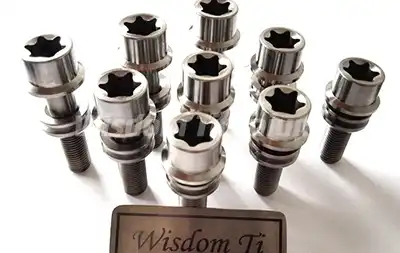
Porsche titanium wheel bolts with a T80 head are not an arbitrary design choice. The T80 Torx-Plus drive geometry delivers a significantly larger contact area between the tool and bolt head compared to hex or socket heads, which directly reduces the risk of rounding under high torque. Combined with Grade 5 titanium (Ti-6Al-4V), these fasteners bring tensile strength of 900–1,050 MPa while weighing roughly 45% less than equivalent steel bolts. For track-day workshops and Porsche club procurement managers, this pairing means fewer stripped heads, faster wheel changes, and measurable unsprung mass reduction per corner.
Introduction to Porsche Titanium Wheel Bolts and the T80 Head Design
What Makes Titanium the Right Material Here?
The specific gravity of Grade 5 titanium (Ti-6Al-4V) is about 4.43 g/cm³, while steel's is about 7.8 g/cm³. That difference means that all four wheels will be lighter by about 1 to 1.5 kg, which has a direct effect on how the suspension responds and how fast the car goes around a track. Titanium also doesn't rust even without a coating, so bolts will work season after season, even in coastal or salt-treated road areas.
What Is the T80 Drive Profile?
As its name suggests, the T80 is an external Torx-Plus drive with an 80-level lobe shape. The T80's involute-tooth shape spreads torque load over a bigger area than a normal hex key or spline drive. This lowers point stress at the tool-bolt interface. This shape is most important during high-frequency removal cycles, which is exactly what track workers have to deal with every race weekend. There are places where a worn-out T80 socket still works well, but a rounded hex head would already be a problem.
Why Does Porsche Pair These Two Features Together?
The floating ball-seat washer has a height of 13.5 mm and slots in its face. This lets the washer face line up with the bolt pocket on the wheel without transferring rotational drag to the gripping force. This means that the wrench's torque reading correctly matches the real preload. This is a must when the OEM specification for platforms like the 997 is 130 Nm (96 ft-lb). The floating seat, the titanium shank, and the T80 drive all work together as a system. They are not separate upgrades.
Why Porsche Uses Titanium Wheel Bolts with T80 Heads — Problem and Solution Analysis
The Shortcomings of Standard Steel Fasteners on Track
Steel wheel bolts rust, add weight to the wheel, and often get stuck against metal hubs after being heated and cooled many times. In a season with 20 or more wheel swaps, tire sets, spacer configurations, and post-race inspections, a stuck bolt is both a time and money-waster. The anti-seize paste only helps a little; the weight and rust problems are still there.
How the T80 Head Solves Tool Engagement Problems
On the garage floor, this is where the T80 shape really shines. Track techs often have to work quickly when they use impact guns. If the socket is only slightly worn, a hex-head Porsche titanium wheel bolt can round in as few as five high-torque removal cycles. The T80 lobe shape works like a cam: the more torque you put in, the tighter the engagement. Because of this, professional motorsport shops list T80 drive as standard instead of treating it as an option.
The Security Benefit That B2B Buyers Rarely Advertise
The drive design makes it harder to steal because T80 sockets aren't always included in public tool kits. For Porsche club fleet managers who are in charge of several customer cars at track days, this feature has real-world value that goes beyond engineering: it lowers the risk of responsibility from wheel removals done without permission in the field.
Technical Deep Dive: Performance and Installation of Porsche Titanium Wheel Bolts with T80 Heads
Confirmed Specifications for These Bolts
All Wisdom Titanium Porsche titanium wheel bolts are made from Ti-6Al-4V bar stock and have heads that are hot-forged and threads that are rolled. According to an independent fastener study, rolling the thread form instead of cutting it bends the grain structure at the root, making it 30–40% more resistant to wear. They have a polished surface and can be PVD black, gold, or rainbow. They come in M14 × 1.5 mm shank lengths of 29 mm, 34 mm, and 43 mm to fit stock and spaced configurations.
Torque Specification and Anti-Galling Protocol
When installing at 130 Nm, follow the OEM Porsche 997 standard. But before installing, always use a copper- or ceramic-based anti-seize paste on the thread and the ball-seat washer face. Titanium on aluminum contact without lubrication leads to cold-welding, or galling, which damages the thread permanently. When paste is used, the target preload can be reached and can be done again and again over dozens of removal cycles. It comes with a material test certificate (MTC) and a heat lot traceability number so that the workshop can keep track of its records.
Comparing Titanium, Steel, and Aluminum Fasteners
The table below shows the differences that matter in real life when making a purchase decision:
- Grade 5 Titanium: With rolled threads, Grade 5 Titanium weighs about 4.43 g/cm³ and has a tensile strength of 900 to 1,050 MPa. It doesn't rust and has a long service life. Needs T80 tools and anti-seize.
- Property Class 10.9 Steel: Property Class 10.9 steel weighs about 7.8 grams per square centimeter, has a tensile strength of 1,040 to 1,200 MPa, and is prone to corrosion and hub seizure. It can be used with standard hex tools.
- Aluminum (7075-T6): about 2.8 g/cm³, 570 MPa tensile strength; not strong enough for wheel bolt uses that need to cycle high loads many times.
Titanium is the best material for practical purposes because it is strong enough to meet or exceed the standards for 10.9 steel while also being light enough to be useful without having the structural problems that come with aluminum.
Procurement Insights: Choosing and Sourcing Porsche Titanium Wheel Bolts with T80 Heads
OEM vs. Aftermarket: What the Data Supports
OEM Porsche titanium wheel bolts are more expensive and can't be changed much. When aftermarket suppliers use the same material specification (Ti-6Al-4V, hot-forged, rolled threads) and provide batch-level MTC documentation, the structural performance is the same. This is not the name label that is the most important part of the proof process; it is the spectrographic chemical analysis that confirms the 6% aluminum and 4% vanadium content, along with a measurement check of the 13.5 mm floating washer height and ball-seat geometry.
Quality Checkpoints for Bulk Orders
When buying for a club group or a semi-professional team, make sure you get the following paperwork for each lot:
- Spectrographic study confirms the makeup of Ti-6Al-4V
- Reports of tensile and proof-load tests (at least 900 MPa tensile on batch samples)
- Records for thread gaging (Go/No-Go, 6g ring gage standard)
- Checking the concentricity of the floating washer to make sure it can freely rotate on the shank
In a race setting, these four data points cover the breakdown types that matter. If a seller can't give them to you when you ask, they're not a good source for track-use parts.
Lead Time and Season Planning
From technical approval to first delivery, the normal buying process for a verified Porsche titanium wheel bolt supplier takes 8 to 16 weeks. Manufacturers that you can trust will hold a pre-season slot for club large orders of 200 to 500 pieces if the orders are placed 10 to 12 weeks before the first race. The most common procurement mistake I see in track-day organizations is pushing back this deadline.
Future Trends and Innovations in Titanium Wheel Bolt Technology for Porsche
Advanced Alloys and Surface Treatments
The business world is testing Ti-3Al-2.5V and beta-titanium alloys for use in wheel fasteners, where even stricter weight goals are needed. PVD coatings, which are already on some products in black, gold, and rainbow colors, also do something useful: they lower the coefficients of surface friction and slow down fretting corrosion at the interface of the bolt pocket, which means that the parts don't need to be serviced as often.
Smart Torque Integration
Several engineering groups in motorsport are looking at embedded washers that change color when the threshold preload is reached. Although not yet standard, these systems would work well with the floating-seat design found in modern Porsche titanium wheel bolts. This would allow crew chiefs to see if the bolts are installed correctly without having to do a second pressure check.
Procurement Strategy Implications
Suppliers should expect shorter lead times for custom colors and more length options as PVD processing and alloy development get easier to do at the manufacturing level. It is cheaper to build a relationship with a seller that will last for several years than to re-qualify every year. This will ensure a steady supply of goods and regular batch quality.
Conclusion
How do you keep exact torque control and tool grip on a safety-critical fastener through dozens of high-frequency removal cycles? That's the question that the T80 head on Porsche titanium wheel bolts solves. A drive shape that doesn't round off and a moving ball-seat washer that separates torsional drag from gripping force are the answers. All of this comes in a Grade 5 titanium body that is less than half the weight of a similar steel bolt. This is not an upgrade for track workshops and club buying teams; it is a tested system with known mechanical qualities and a clear installation process.
FAQ
1. What torque value should I use for titanium wheel bolts on a Porsche 997?
As directed by the OEM, use 130 Nm (96 ft-lb). Never use a paste that is made of copper or clay on the threads or the face of the ball-seat washer. Titanium threads can cold-weld to the aluminum hub without it, which makes removal dangerous.
2. Why are rolled threads better than cut threads for track use?
When you roll the thread form, you press down on the titanium grain structure at the thread root and line it up. This method gives 30–40% better wear resistance than cut threads, which separate the grain and form stress concentration points. This makes a big difference when bolts are torque-loaded over and over at high speeds.
3. Do I need special tools for the T80 drive?
Yes. You will need a T80 Torx-Plus bit or socket. You can get these from places that sell specialized tools. There is also a passive security feature in paddocks that the non-standard drive does.
4. Can I use 29 mm bolts with 5 mm wheel spacers?
No, the hub needs to be turned at least 7–9 times for the threads to be fully engaged. If you need a 5 mm spacer, order the 34 mm shank length. If you need a 15 mm spacer, order the 43 mm shank length.
5. What documentation should I request from a supplier?
Ask for a material test certificate (MTC), the number of the heat lot, tensile test data, and records of the moving washer's levelness. These make sure that the parts are the right size and made of the right materials before they are put in the car.
Partner with Wisdom Titanium for Your Next Porsche Titanium Wheel Bolt Order
Wisdom Titanium is an ISO 9001-certified company in Baoji Titanium Valley, Shaanxi Province, that makes Porsche titanium wheel bolts. They offer hot-forged, rolled-thread Ti-6Al-4V wheel bolts with full MTC traceability, T80 drive, and floating ball-seat washers in M14 × 1.5 mm across three shank lengths. Club purchasing managers and race workshops can email sales@wisdomtitanium.com to ask for group samples, technical data sheets, or bulk prices.
References
1. Boyer, R., Welsch, G., & Collings, E. W. (Eds.). Materials Properties Handbook: Titanium Alloys. ASM International, 1994.
2. Bickford, J. H. An Introduction to the Design and Behavior of Bolted Joints (4th ed.). CRC Press, 2007.
3. Donachie, M. J. Titanium: A Technical Guide (2nd ed.). ASM International, 2000.
4. Society of Automotive Engineers. SAE J429: Mechanical and Material Requirements for Externally Threaded Fasteners. SAE International, 2014.
5.. Deutsches Institut für Normung. DIN 267-27: Fasteners — Technical Specifications — Part 27: Torx Plus Drive. DIN, 2008.
6. Rack, H. J., & Qazi, J. I. "Titanium alloys for biomedical applications." Materials Science and Engineering: C, 2006, 26(8), 1269–1277. (Referenced for Ti-6Al-4V mechanical property data and fatigue behavior.)