
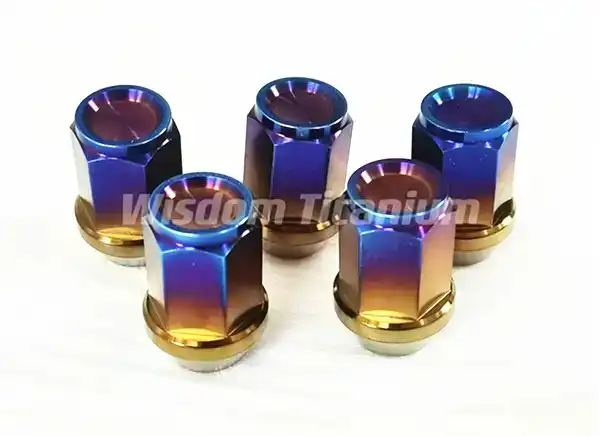
Burnt titanium lug nuts are made from Titanium Grade 5 (Ti-6Al-4V) and have a unique burnt finish that is achieved through controlled heat treatment. They are hex-shaped and closed at the ends, so they can be used with tuning cars and forged wheel assemblies.
Understanding Burnt Titanium Lug Nuts and Their Sizes
Material Composition and Heat Treatment Process
Burnt titanium lug nuts are created differently from anodized or normal titanium ones because controlled thermal oxidation provides a passive titanium dioxide layer that resists heat better than surface coatings. Titanium has a yield strength of over 880 MPa and an ultimate tensile strength of over 950 MPa, similar to Class 10.9 hardened steel. Its low thermal conductivity prevents heat from moving from brake rotors to wheel bearings when driving aggressively, and its naturally occurring oxide layer provides corrosion resistance.
Critical Sizing Metrics for Procurement Specifications
Thread diameter and pitch are the most important sizes for fitting into vehicle hub assemblies. Most of Europe and Asia use metric measurements, but North America still uses imperial measurements, especially for classic muscle cars and light-duty trucks. The type of seat—conical (60-degree taper), ball, or spline drive—affects how clamping force is spread across the wheel mounting surface, which affects installation torque and performance. Procurement professionals must compare these specs to OEM fitment data or aftermarket wheel manufacturer guidelines to avoid costly mistakes when working with global markets or managing a fleet of vehicles. The hex size (wrench engagement surface) is usually 17mm, 19mm, or 21mm to match standard automotive tool sets.
Comparing Burnt Titanium Lug Nut Sizes With Other Types
Material Performance Differences
Steel lug nuts are cheap and easy to find, but they make the car heavier and harder to move. A full set of steel fasteners adds 1.5 to 2 kg of unsprung rotational mass compared to titanium equivalents, which affects suspension response and speed. Steel rusts, especially in harsh climates where road chemicals accelerate oxidation. Aluminium alloy lug nuts are lighter than titanium, but their tensile strength ratings are 60–70% lower than Grade 5 titanium, which is a problem for high-torque applications or vehicles with track-level lateral loads. Chrome-plated brass or steel nuts look nice, but the coating can easily come off and rust the base metal. The burnt titanium lug nuts finish requires no maintenance while developing a stable patina.
Sizing Standard Variations
Different thread pitch standards set by JIS (Japanese Industrial Standards), DIN (German standards), and SAE (Society of Automotive Engineers) make it difficult to find the right parts. Japanese cars made before 2000 may have M12x1.5 thread pitches instead of M12x1.25, so check factory service records. In Europe, manufacturers must meet DIN 934 thread form accuracy standards. To keep wheels in place safely, procurement professionals should ask for thread gauge certifications and material test reports from new suppliers, especially when switching from steel to titanium fasteners. A 40% weight difference may not seem like much for a single part, but it lowers unsprung mass by about 0.8 kg over a 20-lug installation, which is big for performance.
How to Choose the Right Size Burnt Titanium Lug Nuts for Your Fleet or Project?
Vehicle Specification Analysis
Read your car's paperwork before choosing a lug nut size. OEM service manuals list the thread size, seat type, torque requirements, and minimum thread engagement requirements that manufacturers came up with after a lot of testing. Aftermarket wheels may specify different seat styles than OEM assemblies, so you may need transitional seamed lug nuts. Grade 5 titanium has the same or higher shear strength as Class 10.9 steel, but you still need to use the right amount of torque to get the clamping force. If you use too little torque, the wheel could come off when loaded, and if you use too much torque, the threads may be damaged.
Environmental and Operational Factors
Titanium doesn't rust, making it ideal for marine environments, winter road treatments, and chemically-rich industrial environments. When titanium dioxide is exposed to oxygen, it forms a stable layer on the surface that protects the metal permanently without heavy coatings or treatments. Titanium's low heat conductivity acts as a thermal barrier, preventing heat transfer from brake rotors to bearing assemblies through wheel hubs, ensuring constant bearing preload in high-performance applications exceeding 600°C. Burnt titanium lug nuts are therefore ideal for these demanding operational factors.
Supplier Collaboration and Sample Verification
Technically supported manufacturers like Wisdom Titanium provide sample kits with different thread sizes and seat configurations so you can try them before ordering a lot. This is especially helpful when working with aftermarket wheel assemblies where the manufacturer's specs aren't always clear or complete. Writing down the baseline torque values for new fasteners sets maintenance goals, since titanium's anti-galling properties mean that properly installed nuts will keep their removal torque constant over time. Making these rules before buying a lot of them saves money on mistakes and builds institutional know-how.
Procurement and Ordering Considerations for Burnt Titanium Lug Nut Sizes
Minimum Order Quantities and Pricing Structures
Small modification shops that serve niche markets and OEM suppliers that handle multiple vehicle platforms can order burnt titanium lug nuts with a minimum of 200 pieces. Bulk pricing structures usually offer graduated discounts at 500- and 1,000-piece thresholds, encouraging larger commitments that improve supply chain efficiency. Buyers should consider longer service life, fewer corrosion replacements, and fewer fastener failure warranty claims. When comparing quotes from different suppliers, make sure the prices include material certifications, dimensional inspection reports, and torque specification documentation.
Lead Time Management and Logistics
If there is enough raw material, standard-sized burnt titanium lug nuts can ship in two to three weeks after an order is confirmed. If you have specific needs, it can take four to six weeks due to materials, CNC machining, heat treatment cycles, and final inspection. International shipping requires clearing customs, labelling materials correctly, and packaging to avoid damage. Sending multiple SKUs at once can save freight costs, especially for people who need to track a lot of fastener stocks for industry or vehicles.
Quality Assurance and Supplier Vetting
Wisdom Titanium is in Baoji, Shaanxi Province, China's best titanium industry cluster, so it has access to vertically integrated supply chains. Aerospace-grade titanium part manufacturers must be ISO 9001 certified. If you ask new suppliers for first-article inspection reports or changes to specifications before full production begins, you can be sure the products meet the drawing's requirements. These reports should include spectrometer results for material composition analysis, thread gauge and micrometre measurements for dimensions, and surface finish verification. Being clear about what you accept as material and how it should be inspected keeps low-quality materials out of your supply chain.
Conclusion
Burnt titanium lug nuts with M12x1.25, M14x1.5, and 1/2"-20 thread sizes can assist tuners, racers, and OEM part users accelerate faster. Despite being 40–45% lighter, they won't rust and are constructed of stronger steel. It makes them ideal for hard labour. Buyers must combine technical demands with vendor capabilities and pricing. They should remember that the correct size influences automobile safety and maintenance expenses. ISO 9001-approved companies provide quality and experienced assistance throughout the process. Due to the 200-piece minimum order, many clients can buy. This keeps production costs low enough to compete with high-end steels.
Partner With Wisdom Titanium for Premium Burnt Titanium Lug Nut Solutions
Buying managers should trust Wisdom Titanium for burnt titanium lug nuts. The Baoji Titanium Valley in Shaanxi Province is China's largest titanium business location. Our production procedures are ISO 9001-certified, and our supplier chains are vertically integrated. Thus, our products are of the same excellent quality whether ordered in bulk or individually. Our specialists will recommend thread size, pressure, and material according to your demands, supported by all the paperwork needed to track and size items. We collaborate with motorsport teams, OEM manufacturers, and automobile tuners worldwide. Email sales@wisdomtitanium.com for pricing, material approvals, and sample kits.
FAQ
How Do I Measure Existing Lug Nuts for Replacement?
A thread pitch measure shows how many threads are in an inch or millimetre. Find the thread point average width using a precise measuring tool. Check the seat where the wheels touch to identify its kind; a ball seat has a bend while a conical seat has a 60-degree curve. Matching these parameters ensures the proper burnt titanium lug nuts will be picked.
Will Burnt Titanium Lug Nuts Work With Steel Wheel Studs?
Grade 5 titanium works nicely with steel studs if oiled. Rub threads with copper or nickel-based anti-seize powder before installing studs to prevent galling. Galling is a heatless welding method that can occur between dissimilar metals. This safety feature makes it easy to remove and repair the item and maintains the thread robust after several installations.
Can I Order Custom Thread Sizes for Industrial Equipment?
Wisdom Titanium needs technical drawings of thread form, seat geometry, and dimensional tolerances to create parts to your specifications. New tools increase lead times by 4–6 weeks, and the minimum order number may vary. Technical assistance improves designs for specific conditions and loads, ensuring the unique screws work for specialized applications.
References
1. American Society for Testing and Materials. (2021). ASTM B348: Standard Specification for Titanium and Titanium Alloy Bars and Billets. ASTM International.
2. Donachie, M. J. (2000). Titanium: A Technical Guide (2nd ed.). ASM International.
3. Society of Automotive Engineers. (2019). SAE J1701: Fastener Part Standard - Wheel Nuts. SAE Technical Standards Board.
4. Lutjering, G., & Williams, J. C. (2007). Engineering Materials and Processes: Titanium (2nd ed.). Springer-Verlag Berlin Heidelberg.
5. Boyer, R., Welsch, G., & Collings, E. W. (1994). Materials Properties Handbook: Titanium Alloys. ASM International.
6. International Organization for Standardization. (2017). ISO 898-1: Mechanical Properties of Fasteners Made of Carbon Steel and Alloy Steel - Part 1: Bolts, Screws and Studs. ISO Standards Catalogue.