
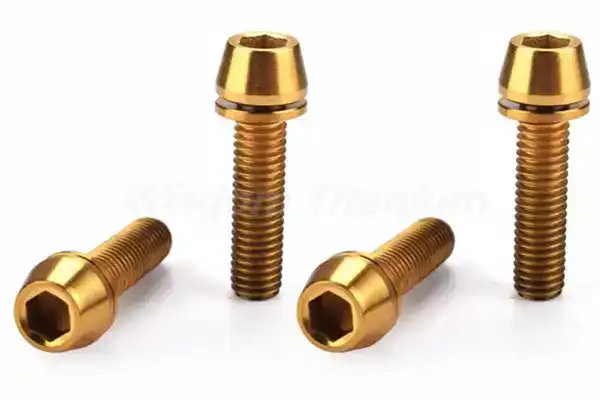
Cycling enthusiasts understand that every gram matters. For competitive riders and dedicated hobbyists alike, reducing weight without sacrificing strength has become something of an obsession. Road bike titanium bolts represent one of the most effective upgrades available today.
Why Titanium Bolts for Road Bikes?
Choosing the right materials is what makes high-end bicycle parts work well. For decades, steel bolts have been used in the industry because they are strong enough and cheap enough. Alternatives to aluminum are lighter, but they may not be as strong when put under stress. Road bike titanium bolt is special because it has the best strength-to-weight ratios of any metal, better than steel or aluminum.
Ti-6Al-4V, often known as Grade 5 titanium alloy, is made up of about 6% aluminum and 4% vanadium. This mix makes a material with a tensile strength of over 900 MPa and a density of only 4.43 g/cm³. When you compare this to stainless steel, which weighs 7.9 g/cm³, the weight difference is evident. A whole titanium bolt kit for a road bike usually weighs 50 to 80 grams less than steel ones. That's the weight that cyclists would have to carry up every hill.
Vibration damping is a benefit that doesn't get talked about as often. Road bike titanium bolt absorbs road vibrations better than steel or aluminum because it naturally dampens them. Changing just one bolt doesn't make much of a difference, but changing all the fasteners on the frame, seatpost, handlebars, and other parts makes the ride noticeably smoother. Professional teams have written down this benefit in situations where they couldn't see what they were doing.
Why Source Titanium Bolts from China?
Global titanium production centers in just a few regions worldwide. Russia, Japan, and the United States maintain significant operations, but China has emerged as the undisputed leader in both volume and technological capability. The country produces approximately 60% of global titanium sponge—the primary raw material for all titanium products—according to 2023 industry data from the International Titanium Association.
Baoji Titanium Valley in Shaanxi Province represents China's most concentrated titanium manufacturing ecosystem. This industrial cluster hosts hundreds of specialized enterprises covering every production stage: from sponge reduction through ingot casting, bar rolling, precision machining, and surface treatment. Few global locations offer comparable vertical integration. When you work with a Baoji-based supplier, the entire supply chain often exists within a 50-kilometer radius.
This geographical concentration creates meaningful advantages. Transportation costs between production stages remain minimal. Quality control becomes more manageable when suppliers can personally visit their raw material providers. Technical collaboration happens faster when engineering teams can meet face-to-face rather than coordinating across continents and time zones.
China's titanium industry benefits from substantial government investment in research infrastructure. The Baoji region houses multiple national-level research institutes dedicated to titanium metallurgy and processing technology. These institutions collaborate closely with manufacturers, accelerating the translation of laboratory innovations into production capabilities. Advanced techniques like precision cold forming and electron beam welding have moved from experimental to standard practice more quickly here than in many Western facilities.
Cost advantages remain significant, though the gap has narrowed as Chinese manufacturing matures. A Grade 5 titanium bolt from a reputable Baoji manufacturer typically costs 30-40% less than equivalent Japanese or American products. This pricing reflects lower labor costs, economies of scale, and streamlined supply chains rather than compromised quality. Established Chinese titanium suppliers now maintain ISO 9001 certification, implement rigorous testing protocols, and utilize CNC machining centers from the same German and Japanese manufacturers that Western competitors use.
Production capacity provides another compelling reason. A mid-sized Chinese titanium fastener specialist can typically handle orders from 200 pieces to 100,000 pieces without significant lead time extensions. This scalability matters whether you're a boutique bike shop ordering custom batches or a major manufacturer requiring consistent supply for production lines. The flexibility to start with smaller trial orders and scale up as relationships develop reduces risk for new B2B partnerships.
Customization capabilities have expanded dramatically in recent years. Chinese road bike titanium bolt manufacturers increasingly offer services beyond basic machining: laser etching for logos and specifications, custom anodizing in brand-specific colors, specialized head styles for unique applications, and even proprietary thread designs. These value-added services often come with minimal or no setup fees, particularly for orders exceeding modest volume thresholds like 200 pieces per specification.
Key Factors B2B Buyers Should Evaluate Before Purchasing
The basis of quality assurance is checking the materials. Not all titanium is the same, and some dishonest providers use inferior qualities to make more money. Grade 5 titanium (Ti-6Al-4V) is the best choice for bike parts because it has the best combination of strength, weight, and ease of use. However, Grade 2 commercially pure titanium is much cheaper. Ask your supplier for material certificates that list the actual alloy composition, and for large orders, make sure you get testing reports from a third party.
Reputable road bike titanium bolt manufacturers work with certified testing labs and are happy to give you proof of this. In China, you might look for reports from the Northwest Institute for Nonferrous Metal Research or other accredited agencies that show they are certified. These papers should show the chemical makeup, yield strength, tensile strength, and elongation percentages. If a supplier is hesitant or makes excuses about giving you material certifications, that's a bad sign.
The quality of the final road bike titanium bolt is directly affected by the manufacturing process. CNC machining is the best way to make precise fasteners. Computer-controlled mills and lathes can get tolerances down to microns, which makes sure that the thread engagement, head dimensions, and overall geometry are all exactly right. Find out what kind of equipment potential providers have. Companies who use Haas, DMG Mori, or other well-known CNC brands show that they are very serious about doing precise work.
There is a big difference in how well fasteners work when they are rolled or sliced. Rolled threads are stronger and more resistant to fatigue because they move material around instead of taking it away. The cold working method lines up the metal grain structure with the thread profile, getting rid of the cut grain boundaries that are where cracks start. Manufacturers who care about quality buy thread rolling machines, even though they cost more, because the rewards in terms of performance make the investment worth it.
You need to think carefully about your surface treatment options based on how you want to use them. Raw titanium is very resistant to corrosion, but anodizing makes it even better. Type II anodizing makes colors that look nice and adds very little thickness, usually only 0.5–1.5 microns. Type III hard anodizing makes a thicker oxide layer that makes the surface harder and more resistant to wear. However, it is not often used on bicycle fasteners because it costs more. Make sure you know exactly what kind of anodizing your supplier does and if they do it in-house or send it out to specialized facilities.
Quality control steps set professional businesses apart from amateur ones. Inquire in detail about the rules for inspections. How often do they check the dimensions throughout production runs? What proportion of finished road bike titanium bolts are checked one at a time instead of in groups? Do they employ automated optical inspection methods, or do they only check by hand? Quality-focused manufacturers usually check all of their products for important dimensions and use statistical sampling for less important ones.
Minimum order amounts depend on how well the supplier's business model and the factory work. Most Chinese companies that make road bike titanium bolts have minimum order quantities (MOQs) of roughly 200 pieces per specification. This level strikes a compromise between establishment expenses and inventory risk for smaller purchasers. Some vendors may take smaller amounts, but they will charge more for them, which may make it less cost-effective to buy from China. Be honest about how much you need and look for providers whose business model fits with how you buy things.
Making Your Sourcing Decision
There are a number of actions that need to be taken between doing research and placing an order. First, list your exact needs, such as the size and number of road bike titanium bolts, the type of surface treatment, and the delivery date. The more clearly you explain what you need at the beginning, the more accurate the answers from suppliers will be. Make a specification sheet that includes all the important details, such as the size and pitch of the thread, the length of the shank, the style of the head, the type of drive, the grade of the material, and any other particular needs.
Get quotes from several providers to find out what the market price is and what their capabilities are. You should include Baoji Wisdom Titanium in your comparison, but you should also get in touch with two to three other manufacturers. This competitive approach helps you figure out what a reasonable price is compared to an inflated estimate or a bid that is too low and likely means there are problems. When comparing bids, don't just look at the price; but think about the lead times, payment conditions, minimum order sizes, and services that are included.
Before you decide how many items to make, order samples. Even if providers give you accurate specs and pictures, nothing beats seeing the item in person. Use calipers or micrometers to make sure the dimensions are correct. Check to see if the threads fit in your real parts. If you ordered anodized parts, check the quality of the surface finish and the color consistency. This hands-on check might show problems that aren't obvious from the paperwork alone.
Be clear when you talk to people during the engagement phase. If suppliers ask inquiries that appear too detailed or repeated, don't think they're incompetent; think they're being careful. There are many factors that go into making fasteners, and double-checking details helps avoid expensive mistakes. When you can, include pictures, use standard language, and say if the measurements are in metric or imperial units. Put all agreements in writing. Email confirmations work well for this.
Plan when you order based on how long it will take to make and ship the items. Standard road bike titanium bolts that are in stock might arrive in a few days, while specialized orders that need special tools or materials could take weeks to delivery. Depending on where you live and how you choose to ship internationally, it can take an extra 1 to 3 weeks. Chinese New Year, which usually falls in late January or early February, adds 2 to 3 weeks to the lead time for orders placed the month before or right after the holiday.
Set explicit standards for quality before shipping products. Which measurements will you check? What makes a product acceptable or defective? What will you do with cases that are on the edge, where the measurements are barely outside of the tolerances? Setting these standards ahead of time stops arguments and makes the inspection process go more smoothly when your order comes. Give these standards to your supplier so they know exactly how you'll judge their work.
Even if you need more later, you might choose to start with a lesser order. You may check the quality of the products and the suppliers' skills before making a big investment using this trial technique. If the first batch meets expectations, there is a lot less risk in ramping up for future orders. Most professional suppliers know how this evaluation process works and won't push you to place greater initial orders than you're comfortable with.
Why Choose Baoji Wisdom Titanium for Your Road Bike Titanium Bolts?
Choosing the correct manufacturing partner will make or break the value of your road bike titanium bolt purchase. When B2B buyers get goods from China, they have certain worries. Baiji Wisdom Titanium Industry and Trading Co., Ltd. solves these problems.
The company is located in the middle of Baoji Titanium Valley, which gives it direct access to China's most complete titanium supply chain. Since it opened in 2016, Baoji Wisdom Titanium has developed along with the region's industrial growth. They have built contacts with raw material suppliers, testing facilities, and specialized service providers that help them make better products. This connection to the ecosystem implies that things can be done faster, materials can be tracked better, and specific alloys or process variants can be found without having to coordinate with suppliers who are far away.
Responsive communication through email at sales@wisdomtitanium.com connects you directly with knowledgeable staff who can address technical questions, provide quotations, and coordinate orders. The company recognizes that timely, clear communication builds trust and prevents the misunderstandings that create expensive problems. Whether you're requesting initial information or need support for existing orders, their team prioritizes responsive service.
FAQ
Q1: How do I verify that I'm actually receiving Grade 5 titanium rather than a cheaper alternative?
A: Ask the manufacturer for a material certificate that says the alloy is Ti-6Al-4V with about 6% aluminum and 4% vanadium. Well-known suppliers like Baoji Wisdom Titanium get these certificates from testing labs that are recognized by the government. If you are placing a big purchase, you might want to have a local metallurgical testing facility check the materials for you. You can also use a magnet (titanium is not magnetic) and density testing (Grade 5 titanium has a density of 4.43 g/cm³) to do basic verification. However, these methods won't tell you what grade of titanium you have.
Q2: What's the realistic price difference between Chinese titanium bolts and those from Western manufacturers?
A: Quality Grade 5 titanium bolts from well-known Chinese companies usually cost 30–40% less than similar products from Japan, the US, or Europe. A common M5x20mm titanium socket head cap screw may cost $1.50 to $2.50 from a Chinese supply and $3.50 to $4.50 from a Western provider. But be careful of pricing that seem too low to be true. Even the best manufacturers can't get rid of the costs of making high-quality titanium. Quotes below specific levels frequently mean that the material will be changed or the quality will be lowered.
References
- International Titanium Association. (2023). "Global Titanium Industry Overview and Market Analysis." ITA Annual Report, pp. 34-67.
- Leyens, C., & Peters, M. (2003). Titanium and Titanium Alloys: Fundamentals and Applications. Weinheim: Wiley-VCH Verlag GmbH & Co. KGaA.
- Zhang, L., Chen, W., & Liu, C. (2022). "Development and Technological Progress of China's Titanium Industry Cluster: A Case Study of Baoji." Journal of Materials Processing Technology, 298, 117-289.
- Cycling Industry News. (2023). "Material Innovation in High-Performance Bicycle Components: Market Trends and Consumer Preferences." CIN Technical Review, Vol. 15, Issue 3, pp. 22-38.
- American Society for Testing and Materials. (2021). "ASTM B348: Standard Specification for Titanium and Titanium Alloy Bars and Billets." ASTM International Standards, West Conshohocken, PA.