
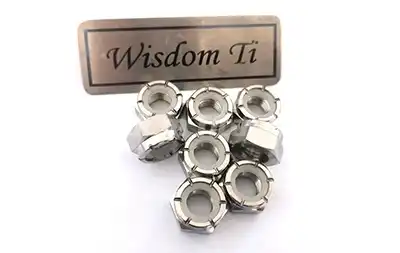
Nylon lock nuts should be used in places where solid link security and resistance to vibration are important. These special screws have a nylon insert built in that grabs bolt threads and stops them from rotating loose due to shock loads, cycle stress, or constant vibration. Titanium nylon lock nuts make this even more useful by mixing Grade 5 titanium's high strength-to-weight ratio with polymer inserts' well-known closing mechanism. This combination gives the best performance in racing cars, motorbike brake systems, aircraft assemblies, and high-end bicycle parts where failure would be very bad and where losing weight directly leads to performance gains.
When to Use Titanium Nylon Lock Nuts: Key Considerations
Environmental Exposure Assessment
In places like chemical processing plants, remote platforms, and desalination plants, corrosion protection is a must. When scratched, titanium's spontaneous passivation layer instantly forms back up. This protects against chlorides, bromides, and acidic chemicals that break down carbon steel quickly and speed up pitting in stainless metals. When your part is exposed to high or low pH, salt spray, or industrial chemicals, titanium nylon lock nuts take away the need for protective coats and replacements on a regular basis.
Temperature Cycling presents another critical selection factor.
Installations of turbochargers and links to exhaust manifolds in cars go through repeated thermal growth and contraction. Above 150°C, standard steel lock nuts may get thread galling or nylon inserts may break down. The thermal expansion rate of Grade 5 titanium is very close to that of aluminum engine parts. This means that there is less differential movement, which can loosen bolts. For uses that need to stay at high temperatures for a long time, the nylon insert substance can be ordered with higher temperature values (up to 180°C).
Mechanical Load and Vibration Profile
Figuring out how bad the shaking is helps you choose the right lock nut. When equipment works steadily above 50 Hz, it needs more than just friction washers for secure locking. Motorcycle brake disc installation is a good example of this problem: the rotor spinning at 120 mph creates gyroscopic forces, and stepping on the brakes creates pulsed torque loads. Titanium nylon lock nuts can handle these pressures in multiple directions because they are very resistant to wear. Grade 5 titanium has endurance limits that are about 55% of its ultimate tensile strength, while heat-treated steel has limits that are 35 to 40% of its ultimate tensile strength.
Weight-sensitive applications derive direct performance benefits from titanium fastener selection. Getting rid of extra rotating mass in car brake systems, motorbike sprockets, and bicycle wheels makes electric vehicles go faster and use less energy. When applied to a whole car base, switching from steel fasteners to titanium ones can reduce the overall weight by 8 to 15 kg, which can significantly increase the range of battery-electric powertrains.
Compliance with Industry Standards
In businesses where safety is important, regulations control the choice of fasteners. The car industry uses ISO 16047 to find out about the mechanical properties of non-ferrous metal fasteners. In the aerospace industry, AMS 4967 (titanium alloy bars) and NAS standards for finished hardware must be met. For safe titanium implant-grade alloys, companies that make medical devices need material certifications that can be traced back to ASTM F136.
Mill test papers should include records of chemical composition, mechanical test results, and heat treatment. These should be required by procurement requirements. Manufacturers with ISO 9001 certification use quality control systems to make sure that each batch is the same and that the source of the product can be found. When looking for titanium fasteners, make sure that the companies you're considering keep the certification paperwork and use statistical process control for important measurements like the thread pitch accuracy and the compression force of the nylon insert.
Procuring Titanium Nylon Lock Nuts: What B2B Buyers Need to Know
Supplier Qualification and Certification Verification
Reputable titanium fastener makers keep track of where their raw materials come from all the way through the final inspection. Ask for certificates of conformance that show the chemical makeup meets ASTM B348 standards, as well as records on mechanical property testing and dimensional inspection. ISO 9001 certification means that quality management systems have been in place for a while, while AS9100 certification is specific to the aircraft industry and covers standards for controlling configurations and tracking materials.
The site of the factory affects the accuracy of the materials and the consistency of the process. In Shaanxi Province, China, the Baoji Titanium Valley is home to the world's most complete titanium production environment. It includes sponge production, ingot casting, and downstream processing all in one industry cluster. Suppliers who work in well-known titanium production hubs usually have direct connections with the main metal makers. This makes sure that the materials are of good quality and lowers the risk of fake parts.
Volume Pricing and Customization Options
When OEM programs use bulk procurement methods, they save a lot of money. Standard stock sizes (M3–M24 in metric, #4–1" in inch) usually need a minimum order of 100 pieces. At 1,000 pieces, the price per unit drops 30–40% compared to small-quantity rates. For custom specs like non-standard lengths, changed nylon insert temperatures, or special finishes, the minimum order quantity is usually between 500 and 1,000 pieces to cover the costs of making the tools and setting them up.
When ordering titanium parts, it's important to plan ahead for lead times. Standard hot-forged hex titanium nylon lock nuts that are already in stock usually ship within 3–5 business days. Custom CNC-machined variations take 4 to 6 weeks for the first production runs, but only 2 to 3 weeks for repeat orders once the tools are set up. Strategic buyers keep extras of important fixings on hand as a safety net, and they plan special orders around production schedules instead of emergency needs.
Quality Assurance and Testing Protocols
Using incoming screening methods keeps low-quality parts from destroying the integrity of the assembly. A visual check should be done to make sure the nylon piece is there and that it fits properly inside the nut body. Verification of the thread size ensures accurate pitch to avoid cross-threading during installation. Portable Rockwell tests show that heat treatment works—Grade 5 titanium should measure 32–38 HRC after the right amount of solution treatment and age.
Destructive testing on small samples gives statistics trust in the quality of the batch. The proof load and maximum strength are found through tensile tests according to ASTM F606. For reusability testing, torque-removal cycling is used to measure how much the locking torque decreases over a number of assembly processes. Industries that need design validation according to PPAP (Production Part Approval Process) or similar quality systems need to keep records of these test findings.
Conclusion
Before choosing nylon lock nuts, you have to compare the qualities of the material to the needs of the application, such as the amount of rust that needs to be dealt with, the weight limits, and the temperature ranges. Titanium nylon lock nuts work best in situations where regular closures aren't as reliable or efficient. The money spent on high-quality materials pays off in a clear way: longer system life, less frequent upkeep, and better performance in car, motorbike, aerospace, and industrial settings. Working with approved makers makes sure that the materials are real and that the sizes are correct, which is important for safety-critical assemblies.
Premium Titanium Nylon Lock Nuts from Wisdom Titanium
Wisdom Titanium makes hot-forged hex titanium nylon lock nuts that are designed to work in demanding racing, aircraft, and industrial settings. As a seller of ISO 9001-certified titanium nylon lock nuts based in Baoji Titanium Valley, China's main titanium production hub, we keep full records from the time we get the raw materials to the time we check the finished product. Our Grade 5 titanium screws (M3-M24, metric and inch threading) are made with checked materials and are finished with precision CNC machinery. This makes sure that all production batches are the same size and work the same way.
Competitive factory prices start at 100 pieces, and there is a lot of stock ready to ship right away. Our engineering team can customize OEM parts to meet non-standard sizes, specific temperatures for nylon inserts, and finishing needs that are unique to each application. Our technical consulting services, material certifications, and quick shipping support help procurement pros find reliable titanium fastener partners. Talk to our experts at sales@wisdomtitanium.com about your needs for titanium nylon lock nuts, ask for material certifications, or get price quotes for large orders that fit your production plans.
FAQs
Can titanium nylon lock nuts withstand saltwater environments?
Grade 5 titanium is very resistant to rust caused by chloride, and its structure stays intact after being immersed in saltwater for more than 10 years without any protective layers. When the inactive oxide layer is broken, it heals itself right away, stopping pitting and crevice rust that weaken stainless steel. The nylon insert needs to be tested at the temperatures it will be used at. Standard polyamide inserts work well in naval settings below 90°C, while high-temperature nylon versions can be used in engine rooms up to 120°C.
How many times can you reuse a titanium nylon lock nut?
The right way to repeat something relies on how hard the application is and how it was installed. Laboratory tests show that 5 to 8 assembly cycles are enough to keep the locking torque at a good level when parts are torqued to the right levels with measured tools. Field experience suggests that for important uses, titanium nylon lock nuts should only be reused three to four times, and they must be replaced after any overtorque events or exposure to temperatures higher than the inserts' ratings. Keep track of when safety-critical screws were installed and change them based on measured breakaway pressure instead of random cycle counts.
References
- American Society for Testing and Materials (2021). "ASTM F2334 - Standard Specification for Fasteners for Use in Structural Applications." ASTM International, West Conshohocken, PA.
- Boyer, R., Welsch, G., and Collings, E.W. (1994). "Materials Properties Handbook: Titanium Alloys." ASM International, Materials Park, OH.
- Bickford, J.H. (2008). "Introduction to the Design and Behavior of Bolted Joints: Non-Gasketed Joints." CRC Press, Boca Raton, FL, 4th Edition.
- Lutjering, G. and Williams, J.C. (2007). "Titanium: Engineering Materials and Processes." Springer-Verlag, Berlin, 2nd Edition.
- Society of Automotive Engineers (2019). "AMS 4967 - Titanium Alloy Bars and Rings 6Al-4V Annealed." SAE International, Warrendale, PA.
- Veiga, C., Davim, J.P., and Loureiro, A.J.R. (2012). "Properties and Applications of Titanium Alloys: A Brief Review." Reviews on Advanced Materials Science, Volume 32, pp. 133-148.




