
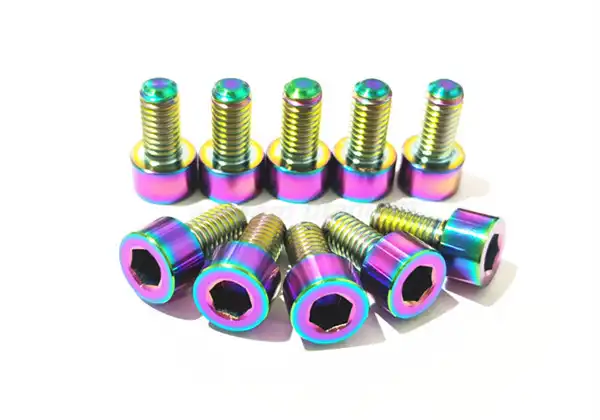
At Wisdom Titanium, we offer a broad range of titanium fasteners for bicycles, covering sizes M3 through M10 in styles including DIN 912 socket head cap screws, DIN 7991 countersunk bolts, DIN 6921 flange bolts, and ISO 7380 button head screws. Surface treatments include anodizing and PVD coating. We also accept fully custom designs from CAD drawings. Every fastener is manufactured from Grade 5 Ti-6Al-4V alloy, delivering tensile strength ≥950 MPa with weight savings up to 40% compared to steel equivalents—making them the go-to choice for road and mountain bike builders who count every gram.
Overview of Titanium Fasteners for Bicycles
What Makes Titanium Special for Bike Components?
Titanium costs about 4.43 g/cm³, which is about 43% less than steel, which costs 7.85 g/cm³. Those who work on bicycles can feel that difference in every fastener spot on the frame. The minimum tensile strength of Grade 5 (Ti-6Al-4V) alloy is 895 MPa, and the minimum yield strength is 828 MPa. This is about the same as Grade 10.9 steel bolts, but Grade 5 alloy is almost half the weight.
Key Properties That Matter to Bike Builders
Titanium builds a passive oxide film of titanium dioxide (TiO₂) on its surface that can heal itself. This film shields the metal from chlorides, sweat, mud, and environments that cause rust, all of which are common on road and mountain bikes. Fasteners made of titanium don't rust as steel ones do, so they last longer and cost less to maintain over time.
Where Titanium Fasteners Are Used on a Bicycle
Titanium fasteners for bicycles appear in almost every part of the bike that goes together. These include stem clamps, handlebar faceplate bolts, bottle cage mounts, derailleur clamps, brake caliper mounting bolts, saddle rail clamps, and crankarm bolts. Each spot benefits from less rotating or static mass, which helps premium road bike brands advertize build goals of less than 7 kg.
Comparison of Titanium Fasteners with Other Materials
Titanium vs. Steel: The Weight Argument
Usually, an M5 × 10mm DIN 912 steel bolt weighs about 2.1 g. About 1.2 g is how much the same bolt weighs in Grade 5 titanium. That difference adds up to 36–54 g over a set of 40–60 bike fasteners, which is enough to change the official claims about how much a whole bike weighs.
Titanium vs. Aluminum: The Strength Argument
Aluminum bolts are lighter, but they rarely have a tensile strength of more than 300 MPa. Grade 5 titanium gives more than 895 MPa, which is almost three times as much. When used in high-stress areas like stem clamping or axle pinch bolts, metal screws can bend after being torqued many times. If you use anti-seize paste on the threads of titanium, they will keep their shape even after being taken off and put back on.
Titanium vs. Carbon Fiber Hardware: The Reliability Argument
Carbon fiber fasteners are very light, but they are naturally brittle and can't handle being over-torqued. Titanium fasteners for bicycles are in the middle of carbon and steel in terms of cost-performance. They are lighter than steel, much more reliable than carbon, and galvanically compatible with carbon fiber frames, so they don't rust like steel bolts do when they touch CFRP structures.
Types of Titanium Fasteners Offered for Bicycle Applications
Standard Bolt Styles and Sizes
Titanium fasteners for bicycles come in sizes M3, M4, M5, M6, M8, and M10. There are the following head styles for each size:
- DIN 912 – The most common type for stem, derailleur, and caliper mounts that need a low-profile hex socket.
- DIN 7991 – Countersunk flat head; best for bottle cage mounts and other places where the bolt head needs to be flush.
- DIN 6921 – Flanged hex bolt; used in axle and dropout hardware where load spread over a wider bearing area is important.
- ISO 7380 – Button head socket screw; often used for aesthetic builds where a low-profile, rounded head is wanted on parts that will be seen.
All of the threads meet the standards of ISO metric tolerance class 6g/6H, which means they will reliably engage with both aluminum and titanium tapped threads. Your technical models can be used to get custom head profiles, drive types (Torx, hex, tri-lobe), and length changes.
These four standard styles cover most of the needs for putting together a bicycle. In addition, our CNC machining can handle non-standard head shapes, hollow-machined shanks for weight goals in grams, and custom drive systems that protect brand uniqueness.
Surface Treatments: Anodizing and PVD Coating
The surface finish is what makes titanium bike parts look and work different. There are two main methods we offer. Anodizing changes colors—gold, blue, rainbow, black, and purple—by changing the thickness of the oxide layer. It does this without adding any mass to the material. Physical Vapor Deposition (PVD) treatment adds a harder, more durable layer to the surface. It comes in black, bronze, and gray colors and is better at resisting scratches than anodizing.
Process parameters are closely watched to make sure that colors in each batch are always the same. Reference samples are used to make sure that there isn't too much difference between batches, which is a known problem with anodized rainbow and blue finishes.
Custom Design and OEM Branding
For custom fastener profiles, our CNC machining team can work with STEP, IGES, or DWG/DXF files. On bolt heads, brand logos, part numbers, or serial codes can be engraved with a laser. Before any review of drawings can begin, non-disclosure agreements (NDAs) are signed. These protect proprietary designs during prototyping and production. As few as 50 pieces are needed for a prototype, and 200 pieces of each SKU are needed for mass production.
Maintenance, Identification, and Lifespan of Titanium Fasteners
How to Identify Genuine Grade 5 Titanium Fasteners
Real Grade 5 titanium fasteners for bicycles come with a Material Test Report (MTR) that lists the chemicals they are made of according to ASTM B348. It says that the aluminum content is between 5.5 and 6.75% and the vanadium content is between 3.5 and 4.5 % by weight. More field verification is done with spark tests and density checks (about 4.43 g/cm³ via displacement). When a supplier refuses to give you an MTR, you should be very careful.
Correct Installation Practice
Titanium is prone to galling, which is when mating threads cold-weld under torque because of its high friction coefficient. Before installing, put a small layer of molybdenum disulfide (MoS₂) anti-seize paste on the threads. Follow the torque specs given by the company that made the part; don't just use steel torque values; titanium has a lower shear modulus, so the numbers need to be changed.
Expected Service Life
Under normal cycling loads, grade 5 titanium fasteners don't break down much over time. In controlled fatigue tests, Ti-6Al-4V samples keep their shape for up to 10 rounds at stress levels that are well within the range of what is used in bicycles. Titanium doesn't get surface rust like steel does, which is what starts corrosion stress. When stored properly in a dry place with thread caps on, the service life is extended indefinitely between build seasons.
Procurement Guide: How to Choose and Where to Buy Titanium Fasteners
Qualifying a Titanium Fastener Manufacturer
Look for ISO 9001 certification, CNC machining that is done in-house (not by a third party), and documented control of the anodizing process. Before you place a trial order, ask for sample MTRs and look over the chemical makeup data. If you sell to European retailers or distributors, make sure the supplier can give you REACH and RoHS compliance declarations for titanium fasteners for bicycles.
Understanding MOQ and Lead Time
Our MOQ is 200 pieces per SKU, which works well for developing new products and doing small yearly updates. From the approval of the drawing to shipment, the standard wait time for production is 15 to 25 business days. It usually takes 7–10 business days to make prototype samples from CAD drawings. There are options for faster launch times for trade shows.
Building a Long-Term Supply Partnership
Purchasing teams that build direct relationships with factories get better timing, stable prices that are tied to the market rates for titanium rods, and the chance to talk to engineers about thread design and weight optimization. Seasonal blanket orders with staged delivery ease the stress on warehouses and protect material prices from changes in the market.
Conclusion
Titanium fasteners for bicycles have a well-known mix of low weight, resistance to corrosion, and long service life that steel options at the same mass can't match. If you want to make a race-ready road bike, a high-end mountain bike platform, or a line of branded aftermarket hardware, you need to start with the right manufacturing partner. Wisdom Titanium is in Baoji Titanium Valley, which is China's biggest integrated titanium production base. Since 2016, they have been using ISO 9001 quality management to make precision titanium parts. We offer a complete selection of M3–M10 bicycle bolts in both standard and custom styles, with finishes that are anodized or PVD-coated. We can also make 50-piece prototypes to help you with your next product development cycle.
FAQ
1. Can titanium bolts be used on carbon fiber frames?
Yes, titanium is galvanically compatible with carbon fiber reinforced plastics (CFRP). This means that it doesn't cause galvanic corrosion at places where metal meets carbon, as steel bolts can. Always use an assembly paste that is compatible with carbon, and always follow the power specs given by the frame maker.
2. What grade of titanium do you use for bicycle fasteners?
The Grade 5 (Ti-6Al-4V) alloy we use to make titanium fasteners for bicycles has a tensile strength of at least 950 MPa and is the standard material for structural bike gear. Every batch comes with a material test report.
3. Do you offer color-matching across multiple production runs?
Yes. To keep variation to a minimum, anodized color batches are made based on reference samples and controlled process parameters. Before committing to big seasonal numbers, we suggest that you order a reference batch sample set.
4. What is the minimum order for a custom design?
The first 50 pieces of prototype samples are free. For standard production runs, each SKU needs at least 200 pieces. We agree to follow NDAs before looking at any confidential pictures.
5. Do your fasteners comply with EU REACH and RoHS requirements?
Yes. As part of meeting the rules for European markets, we provide REACH and RoHS compliance declarations for all of our titanium fastener products.
Get a Quote from Wisdom Titanium — Your Trusted Titanium Fasteners for Bicycles Manufacturer
Wisdom Titanium has been making high-quality titanium fasteners for bicycles for brands in North America, Europe, and Asia since 2016. Our factory in Baoji, China, is ISO 9001-certified and makes M3–M10 bolts in DIN 912, DIN 7991, DIN 6921, ISO 7380, and custom styles. The bolts are anodized and PVD-coated. A sample of 50 pieces is the first order. To get a price right away, email your pictures or questions to sales@wisdomtitanium.com.
References
1. ASTM International. ASTM B348: Standard Specification for Titanium and Titanium Alloy Strip, Sheet, and Plate. ASTM International, 2021.
2. Boyer, R., Welsch, G., & Collings, E. W. Materials Properties Handbook: Titanium Alloys. ASM International, 1994.
3. Donachie, M. J. Titanium: A Technical Guide. 2nd ed. ASM International, 2000.
4. German Institute for Standardization. DIN 912: Hexagon Socket Head Cap Screws. DIN, 2014.
5. International Organization for Standardization. ISO 4762: Hexagon Socket Head Cap Screws — Product Grade A. ISO, 2004.
6. Peters, M., Kumpfert, J., Ward, C. H., & Leyens, C. "Titanium Alloys for Aerospace Applications." Advanced Engineering Materials, Vol. 5, No. 6, 2003, pp. 419–427.




