
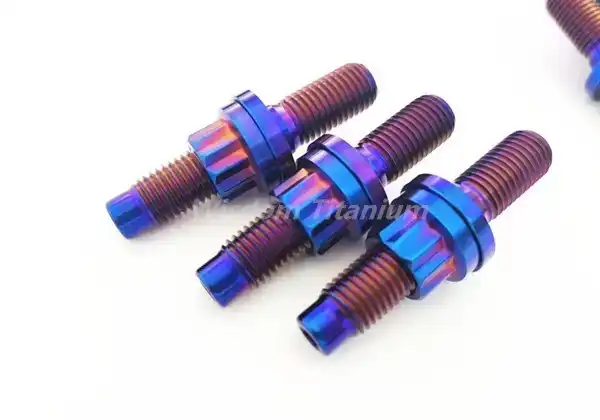
Titanium exhaust manifold stud kits are often available with metric threads of M8×1.25 and M10×1.25 (or M10×1.5) and will cover most Japanese, European, and American engine platforms. M8 studs for lighter four-cylinder engines, M10 for higher-torque applications. Our regular Grade 5 titanium exhaust manifold stud kits at Wisdom Titanium are offered in M8×1.25×45 mm and M10×1.25×45 mm or 54 mm with nut choices of 12-point, hex flange, and lock nut designs. OEM and brand-specific fitments are also available with custom thread pitches and lengths.
Understanding Titanium Exhaust Manifold Stud Kits and Their Specifications
What Makes Grade 5 Titanium the Right Material Choice
Titanium is not all the same. Grade 2 is commercially pure titanium. It is soft and doesn't have the mechanical strength that engine screws need. Grade 5, also known as Ti-6Al-4V, is an aerospace-grade metal with a yield strength of about 880 MPa and a tensile strength of 950 to 1050 MPa. This makes it about 45% lighter than similar steel studs while still being able to hold up under the high temperatures and high frequency of a turbocharged exhaust environment. Our studs meet ASTM B348 Grade 5 standards, and if you ask, we can provide XRF material verification.
Metric vs. Imperial: Knowing Your Standard
Thread standards vary by area and car origin. Most cars in Japan and Europe use ISO metric threads (M8, M10), but some performance and vintage American platforms use imperial sizes like 3/8"-24 or 7/16"-20. If you do this wrong, you could end up with cross-threading, damaged manifolds, or studs that break under force. Always check the OEM workshop manual or cylinder head drawing against the bulk order before placing it. Before production starts, Wisdom Titanium's engineering team works directly from 2D drawings or 3D models to make sure everything works together.
Key Specification Parameters to Confirm Before Sourcing
Size of the thread doesn't tell the whole story by itself. Before deciding on a stud kit standard, every buying manager should make sure of these three main points with their supplier:
- Thread pitch: M8×1.25mm and M10×1.25mm are standard for most Asian and European platforms. M10×1.5mm is common on heavier German engines. Confirming pitch prevents misfits at assembly.
- Stud length: Our standard lengths are 45mm for M8 and 45mm/54mm for M10. Stud engagement depth must be matched to manifold thickness and flange nut height to ensure proper clamp load.
- Surface finish: Available in burnt blue, black PVD, natural titanium, and gold anodizing. PVD coatings increase surface hardness and resist discoloration at elevated temperatures.
Finish on the outside: It comes in burnt blue, black PVD, natural titanium, and gold anodizing. PVD coatings make surfaces harder and keep them from changing color at high temperatures.
Common Thread Sizes Available for Titanium Exhaust Manifold Stud Kits
M8×1.25 — The Compact Engine Standard
It is recommended to use M8×1.25×45mm threads for four-cylinder engines found in Honda, Toyota, Subaru, and Volkswagen cars. The stud handles multiple clamp loads well at this width without adding extra weight. For titanium exhaust manifold stud kits, OEM torque specs for M8 are usually between 18 and 25 Nm. People like to use these studs in street performance cars and cars built for track days where every gram counts.
M10×1.25 and M10×1.5 — The Versatile Workhorse
M10 studs are used on engines with bigger displacements and turbochargers, where the pressure inside the manifold is much higher. Our M10×1.25×45mm and M10×1.25×54mm sizes work with models like the Mitsubishi 4G63, the Nissan RB, and the BMW inline-six families. The 54mm version can fit bigger pipe flanges that are not built by the manufacturer. The torque that should be used is between 35 and 45 Nm. You can choose between 1.25mm and 1.5mm pitch depending on the thread size of the cylinder head. Wisdom Titanium has both sizes in stock.
Custom Thread Options for OEM and Brand-Specific Applications
To make their kits stand out or fit their own manifold designs, some performance brands need non-standard configurations. Wisdom Titanium lets you change the head shape, thread pitch, thickness, and length. For unique setups, the MOQ is 100 sets at first. We sign NDAs to protect our secret designs, and our in-house R&D team sends out pre-production samples within two to three weeks so that we can check the size and finish of the samples before we start full-scale production.
How to Choose the Right Thread Size for Your Application
Match Thread Size to Engine Architecture
The cylinder head standard is always the place to start. People often make the mistake of choosing a stud based on how close it looks instead of accurate thread data. A 0.25mm pitch difference between M10×1.25 and M10×1.5 leads to cross-threading, which damages aluminum cylinder heads in a way that can't be fixed. Before you confirm the stud dimensions, you should always check the OEM thread specification in the engine service manual or ask the manufacturer of your manifold for a technical datasheet.
Consider Thermal Expansion and Load Distribution
Titanium expands at a rate of 8.6 µm/m·°C, while steel expands at a rate of 12 µm/m·°C. This slower rate of thermal expansion is good in places with a lot of heat exhaust because it lowers the stress that builds up at the thread interface during repeated heat cycles. But because of this difference, the force requirements for titanium studs are different from those for steel studs. Don't use steel torque values on titanium fasteners; instead, use Grade 5 titanium torque charts or talk to our engineers directly.
Factor in Nut Style and Clamp Load Requirements
Choosing the right nuts has an effect on the clamping system as a whole. There are three types of nuts in our kits:
- 12-point nut: Allows precise torque application in tight engine bay spaces with reduced rounding risk.
- Hex flange nut: Distributes load across a wider bearing surface, ideal for softer aluminum manifolds.
- Lock nut: Provides vibration resistance in high-RPM or racing applications where loosening under cyclic loading is a concern.
Each type of nut works best with a different type of manifold material and installation environment. Using the right mix of nuts lowers the number of times they need to be serviced and ensures thread integrity over thousands of heat cycles.
Installation Best Practices for Titanium Exhaust Manifold Stud Kits
Always Apply Anti-Seize Before Installation
Titanium may gall — a sort of cold welding — when in contact with other titanium exhaust manifold stud kits, nuts, or aluminum threads. It is not a material fault, its merely the way the oxide layer forms. Answer easy, before installation place anickel-l or copper-based high-temperature anti-seize to the threads of the studs. This allows it to be removed neatly, even after years of usage. This makes future turbo swaps and gasket replacements considerably easier on everything.
Use Calibrated Tools and Respect Torque Limits
The positive thing about titanium is that it is flexible, but that means that if you over-torque it, the stud will compress over its yield point with no real visible warning. Always use a calibrated torque wrench to the correct value (18–25 Nm for M8 and 35–45 Nm for M10) for final tightening. Air tools must not be utilized. For metal cylinder heads, the thread engagement should be a minimum of 1.5 times the breadth of the stud to have proper pull-out power.
Inspect Threads After Each Manifold Removal
Titanium pins may be reused as long as they haven’t been stretched to the breaking point. After each manifold removal, visually check the threads for evidence of distortion, galling marks, or coating wear. Use a wire brush to clean the threads before reassembling. In most street conditions, good quality Grade 5 studs will outlast the automobile if properly fitted. This is one of the reasons they are an excellent long-term investment for performance builds.
Comparing Titanium Studs with Steel and Ceramic-Coated Alternatives
Weight and Corrosion Resistance Advantage
Steel screws rust. This is a severe problem in exhaust situations where road salt, moisture, and exhaust fumes accelerate the oxidation process. When steel studs seize, you normally have to drill them out and put in a Helicoil repair, both of which are costly and time-consuming. Titanium exhaust studs are resistant to corrosion and will not bond to aluminum or cast iron pipes. The weight reduction of over 45% over steel also means less rotating and reciprocating mass, which is a considerable speed increase in racing.
How Titanium Compares to Ceramic-Coated Steel
Ceramic-coated steel studs attempt to help prevent corrosion by coating the exterior of the steel. It lasts until it chips away, then the steel below rusts just as fast as non-covered bolts. Titanium does not rust naturally; hence, it does not require a protective coating to remain rust-free. For manufacturers of high-end items, it’s the qualities of titanium, not simply the looks, that make the price difference worthwhile to buyers.
Long-Term Value in Performance and Race Applications
In professional racing, you may consider weight and reliability. A set of Grade 5 titanium manifold studs will weigh roughly 55% to 60% less than the same size set manufactured of steel. Reducing the weight of under-hood fittings can help your vehicle perform better across a racing season. More practically, the titanium studs eliminate the possibility of a broken stud that has to be machined during race prep, which would cost a lot more in downtime than the stud kit itself.
Conclusion
The correct thread size for your exhaust manifold stud kit is a technical consideration that might impact the fit, clamp, and longevity. The M8×1.25 and M10×1.25 variants fit most popular engine platforms. The M10X1.5 variant is more designed for usage in Europe. Grade 5 titanium exhaust manifold stud kits are unbeatable in terms of strength, corrosion resistance, and weight savings over steel . Getting the thread specification right from the outset pays off during the product lifetime, saving time, money, and difficulties whether you are purchasing standard configurations or building a branded kit with bespoke finishes.
FAQ
1. Do titanium exhaust studs require anti-seize during installation?
Yes. Titanium is very resistant to rust, but it can gall when it meets other titanium or aluminum threads. A high-temperature anti-seize lube based on nickel or copper is strongly suggested to stop cold welding and allow clean removal after a long time of use.
2. What torque values apply to Grade 5 titanium exhaust studs?
For M8 1.25, torque up to 18–25 Nm. For M10 1.25 or M10 1.5, turn up the torque to 35 to 45 Nm. Always look at the engine's service manual and never use torque specs for steel fasteners on titanium ones, because steel and titanium have different elastic moduli.
3. Can these studs be reused after manifold removal?
Yes, as long as they haven't been over-torqued past the point where they will break. Under normal working conditions, Grade 5 titanium threads stay strong for a lot longer than steel ones. This means that they can be used again for most street and track uses.
4. Will PVD color finishes fade from exhaust heat?
High-quality PVD coatings, like burned blue, black, and gold, last a very long time. Long-term contact with very high temperatures (red-hot manifolds) may change the color tone over time, but the resistance to corrosion and structural function stay the same.
5. Are custom thread sizes available for OEM fitments?
Yes, Wisdom Titanium can make threads with any pitch, diameter, or length starting at an MOQ of 100 sets. We use customer drawings or 3D models as a guide and send pre-production samples within two to three weeks. You can use an NDA to protect your own ideas.
Request a Quote from Wisdom Titanium — Trusted Titanium Exhaust Manifold Stud Kits Supplier
Wisdom Titanium has been making ISO 9001-certified titanium screws since 2016. The company is based in Baoji Titanium Valley, Shaanxi Province, which is one of the most famous places in the world for titanium production. You can get our Grade 5 titanium exhaust manifold stud kits in two sizes: M8×1.25×45 mm and M10×1.25×45/54 mm. You can choose between a 12-point, hex flange, or lock nut, and the finish can be burned blue, black, natural, or gold. MOQ is 100 sets, and the price is factory-direct. There are also plenty of sets in stock. For details and samples, email us at sales@wisdomtitanium.com.
References
1. Boyer, R., Welsch, G., & Collings, E. W. (Eds.). Materials Properties Handbook: Titanium Alloys. ASM International, 1994.
2. Donachie, M. J. Titanium: A Technical Guide (2nd ed.). ASM International, 2000.
3. Society of Automotive Engineers. Fastener Standards Manual. SAE International, 2019.
4. ASTM International. ASTM B348: Standard Specification for Titanium and Titanium Alloy Bars and Billets. ASTM International, 2021.
5. Bickford, J. H. Introduction to the Design and Behavior of Bolted Joints (4th ed.). CRC Press, 2007.
6. Machinery's Handbook Editorial Staff. Machinery's Handbook (31st ed.). Industrial Press, 2020.