
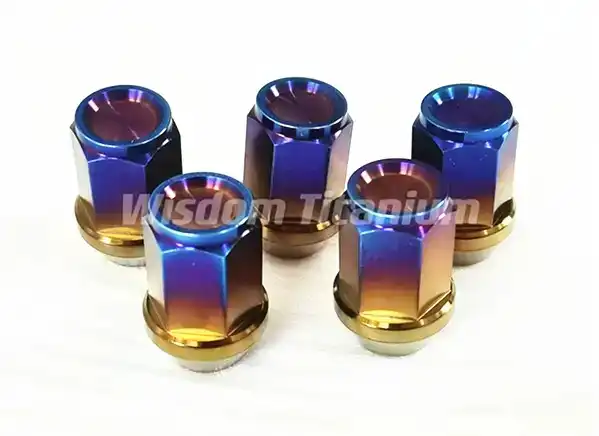
Burnt titanium lug nuts are available in many forms and sizes to suit automotive performance and flair. Closed-ended hex-style, conical, and circular seat forms, and locking and non-locking models are the primary varieties. Controlled oxidation gave the titanium Grade 5 screws a burnt finish. This gives the metal blue, purple, and gold hues. In M12, M14, and 1/2" sizes, these lightweight yet sturdy components perform well with tuning automobiles and forged wheels and resist corrosion and stay long in tough conditions.
Comparing Burnt Titanium Lug Nut Styles and Their Performance
Material selection affects costs and operating reliability. Understanding performance-cost trade-offs helps buying teams pick burnt titanium lug nuts that fit the application and budget.
Burnt Titanium Versus Standard Titanium
Surface treatment, not base material, distinguishes normal and burnt titanium screws. Unfinished titanium is matte gray and oxidizes, discoloring with time. The controlled burnt process provides a steady oxide layer ahead of time, eliminating unpredictable oxidation patterns and improving the material. Mechanically, both types have the same tensile strength, fatigue resistance, and weight savings.
Burnished surfaces are 50–100 HV (Vickers hardness) harder than untreated surfaces. Because wheels are less likely to scrape when put on and taken off, the car's appearance will last longer between service visits. Cars driven near the shore or in winter salty areas benefit from the oxide layer's chloride rust resistance.
Material Alternatives and Their Limitations
Steel lug nuts are the most common economic option since they are inexpensive and versatile. Titanium pieces weigh 25–30 grams, whereas carbon steel parts weigh 65–75 grams. This weight penalty is crucial for speed automobiles, since unsprung mass directly impacts suspension response and performance. Chrome-plated steel resists rust better, but it can pit if the coating cracks and water and chemicals access the core.
Aluminum loses roughly as much weight as titanium but loses strength and durability. Most aluminum lug nuts need steel inserts to prevent thread stripping. This complicates and adds failure points. Aluminum melts at 660°C, compared to 1668°C for titanium. This is also a concern when hub temperatures exceed 500°C during hard stops. Stainless steel is cheap and rustproof. However, it weighs 40% more than titanium and has a worse strength-to-weight ratio.
Impact of Design Choices on Service Life
According to weight transfer mechanics, seat type impacts maintenance and lifespan. In a small circular region, conical seats concentrate contact stress. Softer wheel materials may give less with time. As the touch surface changes form, bolts might loosen. Spherical seats relieve this problem by spreading pressure uniformly, but the nut radius and wheel counterbore shape must match. When tension is applied, mismatched pairings may rock, causing unequal bolt circle tightening.
Closed-ended designs help prevent corrosion-caused stopping by keeping threads clean. Race cars that swap between track and transport wheels need this. The sealed hole prevents brake dust from clogging threads or stalling installation.
Choosing the Right Style of Burnt Titanium Lug Nuts for Your Needs
Application-specific selection parameters provide optimal performance without compatibility issues that might compromise safety or accelerate part wear. These burnt titanium lug nuts are essential for matching specifications to vehicle needs.
Matching Specifications to Vehicle Requirements
Weight reduction and temperature safety are racing vehicle priorities. Closed-ended hex designs with M12×1.5 thread pitch suit European sports and formula race cars, while 1/2"-20 threads suit American muscle cars and NASCAR-derived platforms. The burnt finish serves two purposes: corrosion protection during transport and storage, and identifying high-quality parts during technical inspection.
High vibration and impact loading test fasteners' fatigue limits, but Grade 5 titanium's fatigue strength (510 MPa) is higher than equivalent steel components, reducing the risk of failure during long-term rough-terrain operation. Its corrosion resistance is also useful for vehicles exposed to mud, water crossings, and salty coastal environments that quickly wear.
Security and Procurement Considerations
Locking lug nuts are harder to steal, but they require a special key tool, so fleet operators must set up key management protocols to prevent service interruptions from key loss. We recommend keeping multiple copies of the keys in safe places only authorized maintenance staff can access. The hex-style interface lets you use other tools for emergency removal, but this shouldn't affect security.
Our minimum order quantity is 200 pieces to keep costs low and allow for small to medium-sized projects. Larger orders benefit from economies of scale, and tiered pricing rewards bulk buyers. We keep raw materials in stock to turn around standard configurations quickly, but custom specifications may require longer lead times for specialized machining.
Wisdom Titanium's Product Portfolio
We sell titanium fasteners to automakers since 2016, taking advantage of the region's supply chain advantages to offer competitive prices without lowering quality. Our facility is ISO 9001 certified, proving that we follow systematic quality management practices to ensure that all of our products meet international standards.
Our burnt titanium lug nuts are constructed from Grade 5 titanium bar stock and come in M12, M14, and 1/2" diameters. Closed-ended hex nuts. Spectroscopic examination checks each batch's composition, while mechanical testing proves tensile strength, hardness, and elongation. Burnt finish uses controlled environment ovens with precise temperature profiles for uniform coloring across production runs. This process control ensures visual consistency for high-end automotive usage where appearances are as critical as functionality.
There are more customization options than shop purchases. We collaborate with technical teams to provide application-specific solutions. Non-standard thread sizes, larger shanks, or other seat forms may be used. Before pilot production, our in-house R&D team employs finite element analysis to ensure design modifications are safe. This reduces development time and ensures performance. This consulting approach has earned the trust of small carmakers and huge motorbike manufacturers seeking innovative parts.
Maintaining and Cleaning Different Styles of Burnt Titanium Lug Nuts
To retain the functional structure and aesthetic appeal of burnt titanium lug nuts, you must maintain them differently from steel fasteners.
Cleaning Without Compromising the Finish
Abrasive cleaning might destroy the few microns-thick oxide layer that produces the burnt effect. Do not use wire brushes, abrasive pads, or harsh chemical cleaners with hydrofluoric acid or strong alkaline solutions. These procedures can remove the oxide layer, leaving bare metal or an unusual tint.
Clean using pH-neutral vehicle soap, warm water, and soft cotton cloths. Moving the surface gently removes brake dust and road filth without damage. You may need to soak difficult deposits in titanium cleansers that remove grime without eroding the oxide coating. Avoid water marks by rinsing and drying properly. The polish shines and is protected by a thin coating of carnauba wax after washing.
Inspection and Torque Maintenance
Regular torque checks prevent tightening that might damage or remove the wheel. We recommend checking torque after 50–100 miles, then at regular service intervals or before competitions. Set torque tools to manufacturer's recommendations. M12 lug nuts require 80–100 ft-lbs, M14 90–120, and 1/2" 95–115. Always follow the manufacturer's guidelines.
If you see thread damage, excessive wear at the seat interface, or color changes that indicate the part is too hot, replace the fastener. Rounding or deformation on the hex drive surfaces indicates over-torqueing or the wrong socket size. Titanium's high fatigue resistance makes it last longer.
Style-Specific Maintenance Challenges
For closed-ended designs, the cavity must be checked regularly for debris buildup. Road salt and brake dust can get stuck, causing the nut body to expand and put stress on it. Flip the nut over and tap it against a soft surface, then use compressed air to remove any remaining particles.
Locking lug nuts are harder to remove if the key is broken or lost. To prevent corrosion bonding, apply a thin layer of titanium-compatible anti-seize compound to the key socket interface. Keep the key with the vehicle's paperwork to prevent theft. Store removed lug nuts in clean, dry containers away from metals that aren't the same as them.
Conclusion
In conclusion, burnt titanium lug nuts, available in M12, M14, and 1/2" sizes, have a hex-style closed-end design and can be used for tuning cars and installing forged wheels. They improve performance beyond appearances. Grade 5 titanium's strength-to-weight ratios, corrosion resistance, and thermal stability are unmatched. Choosing a style that matches seat geometry, thread requirements, and security demands maximizes compatibility and dependability. Maintenance procedures that preserve the finish extend product life. Buy from certified producers to ensure materials are authentic and high-quality for safety-critical usage.
Partner with Wisdom Titanium for Your Burnt Titanium Lug Nut Requirements
Wisdom Titanium brings specialized expertise as a burnt titanium lug nuts manufacturer serving automotive, motorcycle, and racing industries globally. Our ISO 9001-certified facility in Baoji Titanium Valley combines regional supply chain advantages with stringent quality controls, delivering Grade 5 titanium fasteners meeting international performance standards. The 200-piece minimum order quantity accommodates both prototype validation and production volumes, while our customization capabilities support unique application requirements. We maintain complete raw material inventory and mature production technology ensuring stable lead times and consistent product quality. Reach out to our technical team at sales@wisdomtitanium.com to discuss your specific requirements, request material certifications, or obtain volume pricing for your upcoming projects.
FAQ
Can burnt titanium lug nuts fit all vehicle models?
Thread pitch, seat type, and hex size must match each automobile to be globally compatible. Are burnt titanium lug nuts compatible with all cars? Check your car's specs before ordering to avoid wheel damage from mismatched sets. Thread sizes M12×1.5 and M14×1.5 fit most European and Asian automobiles, whereas 1/2"-20 fits American cars.
How do these lug nuts compare to steel in durability?
Grade 5 titanium has a fatigue resistance of 510 MPa compared to 380–450 MPa for typical steel, and its corrosion resistance prevents rust-related degradation, extending service life. While its initial costs are higher than steel alternatives, its lifecycle value is higher due to fewer replacements and maintenance.
Are custom colors or designs available?
The minimum order quantity for custom specifications is 500 pieces to cover the cost of the tools, but we consider smaller quantities based on how complicated they are and the potential for a reorder. Custom burnt color temperatures can achieve desired hues from gold through purple.
References
1. Boyer, R., Welsch, G., and Collings, E.W. (1994). Materials Properties Handbook: Titanium Alloys. ASM International, Materials Park, Ohio.
2. Donachie, M.J. (2000). Titanium: A Technical Guide (2nd Edition). ASM International, Materials Park, Ohio.
3. Lutjering, G. and Williams, J.C. (2007). Titanium (2nd Edition). Springer-Verlag, Berlin Heidelberg.
4. SAE International (2018). Wheel Nuts and Studs for Automotive Applications (SAE J1102). Society of Automotive Engineers, Warrendale, Pennsylvania.
5. Veiga, C., Davim, J.P., and Loureiro, A.J.R. (2012). "Properties and Applications of Titanium Alloys: A Brief Review." Reviews on Advanced Materials Science, 32(2), 133-148.
6. Zwicker, U. (1974). Titan und Titanlegierungen. Springer-Verlag, Berlin Heidelberg.