
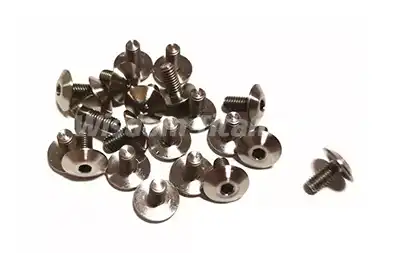
Precision thread rolling, regulated heat treatments, computer numerical control machining with turned heads, and other specialized production processes are used in the fabrication of M3 titanium bolts. The exceptional strength-to-weight ratio and corrosion resistance required by high-performance applications in the automotive, aerospace, and related industries need meticulous material management, exact dimensional control, and high-quality surface finishing of these Grade 5 titanium fasteners.
M3 Titanium Bolts Processing Needs
The precision-engineered fasteners known as M3 titanium bolts have changed the game for high-performance applications in a variety of sectors. Specialized components like these are essential in situations where normal steel fasteners fall short of expectations due to their outstanding material characteristics and 3mm nominal thread diameter.
M3 titanium bolts are distinguishable due to their Grade 5 (Ti-6Al-4V) titanium structure, which offers an exceptional strength-to-weight ratio compared to conventional materials. These bolts achieve a weight reduction of around 45% while preserving exceptional mechanical qualities, thanks to their density of about 4.51 g/cm³, which is far lower than stainless steel's density of 7.9 g/cm³. Aerospace applications, performance improvements for automobiles, and precise electronics—fields where every gram counts—become very dependent on this weight advantage.
Titanium Grade 5 material's fundamental characteristics explain the need for specialist processing methods. Due of its unusual crystalline structure and work-hardening properties, this alloy necessitates carefully regulated production conditions with meticulous parameter control at every stage. In order to avoid work hardening and keep dimensions accurate during titanium machining, unique cutting rates, coolant applications, and tool geometries are required, in contrast to typical steel processing.
Critical Processing Considerations
Processing titanium becomes much more complicated due to its biocompatibility and non-magnetic characteristics. Specialized tooling eliminates magnetic interference during precise operations, and contamination-free manufacturing settings retain the material's natural corrosion resistance. Choosing the right processing methods and quality control processes is heavily impacted by these considerations.
Since titanium has very different thermal conductivity properties than steel, careful temperature control throughout manufacturing becomes very important. Because uncontrolled heat production during machining processes may change material characteristics, thermal monitoring and coolant management are crucial steps in manufacturing.
Overview of Common Processing Techniques for M3 Titanium Bolts
There are a number of complex processing steps involved in making high-quality M3 titanium bolt components, and these steps all add to the product's performance. Procurement experts may make better supplier selection and requirement specification judgments when they are familiar with these procedures.
CNC Machining and Precision Turning
CNC machining provides unmatched accuracy and reproducibility, making it the backbone of current M3 titanium bolt manufacturing. The procedure starts with high-quality titanium rod stock, usually obtained in diameters ranging from 3mm to 6mm in order to keep material waste to a minimum. The bolt heads are machined using computer-controlled turning operations to provide the best possible shape for tool contact and torque transmission.
Machine tools made of carbide or ceramic are ideal for cutting titanium alloys during the machining process. By efficiently dispersing heat, these tools keep cutting edges sharp and minimize work hardening, which may damage material qualities. When compared to steel machining, this kind of cutting usually requires slower cutting speeds and greater feed rates, which need careful optimization of the cutting parameters.
Choosing the right coolant is essential for successful titanium machining. Maintaining constant temperatures and flushing chips away from the cutting zone are both assisted by high-pressure coolant systems that use specific fluids. Chip welding, which may harm the titanium workpiece and the cutting tools, is avoided in this way.
Thread Rolling and Cutting Operations
The mechanical performance and lifespan of the fastener are directly impacted by thread creation, making it one of the most crucial parts of bolt manufacture. Precision cutting and cold rolling are the two main procedures used for threading titanium bolts.
Cutting threads using threading dies or single-point tools allows for precise dimensional control and a high-quality surface finish. If adaptability is more important than speed, this approach is ideal for smaller production runs or bespoke requirements. Cutting allows for exact control over thread shape and surface properties by removing material to generate thread formations.
Because it keeps the material flowing continuously while work-hardening the thread surfaces, cold thread rolling provides better mechanical qualities. Instead of eliminating titanium, this technique compresses and displaces it, making the thread roots stronger and increasing fatigue resistance. Nevertheless, in order to get consistent results while thread rolling titanium alloys, specific equipment and meticulous material preparation are required.
Relieving Stress with Heat
Titanium bolts may have their mechanical characteristics improved and manufacturing-induced residual stresses reduced using post-machining heat treatment techniques. To avoid oxidation, stress relief annealing is usually done in controlled environment furnaces at temperatures ranging from 650°C to 750°C.
To prevent the creation of the hard and brittle alpha case layer, which may reduce bolt performance, the heat treatment procedure has to be carefully regulated. Titanium is best protected and its surface optimized when processed in a vacuum or inert gas atmosphere, which also reduces stress.
The Art of M3 Titanium Bolt Processing: What Method Is Best?
It is important to assess application-specific needs, quality standards, and business factors thoroughly before choosing processing techniques. In order to keep production methods cost-effective while yet meeting performance goals, this methodical approach is used.
Criteria for Application-Based Selection
Thread-rolled M3 titanium bolts are ideal for high-stress automotive applications because they are very resistant to fatigue and have surfaces that have been work-hardened. Wheel hub bolts and suspension components with rolled threads are typically specified by racing teams and performance modification shops due to the severe repercussions of failure.
The dimensional accuracy, rather than the final strength, of CNC-machined components with cut threads may be more important in aerospace and precision electronics applications. When working with precise assemblies, it is essential to maintain very tight tolerances on thread diameters and head shape.
Adherence to Quality Standards
Processing method choice is affected by industry-specific quality criteria. Aerospace applications may need AS9100 certification and process validations unique to that industry, while ISO 9001 production settings can usually handle any conventional processing procedure.
Because of its superior process documentation and quality control capabilities, CNC machining is often used for material traceability needs in aerospace and medical applications. For regulated sectors, the ability to monitor processing parameters and material heat batches via comprehensive production records is becoming vital.
A Review of Supplier Capability
Supplier competencies and certifications play a significant role in the successful selection of processing techniques. While specialist businesses may shine in one or two approaches, well-established manufacturers with extensive equipment portfolios may improve processing processes for specific applications.
Access to full supply chains and specialist knowledge is made possible by the geographic concentration of titanium processing competence in places like Baoji Titanium Valley. Companies that are part of these clusters of related industries usually have better technical skills and more expertise in optimizing processes.
Building Relationships with Reliable M3 Titanium Bolt Producers and Distributors
The first step in acquiring titanium fasteners is to build trustworthy connections with suppliers. Thorough supplier selection and continuous relationship building are essential due to the crucial uses of these bolts and the specialist nature of titanium processing.
Crucial Requirements for Suppliers
When it comes to quality management, the bare minimum for titanium bolt production is ISO 9001 accreditation. Consistent quality control procedures, documented processes, and traceability of materials are all guarantees of this accreditation. But there are a lot of uses that call for supplementary certifications, such AS9100 in the aerospace industry or ISO 13485 in the healthcare sector.
Both the complexity of the equipment and the level of technical knowledge should be included in a manufacturing capacity evaluation. Using state-of-the-art CNC machinery equipped with titanium-specific tooling and cooling systems demonstrates a supplier's dedication to producing high-quality titanium products. Further evidence of sophisticated manufacturing capabilities may be seen in the presence of material testing capabilities and controlled environment heat treatment furnaces.
Efficiency and Adaptability in Manufacturing
Suppliers who can handle both standard and special needs are essential for successful M3 titanium bolt procurement. Prompt delivery schedules and specific requests may be met by manufacturers that have typical sizes (M2 and M3) in stock, with length choices ranging from 5mm to 30mm.
When coping with fluctuating order numbers, production flexibility becomes vital. Companies that have automated manufacturing lines are great at meeting high-volume demands with consistent quality, while those that can efficiently handle small-batch production are good for prototype development and low-volume applications.
Location-Based Benefits and Supply Chain Harmonization
The benefits of location-based knowledge are best shown by Baoji Wisdom Titanium Industry and Trading Co., Ltd, a company headquartered in Shaanxi Province's Baoji Titanium Valley. Complete supply chains, beginning with the processing of raw materials and ending with the fabrication of completed components, are accessible in this area, making it the biggest and most extensive titanium industrial cluster in China.
Within a condensed geographic region, there is an integrated ecosystem that comprises the manufacturing of titanium sponges, ingot casting, rod drawing, and precision machining capabilities. Reduced shipping and handling costs allow for more competitive pricing, shorter lead times, and improved quality control made possible by this integration.
Assistance with Technical Issues and Personalization
In order to optimize bolt specifications for individual applications, advanced suppliers provide engineering assistance throughout the procurement process. By working together technically, we may find ways to optimize costs, improve performance, or reduce weight by changing materials or procedures.
Additional options for personalization include different surface treatments, different head configurations, and altered thread shapes, in addition to dimensional variants. Suppliers who have their own research and development departments are better able to meet their quality and delivery promises even when faced with complex applications.
Conclusion
The production of M3 titanium bolts involves complex manufacturing methods that have an immediate impact on efficiency, dependability, and performance. Thread rolling, by virtue of work hardening, offers more fatigue resistance than CNC machining with precision turning, which in turn yields outstanding dimensional accuracy. In order to maintain constant performance even under the most demanding service circumstances, heat treatment techniques are used to enhance mechanical qualities and stress relief.
Procurement success relies on matching processing methods with application needs, quality standards, and business realities. To ensure the project's success, it is crucial to choose certified suppliers with up-to-date equipment and technical knowledge.
Optimize Your M3 Titanium Bolt Procurement with Wisdom Titanium
Wisdom Titanium delivers precision-engineered M3 titanium bolt solutions manufactured using advanced CNC machining and thread rolling techniques. Our Grade 5 titanium fasteners feature machined heads with rolled threads, available in M2 and M3 sizes with hexagon head styles and length options from 5mm to 30mm. Located in Baoji Titanium Valley, we leverage China's most comprehensive titanium manufacturing ecosystem to provide superior quality, competitive pricing, and 7-15 day production lead times. As an ISO 9001-certified m3 titanium bolt manufacturer, we support flexible payment options including PayPal and T/T. Contact our engineering team at sales@wisdomtitanium.com to discuss your specific requirements and experience our commitment to excellence in titanium fastener manufacturing.
FAQ
What processing technique provides the highest strength for M3 titanium bolts?
Thread rolling combined with controlled stress relief annealing typically produces the strongest M3 titanium bolt configurations. The rolling process work-hardens the thread surfaces while maintaining favorable grain flow patterns, resulting in 15-20% higher fatigue strength compared to cut threads. Subsequent heat treatment at 650-700°C relieves manufacturing stresses while preserving the work-hardened structure.
How do surface treatments affect corrosion resistance in processed titanium bolts?
Titanium naturally forms a protective oxide layer (TiO₂) that provides excellent corrosion resistance without additional treatments. However, passivation processes can enhance this natural protection by ensuring complete oxide layer formation and removing surface contaminants. Anodizing creates thicker, more durable oxide layers while enabling color coding for identification purposes.
Can M3 titanium bolts be processed to meet custom dimensional requirements?
Yes, CNC machining capabilities enable extensive customization of bolt dimensions, head configurations, and thread specifications. Custom processing can accommodate unique length requirements, modified head styles, or specialized thread forms while maintaining Grade 5 titanium material properties. Lead times for custom processing typically range from 7-15 days depending on complexity and quantity requirements.
Which processing technique offers the best cost-effectiveness for volume production?
Thread rolling provides optimal cost-effectiveness for volume production due to faster cycle times and superior material utilization. While initial setup costs are higher, the per-piece processing time advantage becomes significant at volumes above 1000 pieces. Additionally, rolled threads require less secondary processing, reducing overall manufacturing costs.
References
1. Boyer, R.R. "Attributes, Characteristics, and Applications of Titanium and Its Alloys." Journal of Materials Engineering and Performance, Vol. 15, No. 6, 2006.
2. Lutjering, G. and Williams, J.C. "Titanium: Engineering Materials and Processes." Springer-Verlag Berlin Heidelberg, 2nd Edition, 2007.
3. Machining Data Handbook. "Titanium Alloy Machining Guidelines and Best Practices." Institute for Advanced Manufacturing, 3rd Edition, 2019.
4. Peters, M., Kumpfert, J., Ward, C.H., and Leyens, C. "Titanium Alloys for Aerospace Applications." Advanced Engineering Materials, Vol. 5, No. 6, 2003.
5. Rack, H.J. and Qazi, J.I. "Titanium Alloys for Biomedical Applications." Materials Science and Engineering C, Vol. 26, No. 8, 2006.
6. Veiga, C., Davim, J.P., and Loureiro, A.J.R. "Properties and Applications of Titanium Alloys: A Brief Review." Reviews on Advanced Materials Science, Vol. 32, No. 2, 2012.