
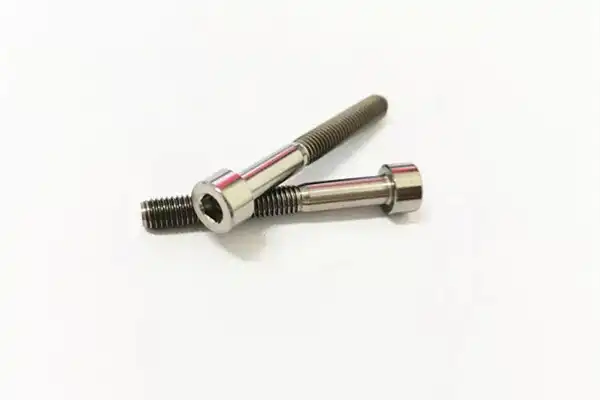
The Deutsches Institut für Normung (DIN) says that DIN 912 nuts are hexagon socket head cap bolts. They are the same as ISO 4762 bolts everywhere in the world. Once upon a time, DIN 912 titanium bolts were only made from stainless steel, alloy steel, or carbon steel. They are now very well known in high-performance businesses. Titanium Grade 2 (almost pure titanium) or Titanium Grade 5 (Ti-6Al-4V metal) is mostly used to make these bolts. These things don't rust easily, are strong for how light they are, and do a good job when other things fail.
DIN 912 Bolts Materials
What Defines a DIN 912 Bolt?
A certain type of metric socket head cap bolt has a circle-shaped head and a hexagon-shaped drive on the inside. The number 912 stands for this bolt. There isn't enough room for hex head nuts in this area, but this type of fastener can because it can handle enough force. Standardized measures make it possible for all machines, tools, and parts to work with each other. The need for them for precise building comes from this.
Common Materials Used in DIN 912 Bolts
Different kinds of materials are used to make DIN 912 nuts for different jobs. It is cheap and strong enough for most jobs, so carbon steel is a good choice. Alloy steel has a higher tensile strength, which means it can handle heavier loads. 304 and 316 stainless steel don't do a great job of resisting rust, so they work well in mild environments. Certain things need to be very light but still be able to hold a lot of weight.
Titanium is not the same, though. How well it doesn't rust and how strong it is are about the same as those of stainless steel and alloy steel. It also makes things lighter than metal does without weakening them.
Titanium Grades for DIN 912 Bolts: Grade 2 vs. Grade 5
Titanium Grade 2 is the most pure type that you can buy. Air and a very small amount of iron make up the other 99.2%. Only about 345 MPa of tensile strength, which means it's not very strong. But it's easy to shape and doesn't rust. There are times when Grade 2 is better than Grade 1 because it can handle weather better. Like tools for making chemicals or things for the ocean.
Titanium Grade 5 (Ti-6Al-4V) is an alpha-beta metal that has about 4% vanadium and 6% aluminum. It is possible to pull this metal apart at least 895 MPa and then back together at least 828 MPa. It's about the same as high-quality steel nuts. Grade 5 is best for sport cars, planes, and high-performance cars because it doesn't rust and can handle a lot of stress, pressure, and temperature changes.
Both grades form a TiO2 (TiO₂) layer on top when they are exposed to air. The metal doesn't get harmed by saltwater, acids, or industrial chemicals because this layer fixes itself.
How Titanium Compares to Traditional Bolt Materials
Titanium does not rust as quickly as stainless steel, especially when it comes to chlorides and sulfides, which are what cause rusting in marine settings to pit and crack. DIN 912 titanium bolts are about 45% lighter than steel. The system is lighter without being weaker because of this. Titanium stays strong at high temperatures (up to 400°C), but aluminum breaks down. It doesn't rust either when mixed with carbon fiber structures.
Even though titanium nuts cost more than steel bolts at first, the extra money is often worth it because they work better, last longer, and need less upkeep. Titanium is used for important fasteners in naval engineering, medical systems, and space travel. If these fasteners fail, bad things can happen in all of these areas.
Key Performance Attributes of DIN 912 Titanium Bolts
Superior Tensile Strength and Mechanical Properties
Pulling strength is about the same as Class 8.8 steel fasteners and very close to Class 10.9 steel fasteners. Engineers can use smaller, lighter nuts instead of these because they are strong enough to hold more weight. It doesn't break completely when it's stressed because it has a high yield strength. In other words, the machine stays together through many load cycles.
Titanium's modulus of elasticity is somewhere between aluminum and steel in terms of how flexible it is, with a number of 114 GPa. It's good for things that need to be strong and bendy because of this. This makes it so that there is less force at the bolt holes. When used in dynamic ways, like in suspension parts or machinery that moves, this makes fatigue breaks less likely.
Exceptional Corrosion Resistance
That's because titanium nuts have an oxide layer on them that stops oxygen from reacting with the metal. Titanium does not rust in salt water, so the navy can use it without any coatings. Titanium bolts are used in chemical plants because they can handle harsh chemicals like chlorine, bleach, sulfuric acid, and caustic solutions that quickly break down stainless steel.
Unlike coated steel bolts, these nuts are not as strong when they are scratched or worn down. But titanium's oxide layer can heal itself, so the bolt won't rust as long as it lasts. The layer won't wear off because of this feature. This is something that often happens when something is used in rough circumstances.
Weight Reduction Benefits
Grade 5 titanium bolts are only 4.43 g/cm³, while steel bolts are 7.85 g/cm³. DIN 912 titanium bolts work better than steel bolts in places like wheels, brake pads, and chassis where there is extra weight. This makes the cars handle, go faster, and stop better.
Titanium is really light, which helps planes move more or use less fuel. Titanium bolts are more of an investment than a buy of parts because they save a ship one kilogram of fuel over its lifetime.
Dimensional Standards and Identification
You can get DIN 912 titanium bolts in lengths from 6 mm to 250 mm and thread sizes from M1.6 to M24. Because we're good at making everything, we can put together a lot of different things. You can choose between standard hex socket caps and torx drives for uses that need to send more power or be harder to mess with.
Real titanium nuts should have the right grade marks, proof that the material is safe, and signs that they can be watched. ASTM B348 (titanium bar standards) and ASTM F468 (titanium fastening standards) say that buyers should keep material test records (MTRs) that show what chemicals are in the goods and how they work. The teams that buy things need to be sure of this.
Surface finishes include natural (mill finish), anodized (Type II or Type III for color coding and more surface strength), or coat it with PVD (Physical Vapor Deposition). Each finish choice is useful or beautiful in its own way, and they all keep the titanium underneath from rusting.
Why Choose Titanium DIN 912 Bolts?
Functional Advantages Summary
Titanium socket head cap bolts are very useful because they have unique qualities that doesn't happen very often in the same material. High strength-to-weight ratio enables lighter assemblies without structural compromise. When it doesn't rust easily, it gets rid of protective covers and goes longer between service calls. Since it's not magnetic, it can be used for work in tech and medicine. Biocompatibility allows medical and food processing applications. Temperature stability maintains performance from cryogenic to elevated temperatures.
These advantages translate directly to operational benefits: reduced fuel consumption in transportation applications, lower maintenance costs in corrosive environments, improved performance in weight-sensitive assemblies, and enhanced reliability in critical systems.
Importance of Quality Assurance
You don't have to worry about the quality of the things you buy as long as the company is ISO 9001 certified and has clear standards for quality. Material certificates should show that the grade is correct and be able to be traced back to the original titanium mill where the metal was made. We check the length, head height, socket depth, and thread pitch limits to make sure they follow the rules for DIN 912 titanium bolts.
Suppliers should offer technical support to help with choosing materials, finishes, and the best ways to install things. When parts are cold welded, they usually need special oils or anti-seize agents to keep them from getting stuck together. People with titanium pins that have been taken care of by professionals before the surgery only
Building Supplier Relationships
A reliable titanium fastener seller that you buy from often can help you in more than one way. Preferred providers give priority access to inventory when supplies are low, meet urgent delivery requests, and work together to come up with custom solutions for changing project needs.
You can find partners who can help with complicated procurement needs by giving suppliers trial orders, reading customer reviews, and checking their technical knowledge. Companies that work in the aerospace, medical, or racing industries should put suppliers with relevant industry experience and certifications at the top of their list.
Conclusion
DIN 912 titanium bolts are a very high-quality way to connect things. They were made for times when regular bolts don't work. These socket head cap bolts are made from either commercially pure Grade 2 titanium or high-strength Grade 5 alloy. They are very resistant to corrosion, have a high strength-to-weight ratio, and work well in very harsh conditions. More and more industries, including aerospace, marine, automotive racing, medical devices, and chemical processing, are using titanium fasteners to improve product performance, lower maintenance costs, and make sure that operations are safe. Procurement professionals can make smart sourcing decisions that balance performance needs with budget realities when they know the material properties, performance attributes, and application considerations. This leads to better reliability and a longer service life, which adds value.
Partner with Wisdom Titanium for Your DIN 912 Titanium Bolt Needs
Baoji Wisdom Titanium Industry and Trading Co., Ltd stands ready to support your titanium fastener requirements with comprehensive manufacturing capabilities and technical expertise. As an ISO 9001-certified DIN 912 titanium bolts supplier located in Baoji Titanium Valley—China's premier titanium production hub—we offer standard and custom socket head cap bolts from M1.6 to M24 in thread sizes, lengths from 6mm to 250mm, and finishes including natural, anodized, and PVD coating. Our experienced engineering team provides material selection guidance, custom design support, and quality assurance backed by complete material traceability. Whether you need prototype quantities or production volumes, our stable supply chain and mature manufacturing processes ensure consistent quality and reliable delivery schedules. Contact our team at sales@wisdomtitanium.com to discuss your specific application requirements and receive expert recommendations tailored to your performance goals and budget parameters.
FAQs
How can I identify authentic Grade 5 titanium bolts?
Authentic Grade 5 titanium bolts should include grade markings on the head or accompanying documentation. Reputable suppliers provide material test reports (MTRs) confirming chemical composition per ASTM B348 standards. Visual inspection shows a distinctive gray metallic appearance, and titanium's low density (approximately 45% lighter than steel) provides a noticeable weight difference. Non-destructive testing methods like X-ray fluorescence (XRF) can verify elemental composition if authentication concerns arise.
Are titanium bolts compatible with aluminum components?
Yes, titanium exhibits excellent galvanic compatibility with aluminum and carbon fiber composites, unlike steel fasteners that cause accelerated corrosion in aluminum assemblies. This compatibility makes titanium the preferred choice for aerospace and high-performance automotive applications combining dissimilar materials. No insulation or protective coatings are necessary when pairing titanium bolts with aluminum components.
What precautions prevent galling during installation?
Titanium's high friction coefficient can cause galling (cold welding) during installation. Apply anti-seize compounds containing molybdenum disulfide or copper-free formulations to threads before assembly. Anodized or PVD-coated bolts reduce friction and galling risk. Control torque carefully—titanium bolts typically require 70-80% of the torque values used for equivalent steel fasteners to avoid thread damage while achieving proper clamping force.
References
- Boyer, R., Welsch, G., & Collings, E.W. (1994). Materials Properties Handbook: Titanium Alloys. ASM International.
- Schutz, R.W., & Watkins, H.B. (1998). Recent developments in titanium alloy application in the energy industry. Materials Science and Engineering: A, 243(1-2), 305-315.
- Donachie, M.J. (2000). Titanium: A Technical Guide (2nd ed.). ASM International.
- Peters, M., Kumpfert, J., Ward, C.H., & Leyens, C. (2003). Titanium alloys for aerospace applications. Advanced Engineering Materials, 5(6), 419-427.
- German Institute for Standardization. (2014). DIN 912: Hexagon Socket Head Cap Screws. Beuth Verlag GmbH.
- ASTM International. (2020). ASTM F468: Standard Specification for Nonferrous Bolts, Hex Cap Screws, and Studs for General Use. ASTM International Standards.