
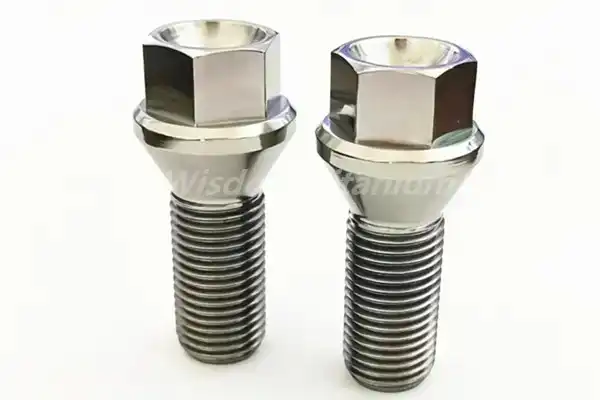
BMW vehicles use several bolt materials depending on the application — steel for general structural points, aluminum for weight-sensitive areas, and titanium for performance-critical components like wheel hubs. Among these, the BMW titanium bolt has become the preferred upgrade for enthusiasts and tuners. Made from Grade 5 Ti-6Al-4V alloy, titanium wheel bolts offer tensile strength above 950 MPa, weigh up to 45% less than steel equivalents, and resist corrosion in road salt and moisture. They come in M12×1.5 and M14×1.25 thread sizes, fitting the 5×120mm bolt pattern common across BMW E, F, and G platform models.
BMW Bolt Types and Applications
Engineers at BMW choose bolt materials based on how much weight they need to be and how much load they will be exposed to. Buyers can find the right replacement or upgrade parts if they know which materials go where.
Steel Bolts: The Default Choice
All of BMW's frame, suspension, and engine parts are held together with steel bolts. Not only do they cost less than specialty materials, but they also clamp heavy loads well. But steel makes things heavier. For example, a 5 Series's full set of 20 steel wheel nuts weighs about 560 grams, while titanium ones weigh about 300 grams.
Aluminum Bolts: Lightweight but Limited
In parts of the car's interior and body where loads are low, BMW uses aluminum fasteners. Silver is lighter than steel, but it rusts more quickly when exposed to road salt and changes in temperature. It can't be used in safety-critical wheel and brake applications because it doesn't hold up well against fatigue.
Titanium Bolts: The Performance Upgrade
If you want to make your car faster or improve the M-series, bmw titanium bolt is the best choice. They pass tests for strength and rust at the same time, which is something that steel and aluminum can't do. For most BMW models, the 5×120mm bolt pattern is standard. Titanium options come with either hex or Torx heads to match OEM tool requirements.
In-Depth Analysis of BMW Titanium Bolts
Grade 5 titanium, designated Ti-6Al-4V, combines 6% aluminum and 4% vanadium to produce a material with aerospace-grade mechanical properties. This alloy is the standard specification for high-performance automotive fasteners.
Mechanical Properties That Matter
Wisdom Titanium's BMW-spec bolts meet the following verified data points:
- Tensile strength: above 950 MPa
- Yield strength: 880 MPa
- Density: approximately 4.43 g/cm³, versus 7.85 g/cm³ for steel
- Weight reduction: up to 45% compared to equivalent steel bolts
These figures align with ASTM F136 and ISO 10664 standards commonly referenced in automotive fastener procurement.
Thread Sizes and Lengths for BMW Models
BMW E, F, and G platform models use two primary thread specifications. Getting the length right prevents both under-engagement and hub interference:
- M12×1.5 — used on older E-platform models including E46, E90, and E60
- M14×1.25 — standard on F and G platform models including F30, F80 M3, G20, and G80 M3
- Available lengths: 28 mm, 35 mm, 40 mm, 43 mm, and 45 mm
Selecting the correct length depends on wheel spacer thickness and hub depth. Most tuners running 5–10 mm spacers move from 28 mm to 35 mm or 40 mm bolts.
Surface Finish Options
Two finish options serve different buyer needs. Polished titanium gives a silver mirror look that photographs well for product listings. PVD gold coating adds a premium visual contrast against dark or silver wheels and holds color consistently across batches. Batch-to-batch PVD color consistency is a documented pain point across the industry — Wisdom Titanium controls this through tightly managed coating cycles and pre-shipment color matching checks.
Comparing BMW Titanium Bolts With Other Bolt Materials
The decision to switch from OEM steel to titanium comes down to measurable data, not just aesthetics. Here is how the three main materials compare across key performance categories.
Strength-to-Weight Performance
Steel bolts typically reach 600–900 MPa tensile strength depending on grade. A BMW titanium bolt above 950 MPa delivers equal or better strength at 45% less mass. Aluminum falls well short — most automotive-grade aluminum fasteners cap at 250–310 MPa tensile strength, making them unsuitable for wheel applications.
Corrosion and Fatigue Resistance
Steel bolts corrode without protective coatings, especially in road salt environments common across northern U.S. states and Germany. Titanium forms a stable oxide layer naturally, requiring no coating to prevent rust. Titanium also has a fatigue endurance limit that remains stable under cyclic loading — a property that steel eventually loses over extended service life.
Long-Term Cost Per Vehicle
An upfront price premium of 3–5× over steel is offset by longer service intervals, zero rust seizure, and reduced labor at wheel removal. For sellers building BMW-specific product listings, titanium bolts carry higher average selling prices and stronger customer retention, which translates to better listing economics on Amazon and independent store platforms.
Procurement Insights for BMW Titanium Bolts
It takes more than a low unit price to find the right titanium wheel bolts on a large scale. Specification accuracy, MOQ flexibility, and finish consistency are all things that affect the total cost of the supply chain.
Specification Verification Before Ordering
When the thread pitch or bolt length doesn't match, the fitting fails, which leads to returns and bad reviews. Before you place an order, make sure that the thread size (M12×1.5 or M14×1.25), length, and head style (hex or Torx) match the BMW model year and wheel spacer combination you want. A organized specification table cuts down on the amount of back-and-forth that happens during the question stage.
MOQ Structure and Mixed-Spec Orders
Wisdom Titanium requires a total of 100 pieces to be ordered before they will ship. Within that 100-piece limit, mixed-specification orders that include more than one thread size and length are allowed. This system lets sellers keep a variety of BMW models in stock without putting too much money into large inventory of just one model.
Packaging and Lead Time
You can have your orders packed in 10- or 20-piece retail sets with your own barcodes. For specifications that are already in stock, the standard lead time is 15 business days. If sellers ask for it, FBA-ready packaging is available, which helps them meet Amazon's prep requirements without having to do any extra work.
Why BMW Titanium Bolts Are Worth the Investment
It makes sense for a business to keep BMW titanium bolts in stock. These items are worth the work it takes to find because they have a higher average selling price, a lower rate of returns due to proper fitting, and a high keyword search volume across BMW model terms.
Performance Gains for End Users
A full set of 20 titanium lug bolts can cut the unsprung rotational mass of a typical BMW 3 Series by around 260 grams. Even though that number doesn't seem like much by itself, reducing the rotational mass at the wheel has a big impact on how fast the car speeds up and stops. This is something that BMW M engineers have talked about in public engineering briefings.
Sustainability and Material Longevity
Titanium doesn't rust, so it doesn't need to be replaced. This means that less material is wasted over the life of a vehicle. For sellers who want to sell to people who care about the environment, this is a real product claim based on science, not marketing speak.
Supplier Reliability Reduces Business Risk
Batch defects, color mismatches, and thread tolerance failures are less likely to happen when the quality is consistent and the manufacturer is certified by ISO 9001. Each of these types of failure is expensive for Amazon sellers. For example, a single wave of bad reviews on a wheel bolt offering can keep it from ranking for months.
FAQ
Are BMW titanium lug bolts compatible with all BMW models?
Thread size and length affect how well they work together. Most BMWs with an E-platform can use M12×1.5 tires, while F and G platform models come with M14×1.25 tires as standard. Before you order, you should always compare the hub specifications of the vehicle to those of any wheel spacers that will be used.
How can you tell if a bolt is titanium?
Titanium is not magnetic, so a regular magnet will not stick to it. It has a unique silver-gray color with a warm undertone as well. Titanium sparks aren't as strong or long as steel sparks when tested on a grinder. Another sign is weight: a bolt made of titanium feels much lighter than a bolt made of steel that is the same size.
What thread sizes do BMW wheel bolts use?
M12 1.5 and M14 1.25 are the two most common sizes. Choice should be based on the model platform. Most models in the E-series use M12×1.5, while most models in the F and G-series use M14×1.25.
What is the minimum order quantity for wholesale buyers?
The MOQ is 100 pieces, and different specifications can be used. This lets sellers cover a lot of different BMW models with a single minimum order.
Do these bolts require special installation torque?
As long as the torque wrench is properly set up, titanium nuts should be put in place. Titanium wheel bolts made for BMW are usually torqued to 120–130 Nm, but this can change based on the thread size and the application. Always follow the power specs given by the vehicle's maker.
Source Your BMW Titanium Bolt Supply Through Wisdom Titanium
Since 2016, Wisdom Titanium has been making Grade 5 titanium fasteners in Baoji Titanium Valley, Shaanxi Province, which is the hub of China's titanium supply chain. The company is certified by ISO 9001. We offer Bmw titanium bolt manufacturer-grade products with full specification coverage, including M121.5 and M14.25 thread sizes, lengths from 28 mm to 45 mm, hex and Torx head styles, and polished or PVD gold finishes. To get a tiered quote right away, send your specification table to sales@wisdomtitanium.com or go to www.wisdomtitanium.com.
Conclusion
Different parts of a BMW car use bolts made of steel, aluminum, and titanium. BMW titanium bolts are stronger, lighter, and less likely to rust than steel ones used in wheel uses. They can withstand tension loads of more than 950 MPa and are 45% lighter. As a result of being able to fit specific BMW models, looking good, and lasting a long time, titanium wheel bolts are a good choice for buyers who want to make significant profits. The easiest way to build a reliable listing and a cycle of repeat orders is to buy from a manufacturer that has been checked out and whose finish quality is always the same.
References
- Boyer, R., Welsch, G., & Collings, E. W. (Eds.). Materials Properties Handbook: Titanium Alloys. ASM International, 1994.
- Donachie, M. J. Titanium: A Technical Guide (2nd ed.). ASM International, 2000.
- ASTM International. Standard Specification for Wrought Ti-6Al-4V Alloy for Surgical Implant Applications (UNS R56401). ASTM F136, 2013.
- Society of Automotive Engineers. Titanium Alloys in Automotive Applications: Engineering and Performance. SAE Technical Paper Series, 2008.
- Lütjering, G., & Williams, J. C. Titanium (2nd ed.). Springer, 2007.
- ISO. ISO 10664: Hexalobular Internal Driving Feature for Bolts and Screws. International Organization for Standardization, 2005.