
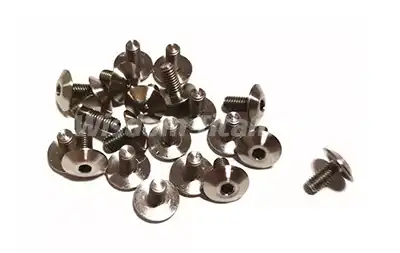
When it comes to thread width and pitch, M3 titanium bolts usually have an error range of ±0.05mm to ±0.10mm. This range depends on how they were made and the grade standards. Manufacturers of Grade 5 titanium bolts with machined heads and rolled threads, like Wisdom Titanium, meet exact tolerances within ISO 4762 standards. This makes sure that the bolts work perfectly in important applications in the medical, aerospace, and automotive industries, where precise dimensions affect the safety and integrity of the assembly.
M3 Titanium Bolts: Specifications and Tolerance Fundamentals
Defining M3 Titanium Bolt Specifications
Precision metric screws called M3 titanium bolts have a minimum thread width of 3 mm and a normal coarse pitch of 0.5 mm. The main material used to make these specialized screws is Grade 5 (Ti-6Al-4V) titanium metal, which has a very high strength-to-weight ratio and is very resistant to rust. The hexagonal head shape is best for applying torque, and the metric threading makes sure that it works with all foreign industrial standards.
Some of the most important measurements for M3 titanium bolts are their thread width (3.0mm), pitch (0.5mm), and hexagonal head measures that meet DIN 912 or ISO 4762 standards. Length choices usually run from 5mm to 30mm, so they can be used for a wide range of tasks, from high-precision electronics to heavy-duty car parts. Knowing these basic standards helps people who work in buying make sure that new tools will work with current systems and that performance needs are met correctly.
International Standards and Manufacturing Guidelines
Tolerances for making titanium screws are very strict and follow international standards like ISO 4762, DIN 912, and ANSI B18.3. These standards set exact measurements for the correctness of the thread pitch, the size of the head, and the quality of the surface finish. Grade 5 titanium bolts must keep their thread pitch tolerances within ±0.075mm so that they can fit properly with other threaded parts.
Coordinate measuring tools and eye inspection systems must be used for full size proof as required by quality control rules. For best performance in high-vibration settings, surface finish standards usually say that Ra values should be less than 1.6µm. These strict standards make sure that the quality and dependability of the product are the same across all runs. This is especially important for safety-critical uses like brake systems in cars and aircraft parts.
Role of Tolerances in Fastener Performance
Tolerance ranges are important factors that determine how well threaded joints fit, how they work, and how long they last. Precise control over dimensions stops cross-threading during assembly and makes sure that the contact strength between matching parts is just right. Tolerances that are too tight can make assembly harder and raise the cost of production, while tolerances that are too loose can weaken joints under operating loads.
Tolerances in manufacturing have a direct effect on how stress is distributed in threaded joints. When the sizes are controlled correctly, the load is spread evenly across the thread contact areas. This stops stress builds up that could cause the part to fail early. This is especially important when using titanium, where the cost of the materials means that each part has to work at its best.
Technical Insights: Factors Influencing M3 Titanium Bolt Tolerances
Material Properties Affecting Manufacturing Precision
The unique properties of grade 5 titanium have a big effect on how well production tolerances are met. The elastic stiffness of the metal is about 114 GPa, which is about half that of steel. This makes the spring-back action different during making processes. To regularly meet goal measurements, this trait needs special machine designs and compensation factors.
Titanium doesn't transfer heat well (about 6.7 W/m·K), which can be a problem when it comes to cutting because heat buildup can change the shape of the part and speed up tool wear. Controlled cutting speeds, specialized cooling systems, and carbide tools made just for titanium machining are some of the ways that manufacturers deal with these problems. For tight error ranges to stay in place during production runs, these process controls are necessary.
Manufacturing Methods and Precision Control
When making a machined head, CNC turning processes are used, which give better accuracy in measurements than cold-forming methods. The cutting process makes it possible to get hexagonal shapes that are accurate to within ±0.02mm and keep the quality of the surface finish. This level of accuracy makes sure that the tools connect properly and that the force is transmitted correctly during assembly.
When it comes to wear strength, rolled thread manufacturing is better than cut thread manufacturing. It also keeps the dimensions very accurately. The cold-forming method makes the thread surface harder, which makes it 15-20% stronger than polished threads in terms of tensile strength. With the right die design and process parameter control, you can always get thread pitch accuracy within ±0.05mm.
Quality Assurance and Measurement Protocols
During the whole production process, advanced measurement tools make sure that tolerances are met. Coordinate measuring tools check important measurements like hexagon head shape, thread size, and major diameter. Statistical process control keeps an eye on measurement trends to find possible changes before they hurt the quality of the product.
Profilometry is used for surface finish testing to measure Ra values and find surface flaws that could affect performance. Analysis of the thread shape shows that the side angles and root radius sizes are correct according to ISO standards. These detailed measurement methods make sure that the goods that are supplied meet or go beyond the acceptable limits that have been set.
Comparing M3 Titanium Bolt Tolerances with Alternative Materials
Tolerance Comparison Across Material Types
Stainless steel M3 nuts usually have the same clearance ranges, but because of the way the material is made, they need to be made in different ways. Because steel has a higher elastic modulus, its spring-back properties are easier to predict. This could make it possible to use tighter limits in some situations. But titanium's better resistance to rust often means that slightly looser standards are okay in exchange for longer service life.
Aluminum M3 bolts usually have bigger error ranges because the material isn't as strong and tends to bend more during production. Titanium bolt tolerances are ±0.05mm to ±0.10mm, while aluminum bolt tolerances are ±0.10mm to ±0.15mm. In precision situations where tight fits are necessary for the job to do right, this difference becomes important.
Manufacturing Complexity and Cost Considerations
Making titanium bolts requires special tools and knowledge, so the process rules are stricter than with other materials. Manufacturers can get regular tolerance ranges while keeping production costs low by investing in precise tools and quality systems. These features make titanium's high price worth it by making it work better and last longer.
The cost of materials for Grade 5 titanium is much higher than those for stainless steel or aluminum. To make production more cost-effective, it is important to optimize tolerances. Precision production cuts down on waste and extra work while getting the most out of expensive raw materials. Because of this cost reason, industrial methods and quality control systems are always getting better.
Performance Advantages in Critical Applications
Titanium has a very high ratio of strength to weight, which gives it performance benefits that support stricter tolerances. In aircraft uses, 45% less weight than steel screws helps improve fuel economy and carrying capacity. These benefits usually outweigh the extra costs that come with making things with more accuracy and tighter tolerances.
Biocompatibility rules in medical uses need both pure materials and exact measurements. Titanium M3 nuts that are used in surgery tools need to be able to keep tight specs and not rust in biological settings. Because these uses are so specific, investing in precise manufacturing and quality assurance methods is a good idea.
Practical Applications and Procurement Considerations for M3 Titanium Bolts
Industry-Specific Requirements and Applications
In automotive uses, M3 titanium bolts are needed that can handle high temperatures and vibrations while still staying the same size. These screws are used in brake caliper systems because they don't rust and are strong even when they're used in tough conditions. Racing teams really like the benefits of lowering weight because it makes the car perform better and handle better.
M3 titanium bolts are used by companies that make medical devices for surgery tools and internal gadgets that need to be biocompatible. Because it isn't magnetic, it doesn't mess up MRI systems, and it keeps its mechanical strength even after being sterilized many times. Tolerance accuracy is very important for making sure the device works right and for patient safety.
For aerospace electronics, M3 titanium bolts are needed to keep sensitive parts in place while being electromagnetically compatible. Because it is not magnetic, it doesn't mess up signals used for tracking and transmission. Dimensional accuracy makes sure that links work well in places where temperatures change a lot and there is a lot of mechanical stress.
Supplier Evaluation and Quality Assurance
When looking at M3 titanium bolt providers, ISO 9001 certification is a good starting point for quality control. For more important uses, though, you may need more aircraft certifications. An evaluation of a company's manufacturing capabilities should include details about the machines it uses, how it checks for quality, and how it uses statistical process control. These things have a direct effect on the supplier's ability to keep limit ranges the same from one production run to the next.
Material tracking is very important for uses that need verified qualities and performance features of the material. For each output lot, suppliers should give mill test certificates, chemical makeup analyses, and checks of the mechanical properties. This paperwork makes sure that the application's unique needs and government standards are met.
Procurement Strategies and Cost Optimization
When buying in bulk, unit costs can go down while supply chain steadiness is maintained for high-volume uses. Standard M3 titanium bolts have production wait times of 7–15 days, which lets you plan your inventory well while still being able to meet pressing needs. Payment terms like PayPal and T/T make it easier to do business when buying things from other countries.
Customization lets sellers change standard goods to fit the needs of specific applications without having to spend a lot of money on new tools. Lengths that range from 5 mm to 30 mm allow for a wide range of building needs while still keeping manufacturing economies of scale. This makes it easier to choose the right parts for each application while reducing the need for supplies.
Ensuring Optimal Selection: Tips for Procurement Managers and Engineers
Critical Selection Criteria and Performance Requirements
Instead of chasing after unnecessarily tight tolerances that raise costs without improving performance, procurement workers should focus on tolerance specs that match the needs of the application. Knowing the connection between clearance ranges and practical needs helps choose parts that are both cost-effective and meet quality standards.
The environment has a big impact on the tolerances that are needed because heat expansion and rust can change the long-term security of dimensions. Applications that are exposed to high or low temperatures may need tighter starting limits to account for thermal growth. On the other hand, titanium's natural resistance to corrosion makes it a good choice for places that are salty.
Risk Mitigation and Supply Chain Management
Supplier diversity strategies lower the risks of production delays or quality problems while keeping prices low by giving companies more than one way to get the materials they need. Building ties with approved providers in different parts of the world makes the supply chain more stable and less reliant on a single source.
As part of quality audits, suppliers should be evaluated on a regular basis on their manufacturing skills, quality methods, and efforts to keep getting better. In addition to finding ways to improve performance and cut costs, these reviews make sure that tolerance standards are always being met.
Conclusion
When buying workers know the clearance values for M3 titanium nuts, they can make choices that combine performance needs with cost concerns. Grade 5 titanium bolts with limits of ±0.05mm to ±0.10mm are very reliable in the medical, aircraft, and automobile industries, where they are used in tough situations. Titanium screws are worth the money for important jobs where failure is not a choice because they are made with exact control, quality assurance, and better material properties.
Partner with Wisdom Titanium for Precision M3 Titanium Bolt Solutions
Wisdom Titanium delivers exceptional M3 titanium bolt manufacturing services with Grade 5 material specifications and tolerance ranges meeting the most demanding application requirements. Located in Baoji Titanium Valley, our ISO 9001-certified facility leverages China's most comprehensive titanium industry cluster to provide consistent quality and competitive pricing. Our experienced engineering team specializes in machined head and rolled thread production with 7-15 day lead times, ensuring your projects stay on schedule. Contact our sales team at sales@wisdomtitanium.com to discuss your specific requirements and experience why leading automotive, aerospace, and medical device manufacturers trust us as their preferred m3 titanium bolt supplier.
FAQ
What is the standard tolerance for M3 titanium bolt threads?
The standard tolerance for M3 titanium bolt threads typically ranges from ±0.05mm to ±0.10mm for thread diameter and pitch dimensions, conforming to ISO 4762 specifications for precision fasteners.
How do manufacturing methods affect tolerance ranges?
Manufacturing methods significantly impact achievable tolerance ranges. Machined heads provide tighter tolerances (±0.02mm) compared to formed heads, while rolled threads offer superior dimensional consistency compared to cut threads.
Why do titanium bolts require different tolerance considerations than steel?
Titanium bolts require different tolerance considerations due to the material's unique properties, including lower elastic modulus and thermal conductivity, which affect spring-back behavior and heat generation during manufacturing processes.
References
1. International Organization for Standardization. "ISO 4762: Socket Head Cap Screws - Metric Series." 2019 Edition.
2. American Society of Mechanical Engineers. "ASME B18.3.1M: Socket Screws - Metric Series." 2018 Revision.
3. Deutsches Institut für Normung. "DIN 912: Socket Head Cap Screws with Low Head." 2017 Standard.
4. Boyer, R. et al. "Materials Properties Handbook: Titanium Alloys." ASM International, 2020.
5. Titanium Development Association. "Guidelines for Titanium Fastener Manufacturing and Quality Control." Technical Report 2021.
6. Society of Automotive Engineers. "SAE AMS 4928: Titanium Alloy Ti-6Al-4V Bars, Forgings, and Rings." 2019 Specification.