
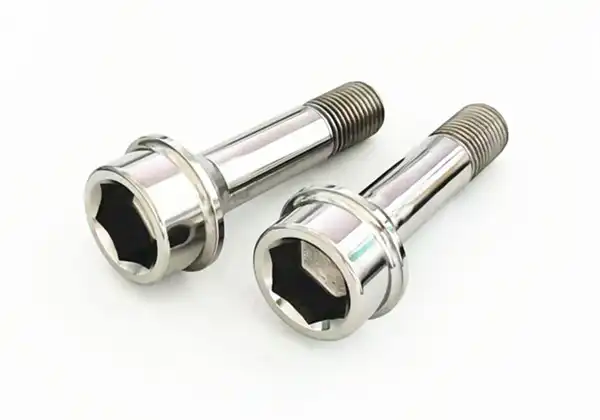
Ferrari titanium lug bolts are made out of aerospace-grade Ti-6Al-4V (Grade 5) alloy and have a tensile strength of 900-1,050 MPa (about 130,000-152,000 psi). This value is equal to or better than the ISO 898-1 Class 10.9 commonly seen in OEM steel fasteners. The bolts include a hot-forged head and rolled threads to prevent thread stripping and fatigue cracking during high-stress cycles in track driving. This strength range is the first step to selecting components that your customers – and their automobiles – can really depend on for distributors and shop owners manufacturing Ferrari-specific wheel bolt kits.
Understanding the Tensile Strength of Ferrari Titanium Lug Bolts
What Tensile Strength Means in This Context
The tensile strength of a bolt is a measure of how much weight it can support vertically before it bends or breaks over time. Every time a wheel strikes a track curb, accelerates or decelerates, or is torqued down, this force is placed on a Ferrari titanium lug bolt. If a bolt is not a minimum grade, it will strain or shear, both exceedingly hazardous for a vehicle that may drive over 200 mph.
Why Ti-6Al-4V Is the Right Alloy
Grade 5 titanium (Ti-6Al-4V) is composed of 6% aluminum and 4% vanadium. The density is 4.43 g/cm3, 43% less than steel, yet the yield strength remains about 880 MPa. It also forms an oxide layer that repels salt, brake dust, and road chemicals from the surface, without the need for an additional cover. No other bolt has these attributes, and no steel bolt can top the weight savings.
Ferrari OEM Standards and Certification
Threads of M14 x 1.5 mm size are present in all model lines of Ferrari. Anything beyond this range, even by 0.05 mm, and the bolt may cross-thread or not seat correctly in the hub. Quality-conscious suppliers utilize spectrometry reports to verify the composition of Ti-6Al-4V, laser measurements to verify sizes, and proof-load tests at 950 MPa or higher to ensure they meet ASTM B348 criteria. These records protect wholesalers in case a customer ever requests tracking information on the items.
Comparison of Ferrari Titanium Lug Bolts vs. Alternatives Based on Tensile Strength
Titanium vs. Steel: Strength-to-Weight Ratio
Most lug bolts are composed of Class 10.9 steel and weigh 65 to 75 grams. A Ferrari titanium lug bolt weighs 35–40 g. That’s around 0.6 to 0.7 kg of spinning, unsprung mass taken off the corners of the automobile. This alters the operation of the suspension and the sensation of the brakes. Steel and Ferrari titanium lug bolts are quite close in tensile strength. Titanium is significantly lighter than steel, and that’s why Ferrari employs so much of it in their racing vehicles.
Titanium vs. Aluminum: Where Aluminum Falls Short
Sometimes the aluminum lug bolts are lighter than the titanium ones. But this is well below the Class 10.9 requirement. Their tensile strength is just 300 to 500 MPa. When the track slows down and speeds up a lot, it rubs against the steel hub. Aluminum fasteners may wear out and shatter . The weight reductions don't justify the structural damage; hence, they aren't stocked by most high-end establishments anymore.
OEM vs. Aftermarket: What the Data Shows
Not every titanium aftermarket bolt is the same. Grade 2 titanium is economically pure titanium, but its tensile strength is only 345-500 MPa, which is only half the strength of Grade 5. The grade of the metal is the most significant line on the spec sheet. You have to include it in your purchase order. Sometimes, wholesale buyers who neglect this stage won’t find out until a customer’s wheel begins to wobble in a weird manner while it’s rolling at high speeds.
Installation and Maintenance Best Practices to Preserve Tensile Integrity
Correct Torque and Tooling
The standard range for the M14 wheel nuts on Ferrari is 100 to 120 Nm depending on the year of the vehicle. Titanium is less prone to galling than steel; therefore, always verify with the bolt manufacturer as to whether they suggest a dry torque or some specific anti-seize compound. Check the torque wrench to confirm it has a 17 mm hex pin. It’s not safe to run an impact wrench without a torque-limiting extension. Over-tighten a Ferrari titanium lug bolt, and you will rip the head off, and it will never bear a load again.
Thread Preparation and Anti-Galling
If you assemble the threads dry and with a lot of tension, titanium may become caught in a steel hub hole. Rolled threads have the grain run all the way through like cut threads. This helps them last a lot longer. Prior to installation, clean the hub bore of debris or dust using a thread chaser. Then apply a little coating of a titanium-safe anti-seize product. This small thing helps extend the life of the nuts and is easy to remove in the future, even after a number of track days.
Inspection Schedule for High-Frequency Use
Workers on the track should inspect the lug bolts every 500 km or after each race. Look for bent threads, tiny fractures in the bolt shank, or worn PVD coatings where the two will contact. If a bolt has stretched beyond its initial length, it has crossed its yield point. It must be changed immediately. You may also utilize a torque log to see whether you need to re-torque a certain hub location time and time again. That could suggest the problem isn't the nuts, but the hub face or the spacers.
Procurement Insights: How to Source High-Quality Ferrari Titanium Lug Bolts
Specifying the Right Length and Seat Type
Models of Ferrari titanium lug bolts made in different decades have bolt lengths that are very different from one another. It's not the same for the 458 or F8 Tributo as the 348 and 355. You can add wheel spacers if you have M14 x 1.5 mm Ferrari titanium lug bolts in lengths of 52, 55, 62, 67, 69, and 72 mm on hand. These lengths work for most models. You should always be sure of the seat type—conical or ball seat—before you place an order. If you mix them, the bolt will sit off-center and stress will be put in different places.
Evaluating Suppliers on Color Consistency and Lead Time
PVD-finished bolts are done in black, gold, or rainbow colors. They look different, and the store owner can charge more for them, so people like to buy these. The major danger with purchasing is that the colors might vary from batch to batch. They want the same hue if a consumer buys a new pair six months later. Ask suppliers how much color variation they can tolerate and ask for an actual sample that will remain in your office and be used as the benchmark for approval. And considerable advance time is also crucial. They should be able to deliver samples to you in 7-20 days and complete production runs to them in 25-35 days. This way, you may keep the amount of goods on the floor low
Here are the primary rewards to consider before you agree to engage with a provider:
- Material Certification: Spectrometry report showing Ti-6Al-4V (ASTM B348) composition, not Grade 2 Titanium.
- Dimensional correctness: Every batch is laser tested for seat concentricity and thread pitch (M14 x 1,5 mm, tolerance 6g).
- PVD color consistency: Color-deviation standard with a reference sample per color every batch.
- Mixed-SKU flexibility: Will carry various styles & lengths from 50-100 pieces per SKU.
Custom laser engraving: You may place your shop’s logo in a clear location and instruct the machine where to locate it in the file.
The three most typical shop complaints are: garments that don't fit; colors that don't match; things that are unnamed yet compete with your brand. These guidelines will protect your shop.
Logistics and Customs Considerations
Most markets don't have rules about importing titanium, but because it is thick and looks like metal, it gets extra attention at customs. Packages are marked with an ASTM grade and a standard tariff number so that they don't get held up. Distributors in the US who work with a service that is ISO 9001 certified are less likely to be audited and get information that meets the needs of both customs and the end customer.
Conclusion
Fans of Ferrari say that Ti-6Al-4V Ferrari titanium lug bolts with hot-forged heads and rolled threads look better and work better than steel ones. The range of 900 to 1,050 MPa is not just marketing speak; it is a real standard that is well above the Class 10.9 limits. To make model-specific kits, the most important things for distributors to be sure of are the metal grade, the length, the type of seat, and how uniform the PVD color is. The item will sell itself at the track and in the shop if those four things are done right.
FAQ
1. What torque should I use for titanium lug bolts on a Ferrari?
As a general rule, Ferrari's factory specs for each model are between 100 and 120 Nm. When putting in a bolt, always check with the maker to see if they recommend dry torque or an anti-seize product that works with titanium. This is because steel and titanium have different friction coefficients.
2. Will Grade 5 titanium bolts handle track use safely?
Yes. Ti-6Al-4V is good enough for Class 10.9 because its yield strength is around 880 MPa and its tensile strength is between 900 and 1,050 MPa. They can be used for many high-stress track drives because the rolled threads make them even more durable.
3. How much weight do I actually save?
In general, a steel lug bolt weighs between 65 and 75 grams, while a titanium one weighs between 35 and 40 grams. Each car saves about 0.6 to 0.7 kg of unsprung, spinning mass with a full set of 20 bolts.
4. Can I use these bolts with wheel spacers?
If so, make sure the addition you order is the right length. The thickness of the spacer tells you how long the bolt needs to be in order to keep at least 7–8 full thread engagements into the hub.
5. How do I prevent galling during installation?
Clean the hub hole first, use bolts with rolled threads, and put on a thin film of titanium-safe anti-seize compound. When steel hubs are dry and have a lot of clamp load on them, titanium bolts should never be put on them.
Get a Quote from Wisdom Titanium — Ferrari Titanium Lug Bolts Supplier
Wisdom Titanium makes Ferrari titanium lug bolts that are ISO 9001-certified and come in six different lengths (52–72 mm). They can have a PVD black, gold, or rainbow finish, and you can have your own design laser-engraved on them. Our company has been around since 2016 and is based in Baoji Titanium Valley in Shaanxi Province. This is the biggest combined titanium production hub in China. We can take mixed-SKU orders as little as 50 pieces per length. Email our sales team at sales@wisdomtitanium.com to get samples or a quote for a large order.
References
1. ASM International. Titanium: A Technical Guide. ASM International, 2000.
2. ASTM International. ASTM B348: Standard Specification for Titanium and Titanium Alloy Bars and Billets. ASTM International, 2019.
3. ISO. ISO 898-1: Mechanical Properties of Fasteners Made of Carbon Steel and Alloy Steel. International Organization for Standardization, 2013.
4. Boyer, R., Welsch, G., & Collings, E. W. Materials Properties Handbook: Titanium Alloys. ASM International, 1994.
5. Bickford, J. H. An Introduction to the Design and Behavior of Bolted Joints. 4th ed. CRC Press, 2007.
6. Society of Automotive Engineers. SAE J429: Mechanical and Material Requirements for Externally Threaded Fasteners. SAE International, 2014.