
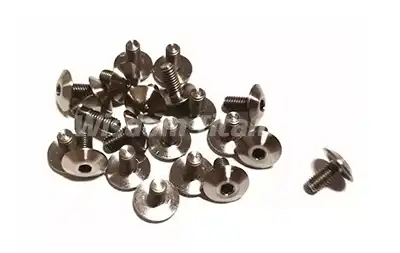
0.8 to 1.2 Nm (7 to 11 in-lbs) of force should be used to install Grade 5 titanium metal screws with M3 titanium bolts. It is normal for engineers to follow these rules, but they only apply to dry setups that don't use thread oils. The m3 titanium bolt needs to be carefully torqued because titanium is different from steel in many ways, such as having less elastic flex and more wear strength. The binding force is just right when the right amount of pressure is used. This keeps thread damage or bolt failure from happening in important car, plane, and precision machinery systems.
Titanium pins are a big improvement in how well things are made. They work better than steel choices and are different in ways that make them stand out. The measures of these one-of-a-kind parts are very accurate, like metric fitting standards, and they are made of aerospace-grade titanium metals, which are very strong.
Material Verification and Quality Assurance
Titanium nuts that are real are different from fake ones in certain ways. It looks different because of its unique gray-silver color and high-quality finish on the outside. It's not magnetic and has permeability values below 1.001, which means it can be used in medical tools and places where electricity is very sensitive.
Density tests are used for official proof. The density of real Grade 5 titanium stays the same within certain ranges. The study of chemical makeup tells us the exact amount of vanadium and aluminum that is needed to meet Grade 5 standards set by the car and airplane businesses.
Recommended Torque Specifications for M3 Titanium Bolts
One important thing to remember about titanium screws is that they work best when they are used with the right amount of force. This will also help the unit stay together and last a long time. Titanium is a unique material, so the force values that should be used for its fasteners are very different from those that should be used for steel fasteners.
Standard Torque Values and Application Guidelines
Under normal fitting conditions, the suggested force range for M3 titanium bolts made from Grade 5 material is between 0.8 and 1.2 Nm (7 to 11 in-lbs). This guideline is for dry installs that don't use thread lube and assumes that the assembly will be done at room temperature with normal thread contact.
Lubricating the thread has a big effect on how much torque is needed. Using light oil or anti-seize chemicals can lower the torque needed by 15 to 20 percent. On the other hand, setups that need specific preload values might need torque changes in the upper standard range to get the holding forces that are wanted.
Environmental and Application Factors
Conditions in the installation surroundings have a direct effect on the torque specifications that need to be met. To account for the effects of thermal expansion, applications that work at high temperatures may need lower torque values. On the other hand, cold setups often need slightly higher torque values to keep the preload at the right level at working temperatures.
When choosing a power standard, load factors are very important. For static loading, the lower part of the torque range is usually used. For dynamic or vibration-prone systems, higher torque values within the range are needed to keep the joint's integrity during cycle loading.
Common Installation Errors and Prevention
Most of the time, techs use steel fastener torque values instead of titanium fastener torque values, which leads to over-torquing. Titanium has a lower elastic stiffness, which means that too much pressure can permanently bend or break the threads, which makes the joint less reliable in the long run.
Under-torquing also leads to problems, such as not enough loading, joints coming loose when they are vibrated, and the possibility of fastener wear failure. The right way to calibrate a torque wrench and train technicians makes sure that the right torque values are always used in production and upkeep.
Comparison of M3 Titanium Bolts with Other Bolt Materials
When it comes to precision bolt uses, the choice of material has a big effect on both performance traits and buying methods. It is possible to make smart decisions about specific engineering needs when you know the pros and cons of different bolt materials.
Mechanical Property Comparison
When compared to stainless steel and aluminum nuts, titanium bolts have better strength-to-weight ratios. While stainless steel fasteners have a higher absolute tensile strength, titanium fasteners do the same job but are much lighter. This is especially important for aircraft and race uses where weight reduction directly affects speed.
Some applications need screws that are strong enough to withstand high stress, but aluminum ones aren't strong enough for those uses. When it comes to cycle loads, which is common in automobile and machinery uses, aluminum bolts don't work nearly as well as titanium ones when it comes to wear resistance.
Cost-Benefit Analysis for B2B Procurement
The initial costs of buying m3 titanium bolt fasteners are much higher than those of other materials. Usually, they are three to five times the cost of similar stainless steel fasteners. However, lifetime cost analysis shows that there are big benefits, such as longer service life, less upkeep, and no more breakdowns caused by rust.
The benefits of reducing weight directly lead to better performance for aircraft systems and less fuel use in car uses. If you optimize the weight of something, you can get better power-to-weight ratios for racing uses and less shaking and better accuracy for precise machines.
Specific Application Advantages
Titanium is used in aerospace for important structure parts because it is strong, light, and doesn't react to high temperatures. The fact that it isn't magnetic makes it perfect for placing sensitive instruments and navigational equipment.
Titanium is good for automotive brake systems because it doesn't rust and stays stable at high temperatures, especially in high-performance and race settings. The material doesn't get ruined by brake fluid or road salt, so it will last for a long time without losing its shine like chrome-plated steel screws often do.
Best Practices for Installing and Procuring M3 Titanium Bolts
To successfully use titanium screws, you need to follow certain fitting steps and plan your purchases ahead of time. These steps make sure that the best performance is achieved while taking into account the special problems that come with using high-quality fastener materials.
Installation Procedures and Torque Application
The first step in a proper fitting is to clean the threaded surfaces very well to get rid of any dirt or debris that might affect the accuracy of the force. Thread checking makes sure that the threads are properly engaged and that there is no cross-threading, which can damage expensive titanium screws beyond repair.
Using measured torque tools that are right for the range should be done slowly when applying torque. Starting with a finger-tight fitting and gradually increasing the torque until it reaches the required level ensures even stress distribution and stops rapid loads that could damage threads or bolt heads.
Procurement Strategy and Supplier Selection
Lead times for making titanium fasteners are usually longer than other materials. For common designs, they can be anywhere from 7 to 15 days. Minimum order amounts and choices to buy in bulk can save you money while making sure you have enough supplies for your production needs.
Because m3 titanium bolt are so expensive, supplier approval and quality assurance processes become very important. With ISO 9001 approval, material tracking paperwork, and measurement inspection records, you can be sure that the product is real and meets the requirements.
Quality Assurance and Incoming Inspection
Incoming checking processes should check the accuracy of the dimensions, the features of the material, and the quality of the surface finish. Thread checking makes sure that the pitch and tolerances are correct, and eye inspection finds any problems that might have happened during production or during handling.
Material proof testing, which includes hardness testing and chemical makeup analysis, makes sure that the titanium grades are met. Reviewing the documentation makes sure that the products can be traced back to approved raw materials and meet quality standards for aircraft or car products.
Troubleshooting and Maintenance Tips for Titanium Bolted Assemblies
Titanium bolt kits last longer when they are maintained properly, and problems are found before they affect the system's performance. Knowing what makes titanium screws special lets you plan for preventative maintenance.
Identifying Improper Torque Application
Over-torquing can cause threads to bend, fastener heads to break, or threads to stretch beyond their elastic limits. These problems make the bolt less able to hold weight, so it needs to be replaced right away to keep the unit from falling apart.
Joints become loose, gaps appear between fixed surfaces, or fasteners turn while they're working as a result of under-torquing. Vibration-induced loosening is a common way for joints to fail in dynamic situations where the joint's integrity is not maintained by enough loading.
Corrosion Prevention and Environmental Protection
Even though titanium is very resistant to rust, correct upkeep improves its long-term performance in harsh settings. Cleaning on a regular basis gets rid of built-up dirt and grime that could cause localized rust cells or mess up the protected oxide layer.
The frequency of inspections should depend on how harsh the working area is. For example, sea and chemical processing uses need to be checked more often. Changes in the surface's color, appearance, or contamination that could be signs of damage from the environment or galvanic rust from metals that are not the same can be seen with the naked eye.
Performance Monitoring and Replacement Criteria
Checking the torque should be a regular part of preventative maintenance plans, especially for safety-critical uses. Over time, a loss of torque could mean that a joint is settling, a material is creeping, or fasteners are breaking down and needing to be fixed.
Criteria for replacement include harm that can be seen, changes in size, or failure to keep certain force values. Because many titanium bolt uses are very important, careful replacement strategies keep systems reliable and stop sudden breakdowns.
Conclusion
The right torque standard for M3 titanium nuts guarantees their best performance and durability in demanding situations in the aircraft, automobile, and precise machinery industries. The suggested range of 0.8 to 1.2 Nm works for a variety of installation situations and stops common failure modes that happen when the wrong torque is applied. Engineers can get the most out of these high-end screws by understanding the unique qualities of Grade 5 titanium, such as its high strength-to-weight ratio and excellent resistance to rust. For execution to go well, installation steps, source selection, and upkeep schedules need to take titanium's unique properties into account compared to regular steel screws.
Partner with Wisdom Titanium for Premium M3 Titanium Bolt Solutions
Wisdom Titanium offers top-notch Grade 5 m3 titanium bolt options that are backed by ISO 9001 approval and strict quality control measures. Our factory is in Baoji Titanium Valley, which is in Shaanxi Province. It is part of China's largest titanium industry center, which gives us access to high-quality raw materials and modern working tools. For uses in aircraft, automobile, and precision machinery, our experienced engineering team can make unique fasteners with polished heads and rolled threads that meet exact requirements.
As a reliable m3 titanium bolt maker, we keep all of our raw materials and common designs in stock. This lets us offer flexible payment options, such as PayPal and T/T transfers, and shortens the time it takes to make your order. Our quality control methods make sure that all hexagon head configurations, with lengths ranging from 5mm to 30mm, are accurate in terms of size and material. Get in touch with our technical experts at sales@wisdomtitanium.com to talk about your unique needs and find out how our high-quality titanium screws can improve the performance and stability of your project.
FAQ
What is the exact torque specification for Grade 5 M3 titanium bolts?
Grade 5 M3 titanium bolts require torque specifications between 0.8 and 1.2 Nm (7-11 in-lbs) for standard dry installations. This range accounts for normal assembly conditions at room temperature with proper thread engagement. Applications involving thread lubricants should reduce these values by 15-20% to prevent over-torquing.
Can I use steel bolt torque specifications for titanium fasteners?
Steel bolt torque specifications are not appropriate for titanium fasteners due to significant differences in material properties. Titanium's lower elastic modulus and different friction characteristics require specific torque values to achieve proper preload without thread damage. Using steel torque values often results in over-torquing and potential fastener failure.
How does temperature affect titanium bolt torque requirements?
Temperature variations influence torque requirements through thermal expansion effects and material property changes. High-temperature installations may require reduced torque to compensate for thermal expansion, while cryogenic applications often need increased torque to maintain adequate preload at operating temperatures. Consult manufacturer specifications for temperature-specific recommendations.
What tools are recommended for torquing M3 titanium bolts?
Precision torque wrenches calibrated for the low torque range are essential for M3 titanium bolt installation. Digital torque wrenches with 0.1 Nm resolution provide optimal accuracy, while beam-type wrenches offer reliable alternatives. Regular calibration ensures consistent torque application across multiple installations.
How do I identify genuine Grade 5 titanium bolts?
Genuine Grade 5 titanium bolts exhibit specific characteristics including gray-silver coloration, non-magnetic properties, and density of 4.43 g/cm³. Professional verification involves chemical composition analysis confirming 6% aluminum and 4% vanadium content. Reputable suppliers provide material certification documentation and traceability records.
References
1. American Society for Testing and Materials. "Standard Specification for Titanium and Titanium Alloy Bars and Billets." ASTM B348-19, 2019.
2. Society of Automotive Engineers. "Torque Specifications for Aerospace Fasteners." SAE AS8879C, 2018.
3. International Organization for Standardization. "Mechanical Properties of Fasteners Made of Titanium Alloys." ISO 3506-6, 2020.
4. Metals Handbook Committee. "Properties and Selection of Titanium Alloys for Fastener Applications." ASM International Handbook, Volume 2, 2019.
5. Aerospace Industries Association. "Installation Guidelines for Titanium Fasteners in Critical Applications." AIA-NAS-3004, 2021.
6. European Committee for Standardization. "Fasteners - Mechanical Properties of Corrosion-Resistant Stainless Steel Fasteners." EN ISO 3506-1, 2020.