
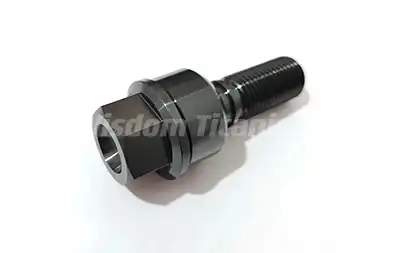
Porsche Titanium Lug Bolts should be torqued to 130 Nm (96 ft-lbs) for most recent Porsche 911 vehicles, while certain chassis versions need up to 160 Nm (118 ft-lbs). Check your exact year in the owner's handbook before installation. Titanium fasteners react differently under load than steel does—especially in terms of friction coefficients—so you must use the right amount of tension using a calibrated wrench. If you under-torque the wheels, you risk them falling off. If you over-torque the wheels, you risk galling the threads. This is for the protection of the driver and the wheel assembly.
Understanding Titanium Lug Bolts for the Porsche 911
What Makes Titanium Different From Steel
Titanium Grade 5 (Ti-6Al-4V) nut bolts are constructed of metal that is predominantly titanium (90%), with a tiny proportion of aluminum (6%), and vanadium (4%). The compressive strength of this combination is in the range of 900–1050 MPa. That is roughly the weight of Class 10.9 steel, but it's 40 to 45 percent lighter. Steel has a density of 7.8 g/cm3, but the density of Ti-6Al-4V is merely 4.43 g/cm3. The two automobiles have quite different weights, and every gram of unsprung spinning mass modifies the function of the suspension.
How Weight Reduction Affects the 911
This allows the Porsche 911 suspension to follow the road surface more accurately. You may replace the five steel lug nuts on each corner with titanium ones that will reduce 1.5 to 2.5 pounds of rotational load off each car. On the track, it helps the suspension react quicker, brakes more uniformly, and keeps wheel hubs cooler.
Corrosion Resistance as a Long-Term Advantage
Steel nuts and bolts rust. Steel nuts may become trapped within the hub and shatter as they are being removed, particularly in locations near the shore or where road salt is utilized. Titanium may rust from air, road salts, or brake dust, but it has a strong natural oxide coating that prevents metal from rusting. This isn’t only something B2B buyers who are establishing a product line around long-term trust say in an effort to encourage people to purchase it. It’s a selling factor you can quantify.
Recommended Torque Specifications for Titanium Lug Bolts on a Porsche 911
Standard Factory Torque Values by Model Generation
Porsche gives different torque numbers for different types of frames and bolts: From 1999 to 2011, the 996 and 997 generations had 130 Nm (96.4 ft-lbs) of torque. From 2012 to 2019, the 991 model had 130 Nm (96 ft-lbs), and for center-lock, similar settings on the 992 generation (2020–present), they had 160 Nm (118 ft-lbs).
- 996 / 997 generation (1999–2011): 130 Nm (96 ft-lbs)
- 991 generation (2012–2019): 130 Nm (96 ft-lbs)
- 992 generation (2020–present): 160 Nm (118 ft-lbs) for center-lock equivalent configurations
The numbers given are for screws with an M14 Æ 1.5 thread. The thread size for most Porsche 911 wheel bolts from this year is this.
Why Titanium Requires Careful Torque Management
Galling is a kind of cold welding. It is a kind of friction welding when two metal surfaces stay together. Steel, in contrast, can’t. If you use dry Porsche titanium lug bolts, they will do that. The threads should be lightly coated with a tiny quantity of an anti-seize chemical based on copper (or a specified kind) before fitting. That’s the business.” You still need to torque to the amount Porsche says you should, even if it alters the coefficient of friction. You can’t simply alter the number for no reason.
Tools and Procedure for Accurate Torque Application
Always use a calibrated digital or click-type torque wrench. Don’t over-torque Ti screws using impact guns, which may mar the polished surface and reduce the effectiveness of the moving collar system. Cross the nuts, then tighten them up one at a time. Make sure you check again. You should re-torque it after driving 50 to 80 miles to make sure you held the number you set .
Installation and Maintenance Best Practices
Pre-Installation Checks You Should Not Skip
Use a thread chaser to check the hub threads for damage, corrosion, or debris before you thread any titanium wheel bolt. Check that the bolt length works with your wheel and gap. Our M14 × 1.5 bolts come in three lengths: 29 mm, 36 mm, and 43 mm. This means they can be used with a range of wheels and spacers. Some lug bolt holes on Porsche cars can use a 19 mm hex size without an adaptor.
Step-by-Step Torque Sequence
Make sure that each bolt fits by hand before you cross-thread it. Use a star-shaped torque wrench until all five bolts on each wheel are flush with the wheel's face. Use half of the goal force on the first pass. Use all of the power on the second pass. This makes sure that the binding force doesn't put too much stress on one part of the hub flange but is spread out properly across the wheel seat.
Ongoing Maintenance and Inspection Intervals
Every time the wheels are turned, which is about every 7,500 miles, the titanium lug nuts should be looked at. Look for thread wear, damage to the finish, or changes in color. These could mean that the item was heated too much. For looks' sake, these nuts have a shiny finish. But it also lets you know right away when something is wrong. If the threads on a bolt are bent, it needs to be replaced. Keep extra bolts somewhere dry and away from metals that aren't the same.
Comparing OEM and Aftermarket Porsche Titanium Lug Bolts
OEM Bolt Standards and What They Guarantee
When it comes to thread pitch, seat geometry, and material stability, OEM Porsche wheel bolts are made to fit inside very small gaps. OEM bolts, on the other hand, are usually made of steel, and it's not easy to find titanium bolts in production form. During the guarantee period, OEM does promise that the sizes will match and the power will be steady.
What to Look for in Aftermarket Titanium Options
The threads on good aftermarket titanium nut bolts are rolled instead of cut, and they are made from forged Ti-6Al-4V bar stock. When you roll threads, the grain structure flows around the thread profile instead of being cut off. This makes the threads stronger against wear and tear. To make sure this process is working right, go/no-go gage records and material test certificates (MTC) that show agreement with ASTM B348 are used.
A smart B2B buyer should make sure that a seller meets these basic technology requirements before giving them the go-ahead:
According to the spectrometer report, the titanium is an alloy of Ti-6Al-4V, not the Grade 1 or 2 titanium that you can buy in stores. ASTM B348 says that it should be able to hold its shape at least 900 MPa.
The thread check report has go/no-go measuring data for the precision of the M14 × 1.5 thread.- Results of the salt spray test: As per ISO 9227, at least 500 hours must pass to prove claims of rust resistance.- For ISO 9001 approval, proof that the quality management system was followed by the maker
- Chemical composition report (spectrometer): Confirms Ti-6Al-4V alloy, not commercially pure Grade 1 or 2 titanium
- Tensile and proof load data: Should meet or exceed 900 MPa tensile strength per ASTM B348
- Thread inspection report: Go/No-Go gauge data for M14 × 1.5 thread accuracy
- Salt spray test results: Minimum 500 hours per ISO 9227 to confirm corrosion resistance claims
- ISO 9001 certification: Quality management system documentation from the manufacturer
When you sell safety-critical wheel bolts under your own name, these checks keep you from having to pay claims for faulty products. This is important because claims can be expensive.
Supplier Vetting Strategies for Private-Label Brands
When aftermarket brands buy porsche titanium lug bolts in groups starting at 200 pieces, they should make sure that the production process is clear, that non-disclosure agreements protect custom specs and logo designs, and that there is proof of where each batch came from. A risky provider is one that can't give you records down to the batch level.
Purchasing and Supply Chain Insights
Where Brands Source Titanium Lug Bolts
If you're looking to acquire titanium wheel fasteners from a manufacturer, you may speak to them in person, conduct some basic research on a B2B marketplace, or attend an industry trade fair like the SEMA fair or Automechanika Frankfurt. If you want steady pricing, predictable wait times, and comprehensive documentation, then direct contacts with manufacturers are generally the best option.
Cost Drivers and Return on Investment
Titanium is a more expensive raw material than steel. But performance aftermarket lug bolts that are "called" titanium always sell for 3 to 5 times the cost to create them. The additional expense is definitely worth it since the material is certified, retains its form nicely, and doesn't corrode. Options that allow manufacturers to construct their own unique SKU grid for the 911, Cayenne, Macan, and Boxster are superior to those that let them compete on price.
Packaging, Warranty, and Procurement Risk
If the retail package includes installation guidelines, torque standards, and anti-seize application recommendations, the consumer is more likely to trust the product and fewer errors will be made during installation. If private-label products have a manufacturer that stands behind them with batch monitoring and documented quality assurance, they may stand behind safety-critical items.
Conclusion
Getting the torque correct is simple on Porsche 911 porsche titanium lug bolts if you have a measured torque wrench, make sure the threads are properly anti-seized, and adhere to the original torque requirements for your chassis generation. Ti-6Al-4V is a fantastic option for wheel nuts. It is lighter, doesn’t corrode, and has nearly the same tensile strength as Class 10.9 steel. This makes it excellent for both track and road usage. Verify the material, verify the thread spec, and torque to the proper amount. It’s the same whether you’re a garage worker or a brand that wants to buy private-label fasteners.
FAQ
1. Do I need different torque specs for titanium versus steel lug bolts on a Porsche 911?
But you shouldn't change anything about the power. Porsche says to keep it at 130 Nm or 160 Nm, depending on the year of your car. Titanium needs anti-seize oil on the threads to keep them from galling. If titanium touches steel without oil, it can cold-weld under pressure.
2.. What thread size do Porsche 911 lug bolts use?
Most Porsche 911 wheel lug nuts have a thread pitch of M14 × 1.5. In general, this is true for the 996, 997, 991, and 992 models. Before you place an order, you should always make sure that the information about your car is correct.
3. Can I mix titanium and steel lug bolts on the same wheel?
It's not a good idea. When you place different kinds of screws on the same wheel, the holding force and torque behave in different ways. Use a full set of bolts that match for each wheel.
4. What lengths do titanium lug bolts come in for Porsche applications?
Most Porsche fitments come in lengths of 29 mm, 36 mm, and 43 mm. The exact length is based on the hub shape, wheel pitch, and spacer width. You need to pick the right length so that the threads connect fully and don't bottom out in the hub hole.
5. Are impact guns safe for installing titanium lug bolts?
Titanium nut bolts should not be tightened with a key. Instead, they should be put in place by hand. A lot of torque can be put on titanium surfaces that have been polished, which can damage the threads and the finish.
Source Your Titanium Lug Bolts Through Wisdom Titanium
Since 2016, Wisdom Titanium has sold titanium screws that are ISO 9001-certified. The company is based in Baoji Titanium Valley in Shaanxi Province and is China's largest combined titanium production base. We can make Porsche titanium lug bolts that are 20 mm wide and 29 mm long, 36 mm long, or 43 mm long. They will have a smooth finish and be made of Ti-6Al-4V. They come with MTC paperwork and can be tracked by batch. The MOQ is as low as 200 pieces, and NDAs can help private-label brands. Email us at sales@wisdomtitanium.com to find out more and get a price.
References
1. STM International. ASTM B348: Standard Specification for Titanium and Titanium Alloy Bars and Billets. ASTM International, 2019.
2. Porsche AG. Porsche 911 (992) Technical Workshop Manual – Wheel and Tire Specifications. Porsche AG, 2020.
3. Boyer, R., Welsch, G., & Collings, E.W. Materials Properties Handbook: Titanium Alloys. ASM International, 1994.
4. ISO. ISO 9227: Corrosion Tests in Artificial Atmospheres – Salt Spray Tests. International Organization for Standardization, 2017.
5. Bickford, J.H. An Introduction to the Design and Behavior of Bolted Joints. 4th ed., CRC Press, 2007.
6. SEMA (Specialty Equipment Market Association). SEMA Data Co-op Product Standards for Automotive Wheel Fasteners. SEMA, 2022.