
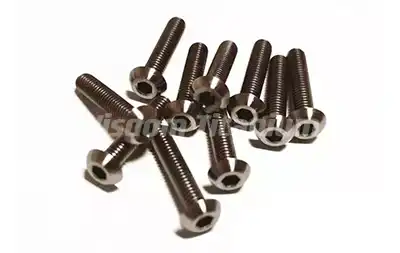
The normal pitch for an M3 titanium bolt is 0.5 mm, which is the distance between two thread crests that are next to each other. This measure standard describes the fitting shape that is needed for fasteners to connect properly and for the machine to work properly. M3 titanium nuts are made from high-quality titanium metals like Grade 5 (Ti-6Al-4V) and have a standard width of 3 mm and coarse threads. Standard metric fitting systems can use the 0.5mm pitch, and these fasteners have better strength-to-weight ratios and are less likely to rust than regular steel fasteners. By understanding this basic standard, engineers and purchasing professionals can choose the right titanium screws for accurate assembly needs in high-performance, aircraft, and automobile settings.
Pitch and Dimensions of an M3 Titanium Bolt
In precision uses, the thread size is one of the most important parameters that decides how well the parts will work together and whether they are mechanically compatible. ISO metric standards are used for M3 titanium screws. The "M3" name means that the theoretical diameter is 3 mm, and the normal coarse pitch is 0.5 mm between thread peaks.
Thread Geometry and Engineering Standards
Specific pitch values are used by metric threading systems to make sure that they can be used in all production situations. The 0.5 mm pitch on M3 titanium bolts makes the best thread contact depth while keeping the structure strong when it is loaded and unloaded. This standardization makes it possible for current metric gear systems used in the industry and car sectors to work with each other without any problems.
These exact specs are used by engineering teams to make parts that need to be fastened in a way that is both light and strong. The shape of the thread affects the force needed, the tensile strength, and the wear resistance. Knowing the exact pitch is important for installing things correctly.
Dimensional Specifications for Procurement
In addition to thread size, M3 titanium nuts have other important measurements that affect choices about what to buy. The standard outer width is 3 mm, and the lengths available vary from 5 mm to 30 mm, based on the needs of the application. Some head styles have hexagonal shapes that make them easier to use with normal tools.
When professional buyers choose titanium screws for their projects, they need to think about these size and material factors. When compared to widely pure titanium alloys, grade 5 alloys are stronger. This makes choosing the right material important for high-stress uses like race parts or aircraft systems.
Properties and Performance of M3 Titanium Bolts
When it comes to difficult uses, titanium screws' high price is justified by their superior performance. These parts are essential for businesses that need to work reliably in harsh conditions because they have high strength-to-weight ratios and excellent rust protection.
Material Composition and Mechanical Properties
It is most often used for high-performance M3 nuts and is made of Grade 5 titanium (Ti-6Al-4V), which has 6% aluminum and 4% vanadium added to it to make it stronger. Compared to steel options, this alloy mixture has tensile strengths higher than 900 MPa and a mass of only 4.43 g/cm³. This means that it is much lighter.
The process of making them uses both machined head construction and rolled threads, which makes them more resistant to wear. Rolled threads make good grain flow patterns that spread stress better and make the part last longer when it's loaded and unloaded many times, like in motorbike and car uses.
Corrosion Resistance and Environmental Performance
m3 titanium bolt's natural oxide layer protects it very well from galvanic rust, salt spray, and chemical contact. This protective TiO₂ film grows back on its own when it gets broken, so it will last for a long time without needing any extra surface treatments or layers that could make the measurements less accurate.
Environmental tests show that it works better than stainless steel choices, especially in sea settings and situations where it will be exposed to chlorides or acidic conditions. This resistance to rust makes repair times longer and lowers the total cost of ownership for important parts.
Non-Magnetic Properties and Specialized Applications
Due to the fact that titanium screws are not magnetic, they don't interact with sensitive electronics and measuring tools. This trait is very important for medical devices, precision machinery, and aircraft electronics where magnetic fields could affect how well they work or how accurately they measure things.
Procurement Insights: Buying M3 Titanium Bolts for B2B Clients
To buy titanium screws successfully, you need to know what the seller can do, what certifications are needed, and what customization options are available. Professional buyers have to find their way through complicated supply lines and make sure that the products they buy are of good quality and will arrive on time for their specific uses.
Supplier Evaluation and Quality Assurance
Titanium fastener providers with a good reputation keep their ISO 9001 certification and make sure that quality control is maintained throughout the whole production process. This determination is shown by Baoji Wisdom Titanium Industry and Trading Co., Ltd, which is based in China's Titanium Valley, which is the country's main titanium production hub. This place gives you access to a wide range of titanium processing options and well-established supply lines.
Some of the steps used to check the quality of a m3 titanium bolt product are certifying the material, checking its dimensions, and trying its mechanical properties. Suppliers should give mill test certificates that list the alloy's makeup and the heat treatment factors that affect how well the finished product works.
Customization Capabilities and Lead Times
Modern production techniques let thread specs, head shapes, and length measurements be changed to fit the needs of a particular application. Standard production times for special orders are between 7 and 15 days, but this depends on how complicated the order is and how many are needed.
Because CNC machines are so advanced, they can change standard designs to fit different fitting needs or limited room. Custom lengths outside of the normal 5–30 mm range can be made to fit specific needs while still keeping accurate measurements and a high-quality surface finish.
Payment Terms and International Logistics
Professional sellers give a range of payment choices, such as PayPal and the more standard T/T (Telegraphic Transfer) system, to meet the needs of different businesses. International shipping makes sure that customers around the world get their orders on time and that products are safe while they're in travel.
Some benefits of buying in bulk are lower shipping costs per unit and lower prices for larger orders. These benefits improve the total economics of the project. Building relationships with qualified providers gives you access to expert help and faster delivery for urgent needs.
Conclusion
The 0.5mm diameter requirement for M3 titanium bolts is just one of many engineering benefits that make them ideal for tough situations. These screws have great strength-to-weight ratios, don't rust, and are reliable over time, which is why they are priced so high. They can be used to make performance changes to cars or to precisely put together machinery.
Procurement pros can make the most of titanium's benefits by understanding its size requirements, material qualities, and the right way to put it. M3 titanium bolts are a great choice for uses that need lightweight, long-lasting, and corrosion-resistant fixing solutions because they work with a wide range of threading types and have better material performance.
Partner with Wisdom Titanium for Premium M3 Titanium Bolt Solutions
Wisdom Titanium delivers exceptional quality M3 titanium bolts manufactured to exacting specifications using Grade 5 titanium alloy. Our ISO 9001-certified facility in Baoji Titanium Valley leverages advanced CNC machining and rolled threading techniques to produce fasteners that exceed industry standards. With hexagon head configurations, metric threading, and length options from 5mm to 30mm, our products serve demanding automotive, aerospace, and industrial applications requiring superior strength-to-weight ratios and corrosion resistance. Connect with our technical team at sales@wisdomtitanium.com to discuss your specific requirements and discover why leading manufacturers choose Wisdom Titanium as their trusted m3 titanium bolt supplier.
FAQ
What is the standard thread pitch for M3 titanium bolts?
The standard thread pitch for M3 titanium bolts measures 0.5mm, following ISO metric threading standards. This coarse pitch specification ensures compatibility with existing metric hardware systems while providing optimal thread engagement for structural applications.
How do M3 titanium bolts compare to stainless steel alternatives?
M3 titanium bolts offer approximately 45% weight reduction compared to stainless steel while maintaining equivalent or superior strength characteristics. Titanium also provides enhanced corrosion resistance and non-magnetic properties, though typically at higher initial costs.
What length options are available for M3 titanium bolts?
Standard length options range from 5mm to 30mm for most applications, with custom lengths available through specialized manufacturers. Head styles include hexagon configurations that accommodate standard tool compatibility requirements.
What is the typical production time for custom M3 titanium bolts?
Production time for custom M3 titanium bolts typically ranges from 7-15 days, depending on order complexity and quantity requirements. Standard specifications may be available for immediate shipment from established inventory.
Which titanium grade is recommended for high-performance applications?
Grade 5 (Ti-6Al-4V) titanium represents the preferred alloy for high-performance M3 bolts, offering enhanced strength properties and fatigue resistance compared to commercially pure grades. This alloy composition provides optimal performance for demanding automotive and aerospace applications.
References
1. American Society for Testing and Materials. "Standard Specification for Titanium and Titanium Alloy Bolts and Screws for Structural Applications." ASTM F467-19, 2019.
2. International Organization for Standardization. "Metric Screw Threads - Part 1: Principles and Basic Data." ISO 68-1:1998, International Standards Organization, 1998.
3. Boyer, Rodney R., and Harold L. Gegel. "Titanium Alloys: Processing, Properties and Applications." ASM International Handbook Committee, Materials Park, Ohio, 2007.
4. Lutjering, Gerd, and James C. Williams. "Engineering Materials and Processes: Titanium." 2nd Edition, Springer-Verlag, Berlin Heidelberg, 2007.
5. Rack, Henry J., and James N. Qazi. "Titanium Alloys for Biomedical Applications." Materials Science and Engineering Reports, Volume 26, Issues 1-2, 2006.
6. Donachie, Matthew J. "Titanium: A Technical Guide." 2nd Edition, ASM International, Materials Park, Ohio, 2000.