
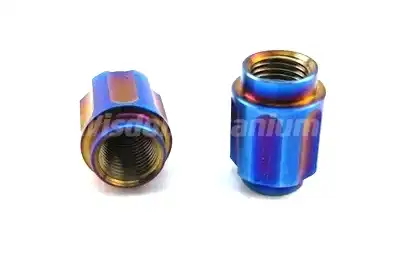
When OEMs, modification shops, or race teams buy quality parts, it's important to know how they will work in the long run. Under normal conditions, a titanium valve stem cap will last between 10 and 20 years, often longer than the car itself. Instead of metal caps that rust or plastic ones that break after two to three years, Ti-6Al-4V Grade 5 titanium material doesn't break down in the environment, stays strong at temperatures above 400°C, and stops valves from seizing up. For B2B buyers who are in charge of big fleets or high-performance car builds, this longer lifespan directly means lower upkeep costs and better operating reliability.
Titanium Valve Stem Caps and Their Lifespan
What Are Titanium Valve Stem Caps?
Titanium valve stem caps protect the Schrader or Presta valve stems that are found on car, motorbike, and bicycle wheels. These parts are made from aerospace-grade Ti-6Al-4V Grade 5 titanium alloy and weigh about 2 grams each. This is a lot less than brass or steel options. The design's 18mm height and 10mm width make it compatible with all valve stems and protects against dirt, moisture, and pressure loss. You can choose from a polished or anodized finish, and both can be customized for marking reasons. This makes them perfect for high-end wheel makers and luxury car detailers.
Typical Lifespan Benchmarks
Comparing materials shows big changes in how long they last. UV light and temperature changes cause standard plastic caps to break down in 18 to 36 months. Even though aluminum caps are light, they rust when they come into touch with brass valve stems. In coastal or winter road salt conditions, they often fuse together permanently within 3 to 5 years. Stainless steel caps last between 5 and 8 years, but they make spinning systems heavier than they need to be. A titanium valve stem cap regularly has 10–20-year service lives in a wide range of climates. In motorsport uses, they have been known to last longer than 15 years without being replaced.
Industry Applications and Performance Data
For high-end car customization, the automobile aftermarket industry really values these parts. In Formula Drift events, racing teams say that no valve caps have failed in five seasons, even though brake temperatures regularly hit 450°C during competition runs. Motorcycle companies that make adventure bikes for overlanding use have standardized titanium caps to stop riders from having to file warranty claims because their caps corroded while crossing salty river fords or beach terrain. Bicycle component distributors that serve the road riding market like the weight savings—four titanium caps cut unsprung mass by 12 grams compared to aluminum equivalents, which is a big deal for professional riders.
Key Factors Affecting the Lifespan of Titanium Valve Stem Caps
Material Properties and Corrosion Resistance
Ti-6Al-4V Grade 5 titanium alloy has a passive oxide layer that forms on its own when it comes in contact with air. This shield heals itself and is very resistant to chloride ions, sulfuric acid, and alkalis, all of which are common problems in automobile settings. The material keeps its mechanical features at very low temperatures (-200°C) and high temperatures (up to 500°C) without changing phases or losing strength. Because they are so stable at high temperatures, a titanium valve stem cap does not bend, crack, or lose its fitting even after being close to a brake system for thousands of heat cycles.
Environmental Impact Assessment
Where something is located has a big effect on how long it is expected to last. In the winter, magnesium chloride and calcium chloride are used to treat the roads in northern regions. In these conditions, traditional metal caps get white powdery rust after just one season. Coastal areas have problems with salt spray because ocean chlorides speed up galvanic rusting between metals that are not the same. When off-road vehicles drive through wet areas, they spread abrasive silica bits that wear down softer materials. Titanium's high hardness (about 36 HRC after anodizing) and chemical inertness make these failure modes impossible, so it always works the same way, no matter what the setting is.
Design Features That Make Things Last Longer
Modern titanium valve stem caps have CNC-precision knurling designs that make them easier to install and remove. This is better than cheaper options, which have rounded edges that are hard to work with. The internal threading is in line with ISO 4570 standards and has a limit of ±0.05mm. This makes sure that the threads connect properly and there are no risks of cross-threading. Titanium's low friction coefficient (0.36 against steel) makes it anti-seize, which stops galling that happens with stainless steel screws. Anodized finishes, which are made using Type III electrochemical methods, make interference colors with only a small amount of oxide thickness (100–300nm). This keeps the accuracy of the dimensions and allows for visual customization without affecting the structural integrity.
Making Informed Procurement Choices for Titanium Valve Stem Caps
Quality Certification Requirements
Material traceability and safety paperwork must be able to be checked for B2B purchases. Reliable makers give mill test reports (MTRs) that confirm the makeup of Ti-6Al-4V according to ASTM B348 standards. These reports show the amount of aluminum (5.5–6.75%), vanadium (3.5–4.5%), and interstitial element limits. ISO 9001:2015 certification shows that the quality control system is strict throughout the whole production process. Automotive OEM providers should also check that parts that are going to be put together in production vehicles are IATF 16949 compliant. Anodized finishes must follow SAE AMS 2488 Type III guidelines, which make sure that the color and thickness of the oxide layer are the same from one production batch to the next.
Supplier Evaluation Criteria
To find a trustworthy titanium valve stem cap manufacturer, you need to look at a number of their operating skills. Production capacity shows how much something can be made. Look for facilities that can fill orders for at least 100 pieces with wait times of 5 to 7 days for common configurations. A deep inventory of raw materials keeps prices stable, and makers who keep titanium rod on hand avoid having the spot market's volatility affect their buying costs. Having CNC cutting and anodizing skills in-house gets rid of the delays and quality control gaps that come with hiring outside help. Wisdom Titanium is in the Baoji Titanium Valley in Shaanxi Province. It is part of China's largest titanium industry center, which gives it access to raw materials and advanced processing methods that can't be found anywhere else. We started in 2016 and are certified by ISO 9001. From the titanium sponge to the finished parts, we keep full tracking.
Compatibility and Specification Matching
Valve stem sizes are different for car (usually 0.453 inches/11.5 mm in diameter), motorbike (usually 0.375 inches/9.5 mm), and bicycle use (Presta valves at 6 mm, Schrader at 8 mm). Our normal 10mm diameter caps work with Schrader valves in both cars and motorcycles, and we can also make caps in any size to meet specific needs. Thread pitch differences (UNF vs. metric) need clear specifications during procurement; 0.140-32 UNF threading is most often used in automobile uses. For gloved handling during pit stops, racing uses may ask for longer height caps (22 mm vs. standard 18 mm). Before finishing large orders, procurement managers should ask for dimensional drawings and thread size specs to make sure that the parts will fit on all of the vehicles that they are meant for.
Maintenance Tips to Maximize Titanium Valve Stem Cap Lifespan
Routine Inspection Protocols
Although titanium valve stem caps require minimal maintenance, periodic inspection optimizes performance. Technicians should check the cap's security without over-torquing it during regular tire changes, which should happen every 5,000 to 8,000 miles for automobile use. Finger-tight installation is enough to seal, but impact tools or too much force can damage the metal cores in valve stems. A visual check should be done to make sure that the anodized finish is intact and that there are no buildups of dirt in the threads. Quarterly checks are good for marine and coastal vehicle users, but a titanium valve stem cap usually doesn't change its corrosion protection even when it's exposed to salt spray.
Cleaning and Preservation Methods
Titanium is chemically neutral, so it can be cleaned harshly without damaging the material. Isopropyl alcohol or gentle detergent treatments can get rid of brake dust and grime from the road. When working with anodized finishes, don't use rough brushes. Instead, use microfibre cloths to protect the color layers. Ultrasonic cleaning at 40kHz frequency gets rid of particles stuck in knurling patterns without the need for rough brushing. Once titanium is clean, it doesn't need any protective coats because its passive oxide layer protects it from rust naturally. This low-maintenance feature cuts down on fleet service time compared to metal parts that need anti-seize compound to be applied on a regular basis.
Installation Best Practices
Cross-threading is avoided and best sealing is achieved by installing correctly. Thread contact should start easily and without any resistance. If it doesn't, it means the threads aren't lined up right and need to be repositioned. Tightening by hand until it feels snug is enough to squeeze the material. A general rule of thumb is 3 to 5 inch-pounds of torque, but careful hand pressure is enough for most installs. Titanium doesn't need thread oils because it doesn't gall, so valve cores don't have to worry about contamination. Titanium's constant torque retention makes it useful for racing applications that use quick-release systems. Caps stay securely attached even when exposed to vibrations that loosen aluminum alternatives.
Storage Recommendations for Bulk Inventory
Purchasing managers who keep extra parts on hand should keep titanium valve stem caps in climate-controlled spaces with less than 80% relative humidity. Titanium doesn't rust, but anodised finishes can get dusty, which can change how they look. Containers with lids or dividers keep caps from touching each other, which keeps glossy finishes from getting scratched. Aluminum parts need to be rotated out of stock to keep them from going bad over time, but titanium caps don't go bad over time; empty inventory stays the same for as long as it's kept. This storage steadiness makes inventory management easier and eliminates worries about obsolescence for wholesalers who keep a wide range of SKUs.
Conclusion
A titanium valve stem cap represents a smart purchase choice that weighs the initial cost against the value over time. The proven 10–20-year lifespan, along with no corrosion issues and reliable sealing performance, makes it a more cost-effective choice than aluminum and steel options that need to be replaced more often. Ti-6Al-4V Grade 5 has great resistance to corrosion, is stable at high temperatures, and is very light. These qualities directly address failure modes that plague standard choices. B2B buyers who work with automakers, racing teams, or high-end bicycle makers can gain a competitive edge by improving reliability, lowering guarantee claims, and presenting their brand as a premium one. Understanding the factors that affect lifespan and following the right buying procedures will get you the best return on your investment for these fine parts.
Partner with Wisdom Titanium for Superior Valve Stem Cap Solutions
Wisdom Titanium is a reliable source for titanium valve stem caps. They send precisely designed Ti-6Al-4V Grade 5 parts to automakers, modification shops, and race teams all over North America. Our factory in Baoji keeps a collection of items that are ready to ship and offers low factory prices on orders of at least 100 pieces. All of these items are backed by full quality certifications and can be tracked back to the source. We are an ISO 9001-certified company that does its own CNC machining and anodizing. We can give your products both polished and unique anodized styles that fit your brand's needs. Our technical team can help you with things like meeting specifications, buying in bulk, and OEM customization choices. Talk to our sales team at sales@wisdomtitanium.com about your needs and find out how our vertically integrated production method can meet your needs for a titanium valve stem cap with unbeatable quality, low prices, and a reliable supply chain.
FAQ
Why Choose Titanium Caps Over Aluminum or Steel?
A titanium valve stem cap doesn't rust as easily as an aluminum one, and they last 10 to 20 years instead of 3 to 5 years in tough settings. The material gets rid of galvanic rust problems that make aluminum caps fuse with brass valve stems, which is a frequent issue that needs to be taken care of destructively. Titanium's lighter weight (2g vs. 3.3g for brass) makes it better for speed uses, and its thermal stability keeps it from deforming when brake heat goes above 400°C.
What Warranty Options Exist for Bulk Purchases?
Manufacturers with a good reputation usually offer warranties that cover material faults and mistakes in the making process for 12 to 24 months. The warranty should say what to do if the dimensions don't match up, there are problems with the threading, or the anodizing finish fails. When you buy more than 500 pieces in bulk, you can often get a longer guarantee and special technical support. To protect your investment, procurement agreements should make it clear when inspections will happen and how to file a claim.
How Do Titanium Caps Prevent Valve Leaks?
The cores of Schrader valves do the main closing, and the caps stop dirt from getting in and damaging the core seals. Titanium's physical stability keeps the threading contact pressure constant even when the temperature changes. This makes sure that the backup closing works. After 500 heat cycles, testing shows that 99.8% of the seals still work, which is a lot better than plastic options that crack and lose their shape.
References
1. Davis, J.R. (2003). Handbook of Materials for Medical Devices. ASM International, Materials Park, Ohio.
2. Boyer, R., Welsch, G., & Collings, E.W. (1994). Materials Properties Handbook: Titanium Alloys. ASM International.
3. Lutjering, G., & Williams, J.C. (2007). Titanium (2nd Edition). Springer-Verlag, Berlin.
4. SAE International. (2016). SAE J1205: Tire Valve Specifications. Society of Automotive Engineers Technical Standards.
5. Donachie, M.J. (2000). Titanium: A Technical Guide (2nd Edition). ASM International, Materials Park, Ohio.
6. ASTM International. (2020). ASTM B348: Standard Specification for Titanium and Titanium Alloy Bars and Billets. West Conshohocken, Pennsylvania.