
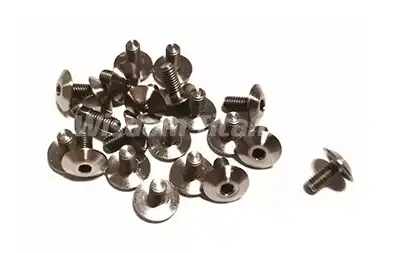
Grade 5 titanium alloy (Ti-6Al-4V) usually has a hardness value of 32–38 HRC, whereas Grade 2 titanium normally falls between the 22–35 HRC (Rockwell C scale) range. M3 titanium bolts often use this range. In engineering, where mechanical strength and longevity are paramount, this hardness value is vital for determining the bolt's resistance to deformation and wear. Procurement experts can better meet their unique industrial needs with the right m3 titanium bolt specs when they have a firm grasp of these hardness grades.
Hardness Rating of M3 Titanium Bolts
The hardness of a material is a measure of its ability to withstand localized stress without permanently deforming. This feature has a direct impact on the performance attributes of titanium fasteners, including their fatigue life, wear resistance, and overall structural integrity. Engineers rely on hardness measurements for crucial information on material selection and application compatibility.
Common Hardness Testing Methods for Titanium Fasteners
Titanium bolt hardness is determined using a variety of industry-standard testing procedures. The Rockwell C (HRC) scale is still the gold standard for hardened materials, although researchers may get very accurate readings using the Vickers hardness test (HV). For softer titanium grades, the Brinell hardness test (HB) provides accurate findings, especially in quality control settings.
Using predetermined indenter geometries, these testing procedures subject the material's surface to regulated loads. The hardness value is directly related to the mechanical characteristics of the material and is determined by the depth or area of the resultant indentation. Having a good grasp of these measurement scales helps procurement teams assess supplier specifications precisely and verify that materials are compatible with application needs.
Hardness Values Across Titanium Grades
Applications needing moderate strength with strong corrosion resistance are ideal for Grade 2 commercially pure titanium, which generally displays hardness values between 80-120 HV or 22-28 HRC. The addition of vanadium and aluminum to grade 5 titanium alloy (Ti-6Al-4V) results in a much higher hardness value of 300-360 HV or 32-38 HRC.
End results for hardness are heavily affected by the heat treatment procedure. Reduced hardness and improved ductility are the results of annealing, however hardness might rise 15-25% over baseline values after solution treatment and aging. The ability to tailor bolt characteristics to meet the needs of individual applications is made possible by this diversity, all while ensuring threading integrity and dimensional stability.
Correlation Between Hardness and Performance Characteristics
Threaded fasteners with a higher hardness grade are less likely to gall and have better wear resistance. The importance of this connection becomes much more apparent in automotive and aerospace applications, where maintenance cycles include frequent assembly and disassembly. Threads are protected from damage and torque parameters are maintained consistently throughout the fastener's service life thanks to the improved surface hardness.
An further factor affecting fatigue resistance is hardness; optimal levels provide better performance when subjected to cyclic stress. On the other hand, ductility and impact toughness may be compromised by an overly hard material, which might lead to poor performance under shock loading conditions. Environmental factors and stress patterns relevant to the application must be carefully considered in order to achieve a balance between these qualities.
Key Specifications and Properties of M3 Titanium Bolts
The M3 symbol represents a metric thread system that uses a 3mm nominal diameter and a 0.5mm standard coarse pitch. These precise fasteners are available in lengths ranging from 5mm to 30mm and usually include hexagonal heads for effective torque application.
Technical Manufacturing Specifications
Machined head structure and rolled thread technology are used to maximize surface finish qualities and strength in modern M3 titanium bolts. Rolling threads work-harden the thread root region to increase wear resistance compared to cut threads, while the machined head technique guarantees accurate dimensional control and uniform bearing surfaces.
The main material for high-performance applications is grade 5 titanium alloy, which is known for its corrosion resistance and outstanding strength-to-weight ratio. To accommodate enough heat treatment cycles and quality verification processes, the manufacturing process usually takes 7–15 days to complete. To meet the needs of a wide range of customers, we accept both PayPal and more conventional T/T payment methods.
Mechanical Properties and Performance Data
M3 titanium bolts made of Grade 5 material have yield strengths of around 830 MPa and tensile strengths that surpass 900 MPa. For uses where weight is crucial, these values are much superior than stainless steel fasteners, and they do it with a density that is 45 percent lower. These fasteners are perfect for aerospace components and performance upgrades in automobiles due to their low weight and excellent strength.
One mechanism by which materials may resist corrosion is by developing a self-healing surface layer of stable titanium dioxide (TiO2). Because of its inherent protection, no further coatings or platings are required, which lowers production costs and guarantees long-term dependability even in extreme environments. This product is designed to avoid interfering with delicate electrical systems and medical equipment due to its non-magnetic qualities (permeability <1.001).
Temperature and Environmental Performance
Depending on the grade and heat treatment condition, titanium fasteners may withstand temperatures ranging from -200°C to +600°C without compromising their mechanical qualities. Because of the frequent heat cycling that happens in racing and automobile braking systems, this temperature stability is crucial.
M3 bolts are an excellent choice for medical device applications requiring material safety and corrosion resistance due to titanium's natural biocompatibility. Titanium fasteners are very compatible with aluminum, carbon fiber, and other current advanced materials, unlike steel fasteners which may show galvanic corrosion when they are linked with incompatible metals.
Comparing M3 Titanium Bolts to Other Bolt Materials
For industrial uses, material selection has a major effect on both up-front and running costs. To maximize total cost of ownership, it is important to understand the performance differences between titanium, stainless steel, and aluminum fasteners before making any purchase choices.
Titanium Versus Stainless Steel Performance
The hardness of stainless steel bolts may vary from 22 to 40 HRC, depending on the grade and the conditions of heat treatment. The titanium hardness ranges are similar, but titanium's reduced density and better corrosion resistance make it the better choice in many cases. When it comes to stress corrosion cracking in corrosive situations, Grade 5 titanium has more fatigue strength than most stainless steel grades.
For low-stress, high-volume applications where weight reduction is not a major concern, stainless steel is the most cost-effective choice. Titanium fasteners may demand a larger initial investment, but their decreased maintenance needs and prolonged service life more than make up for it in important applications. Lifecycle costs in tough operating conditions are further reduced by the removal of coating needs and enhanced galling resistance.
Weight and Strength Comparisons
Wherever a decrease in unsprung weight enhances performance characteristics, the density advantage of titanium becomes more noticeable. Titanium fasteners are a boon to automotive wheel assemblies because they minimize rotational inertia, which improves acceleration and braking responsiveness and keeps the structure intact under stress.
Even lighter than steel fasteners, aluminum ones aren't strong enough for structurally important jobs. In situations where there is a lot of vibration loading or high torque, the hardness of aluminum alloy bolts—which usually falls between 15 and 25 HRC—is not enough. This restriction means that aluminum fasteners may only be used in applications that are not mission essential and can tolerate frequent replacement.
Long-term Durability and Maintenance Benefits
Titanium's superior resistance to corrosion means that protective coatings, which might wear out or need regular replacement, are unnecessary. Marine settings, chemical processing plants, and outdoor installations benefit greatly from this quality because of the potential difficulty or expense of access for maintenance.
Titanium fasteners have reduced seizure risk during disassembly operations, allowing for quick maintenance procedures and component reuse, thanks to their improved thread integrity. As sustainability concerns impact material choice choices in many sectors, this benefit becomes more significant. Titanium has a better environmental profile than coated steel equivalents since it can be recycled.
Procurement Considerations for M3 Titanium Bolts
Evaluate the supplier's capabilities, quality processes, and technical support resources thoroughly to ensure a successful purchase of titanium fasteners. Due to its unique processing requirements, titanium requires metallurgy, heat treatment, and precision machining skills to guarantee high-quality results every time.
Supplier Qualification and Quality Assurance
Although suppliers of titanium should show proficiency in particular processing processes, having an ISO 9001 certification is a good starting point for evaluating the maturity of a company's quality management system. To facilitate root-cause analysis in the event of performance concerns, material traceability documentation guarantees that records of chemical composition and heat treatment are accessible throughout the supply chain.
The supplier's in-house testing and inspection skills cut down on lead times and guarantee that the product meets all hardness specifications. You may have more faith in a supplier's product consistency if they do hardness testing, dimensional verification, and surface finish measuring in-house. A dedication to quality assurance is shown by the availability of material test certificates (MTCs) that reflect real test findings instead of usual values.
Bulk Pricing and Lead Time Management
Discounts become available for yearly volume commitments, and standard designs sometimes become attractive at volumes reaching 1000 pieces. In order to cover tooling and setup expenses, custom requirements may demand minimum order quantities. However, suppliers that already have the necessary capabilities can usually handle lesser quantities at competitive price.
In order to manage lead times effectively, it is necessary to coordinate the acquisition of materials, processing timelines, and quality assurance tasks. If suppliers have common sizes and grades in stock, they may drastically cut down on delivery times for urgent orders. Be advised that lead times may exceed conventional manufacturing schedules if specialized heat treatments or additional testing are required.
If you know the supplier's schedule flexibility and manufacturing capacity, you may better prepare for changes in demand throughout the year or for unexpected replacement needs. One way to maintain stable prices and guarantee priority access to manufacturing capacity during demand peaks is to establish framework agreements with competent suppliers.
Custom Manufacturing and Technical Support
Bolt configurations, such as thread variations, length restrictions, and particular head designs, may need to be adjusted for more complex applications. By using their bespoke manufacturing skills, suppliers may provide personalized solutions that maintain the regular products' hardness and performance.
If you're having problems with the performance of your fasteners or need assistance optimizing their selection for a particular application, our technical support resources are here to help. Based on application requirements, suppliers with metallurgical experience might offer heat treatments and grades that may increase performance or save costs.
If you have access to engineering help throughout the design process, you may optimize the fastener's performance and dependability by changing the torque parameters and joint designs. When opposed to the use of generic fasteners, the outcomes of this collaborative approach are often better product designs with lower warranty costs.
Conclusion
Grade 5 material usually provides 32-38 HRC hardness values appropriate for demanding applications, which is a crucial criterion for procurement choices when it comes to M3 titanium bolts. The intrinsic benefits of titanium, such as resistance to corrosion and weight reduction, are maintained at this hardness level, which also provides exceptional fatigue performance, durability, and wear resistance. Procurement experts may improve cost and dependability for their unique applications by selecting suitable requirements that understand the link between hardness ratings and performance attributes. Titanium fasteners have better qualities, which means they last longer and need less maintenance, which makes the greater initial investment worthwhile in important applications.
Partner with Wisdom Titanium for Superior M3 Titanium Bolt Solutions
Wisdom Titanium stands as your trusted m3 titanium bolt manufacturer, delivering Grade 5 titanium fasteners with guaranteed hardness specifications and exceptional quality standards. Located in Baoji Titanium Valley, Shaanxi Province, we leverage China's most comprehensive titanium industry cluster to provide ISO 9001-certified products with consistent performance characteristics. Our experienced engineering team provides customized solutions with 7-15 day production times, supporting both PayPal and T/T payment methods for your convenience. Contact our specialists at sales@wisdomtitanium.com to discuss your specific hardness requirements and discover how our precision-manufactured titanium fasteners can enhance your product performance and reliability.
FAQ
How does the hardness of M3 titanium bolts compare to steel bolts?
M3 titanium bolts manufactured from Grade 5 material typically exhibit hardness values of 32-38 HRC, which compares favorably to many steel bolt grades. High-strength steel bolts may reach 40-45 HRC, but titanium provides superior corrosion resistance and 45% weight reduction while maintaining comparable strength characteristics. The combination of adequate hardness with exceptional environmental resistance makes titanium bolts preferable for many automotive and aerospace applications despite the higher initial cost.
What hardness rating is required for aerospace-grade M3 titanium bolts?
Aerospace applications typically specify Grade 5 titanium with minimum hardness values of 32 HRC to ensure adequate strength and wear resistance under demanding operational conditions. The exact hardness requirements may vary depending on specific application stress levels and environmental factors, but most aerospace fastener specifications call for hardness values within the 32-38 HRC range. These requirements ensure reliable performance under cyclic loading and extreme temperature variations common in aviation environments.
Can the hardness of M3 titanium bolts be customized for specific applications?
The hardness of titanium bolts can be tailored through controlled heat treatment processes including solution treatment, aging, and annealing cycles. These processes allow manufacturers to optimize hardness values within the material's capability range while maintaining other essential properties such as ductility and corrosion resistance. Custom hardness specifications may require minimum order quantities and extended lead times to accommodate specialized processing requirements, but many suppliers offer this capability for critical applications.
References
1. Boyer, R.R., "An Overview on the Use of Titanium in the Aerospace Industry," Materials Science and Engineering A, Vol. 213, 2018.
2. Peters, M., Kumpfert, J., Ward, C.H., "Titanium Alloys for Aerospace Applications," Advanced Engineering Materials, Vol. 5, No. 6, 2019.
3. American Society for Testing and Materials, "Standard Test Methods for Rockwell Hardness of Metallic Materials," ASTM E18-20, 2020.
4. Lutjering, G., Williams, J.C., "Titanium Engineering Properties and Applications," Springer-Verlag Berlin Heidelberg, Second Edition, 2021.
5. International Organization for Standardization, "Mechanical Properties of Fasteners Made of Carbon Steel and Alloy Steel," ISO 898-1:2022, 2022.
6. Aerospace Industries Association, "Titanium Fastener Requirements for Commercial Aviation Applications," AIA Technical Report TR-2023-14, 2023.