
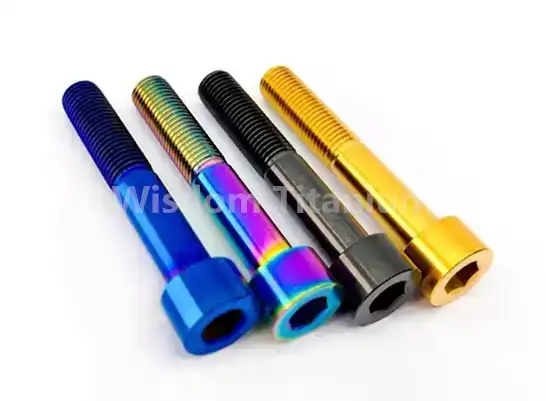
Titanium allen head bolts and titanium socket head cap screws are commonly used interchangeably in speech, although they are not the same. Both have a hexagonal internal drive and utilize an Allen (hex) key . An " Allen head bolt" is often a fully threaded fastener that passes through clearance holes and is secured with a nut. A socket head cap screw has a tall cylindrical head and threads into tapped holes without a nut. Knowing the difference enables procurement managers and engineers to choose the appropriate fastener for each assembly need.
Understanding Titanium Allen Head Bolts and Titanium Socket Head Cap Screws
What Defines a Titanium Allen Head Bolt?
A titanium allen head bolt features a low-profile button head with a triangular recess. It is meant to pass through a hole with enough room to spare and fasten two pieces together with a nut that threads on top of them. These titanium bolts are offered in Grade 2 (Commercially Pure) and Grade 5 (Ti-6Al-4V) and are available in diameters ranging from M1.6 to M18. They have a tensile strength of more than 950 MPa and a weight of only 4.51 g/cm3. Two surface alternatives that may be utilized to make something seem better and protect it better are PVD coating and anodizing.
What Defines a Titanium Socket Head Cap Screw?
If you have a tapped hole, a socket head cap screw (SHCS) will go straight in. Its tall cylindrical head is normally the same width as 1.5 times the conventional thread diameter. The head is elevated to increase the surface area of the bearing and to allow for a stronger clamping torque. Titanium SHCSs are manufactured from the same Grade 2 or Grade 5 material as Allen head bolts and are built to DIN 912 and ISO 4762 specifications.
Side-by-Side Design Comparison
The primary visible distinction is the form of the heads. Allen head bolts are low profile and perform well when head clearance is tight. Socket head cap screws are taller and can bear higher torque. Both tools utilize the same hex key drive; hence, they are the same price. Mixed products merchants may stock both forms of Grade 5 titanium to cater to client needs in the chemical processing, marine, and energy industries.
Technical Specifications and Performance Comparison
Tensile Strength and Mechanical Properties
For Grade 5 titanium (Ti-6Al-4V), the yield strength is around 880 MPa, and the maximum tensile strength is above 950 MPa. This is heavier than 316 stainless steel (515 MPa UTS) and about the same weight as grade 10.9 steel but approximately 56% lighter. These essential qualities are common between Grade 5 Allen head bolts and socket head cap screws. The sole difference between them is the head shape, which varies the maximum pre-load and bearing-area stress.
Corrosion Resistance Under Extreme Conditions
Titanium allen head bolts form a stable, self-healing metal coating that resists chlorides, acids, and salt, all of which induce pitting in stainless steel. From the data of ASTM B265 and ASTM F136, it is shown that Grade 5 titanium does not corrode at extremely low temperatures up to roughly 315°C under continuous usage. Therefore, titanium hex socket fasteners are the preferred option for isolated platforms, chemical reactors, and desalination equipment where changing bolts may be unsafe and costly.
Torque, Thread Pitch, and Weight Efficiency
For an M8 Grade 5 titanium SHCS, the recommended dry torque is about 20- 22 N · m. Anti-seize paste decreases this level by 20-25% to prevent galling. The thread pitch is based on the standard ISO series for coarse or fine . Titanium fasteners are 43% lighter than steel fasteners (density 4.51 g/cm3). This is a major difference when hundreds of fasteners are employed. For example, in aircraft frames or racing chassis, the entire mass of the system is crucial.
Use Cases and Industry Applications
Where Titanium Allen Head Bolts Excel
Because their heads aren't very high, Allen head bolts work well for both flush-mounted and recessed assemblies. The main places where this geometry is useful and can be measured are listed below:
- Motorsport and cycling: Button-head hex bolts on brake calipers, stem clamps, and rotor mounts reduce unsprung weight and eliminate snag points.
- Medical devices: Grade 2 titanium's biocompatibility and low-profile head suit orthopedic implant hardware and surgical instrument assemblies.
- Electronics and UAV frames: M1.6–M4 titanium hex bolts replace steel hardware in drone motor mounts, cutting frame weight without sacrificing joint strength.
Because of these benefits, Allen head bolts are the best choice when it comes to design constraints like assembly depth or aerodynamic profile.
Where Socket Head Cap Screws Are Preferred
When precision-threaded parts need to withstand a lot of torque, socket head cap screws really shine. The tall, cylinder-shaped head gives the hex key more material to grip, which lowers the chance of socket strip-out during repeated assembly cycles. In fields like energy, oil and gas, and heavy manufacturing, titanium SHCSs that meet DIN 912 standards are often used for pump flanges, valve bodies, and pressure tank covers where it is necessary to have a continuous preload.
Customization and Sizing Precision
Both types of fasteners can have rolled threads to make them more resistant to wear, and they can also be provided with PVD coatings or hard anodizing to make the surfaces last even longer. For distributors who work with more than one downstream sector, having both styles in standard DIN/ISO dimensions makes it easier to match up inventory and lowers the risk of lead time.
Comparing Titanium Allen Head Bolts with Other Bolt Types
By analyzing alternative material options, buying teams may create a good commercial case for themselves. The main features are summarized in the table below:
- Titanium Grade 5 versus 316 Stainless Steel: 85% greater tensile strength, 43% reduced weight Better chloride resistance with titanium allen head bolts. Upfront cost is 3-5× greater; however, lifespan savings from maintenance and weight reduction frequently overcome the difference in two or three years of operation.
- Titanium Grade 5 vs. Grade 8.8 Carbon Steel. Steel is cheaper per kilogram, but it rusts without surface protection and adds weight. Titanium eliminates the need for frequent inspections and replacements that are required in any damp or chemical environment for the steel fastener.
- Titanium Grade 2 versus Grade 5: Grade 2 is used in low-stress, high-corrosion applications such as chemical pipelines. If structural load is the major issue, then Grade 5 is the best choice.
The best method to make bulk purchase selections is to look at the whole cost of ownership, not just the unit price. Titanium has a longer service life and does not require re-coating, which, in most commercial environments, makes it less expensive to operate over time.
How to Procure and Install Titanium Allen Head Bolts
Sourcing from Qualified Suppliers
For good measure, ask a titanium fastener supplier for ISO 9001 accreditation, material test reports (MTR) under ASTM B348 or AMS 4928, and REACH/RoHS declarations. Dimensional inspection will be used to verify the product to the requirements of DIN 912 and ISO 4762. Trial orders of 500 to 1,000 pieces give you the chance to test the quality before you go for large-volume contracts. Reputable suppliers retain records for tracing batches and always allow lead times of 15 to 30 days for typical sizes.
Installation Best Practices
Always apply an anti-seize chemical prior to fitting based on nickel or copper. Titanium may gall (cold weld) if the thread surfaces come into contact with each other in a high-friction environment without lubrication. Use a calibrated torque wrench and reduce the goal torque by 20 to 25% from that on dry steel. Check the burrs on the hex socket before you drive. When loaded, a damaged socket can become rounded.
Packaging and Logistics
Export quality packaging with desiccant packs in moisture barrier boxes and sealed poly bags to prevent corrosion during shipping and storage. The unique batch labels on each bag on palletized shipments make it easier for high-volume distributors to integrate and monitor in the warehouse.
Conclusion
Titanium allen head bolts and socket head cap screws have distinct head geometry and varied designs for installation. Socket head cap screws provide more torque in tapped-hole applications. Allen head bolts perform best with flush or clearance-hole joints. Both are manufactured from grade 5 titanium, which gives a remarkable strength-to-weight ratio, will never corrode, and fulfills DIN/ISO requirements. A distributor who wishes to add additional titanium fasteners to their line may securely service their aerospace, marine, energy, and chemical processing clients by stocking both kinds in checked, traceable batches.
FAQ
1. Are titanium hex socket fasteners suitable for high-temperature environments?
Grade 5 titanium retains its mechanical properties up to approximately 315°C in continuous service and up to 400°C for short-term exposure. This covers most engine bay, exhaust bracket, and industrial oven applications without strength loss.
2. What is the difference between Grade 2 and Grade 5 titanium fasteners?
Grade 2 is commercially pure titanium with tensile strength around 345 MPa — excellent corrosion resistance but lower structural capacity. Grade 5 (Ti-6Al-4V) reaches above 950 MPa UTS, making it appropriate for load-bearing joints in aerospace, energy, and motorsport applications.
3. Do titanium bolts require special tools?
Standard metric hex (Allen) keys work for both Allen head bolts and socket head cap screws. The key difference from steel is torque setting; always reduce target torque by 20–25% and use anti-seize to prevent galling.
4. What certifications should I request from a supplier?
Request ISO 9001 certification, material test reports (MTR), dimensional inspection reports against DIN 912 or ISO 4762, and REACH/RoHS compliance declarations. Batch traceability records are essential for quality audits.
5. Can titanium fasteners be anodized or PVD-coated?
Yes. Anodizing adds a thin oxide layer that improves surface hardness and provides color-coding for assembly identification. PVD coating further increases wear resistance. Neither treatment compromises the base material's corrosion resistance.
Partner with Wisdom Titanium for Your Titanium Allen Head Bolts Supply
Since 2016, Wisdom Titanium has been making and selling precision titanium fasteners in Baoji Titanium Valley, Shaanxi Province, which is home to China's biggest titanium industry area. We are an ISO 9001-certified company that makes titanium allen head bolts. We offer full MTR paperwork, DIN/ISO-compliant measurements, batch tracking, and packing that meets export standards. Orders for trials start at 500 pieces, and large orders ship in 15 to 30 days. To get a price, email our team at sales@wisdomtitanium.com.
References
1. ASTM International. ASTM B348: Standard Specification for Titanium and Titanium Alloy Bars and Billets. ASTM International, 2021.
2. Donachie, Matthew J. Titanium: A Technical Guide. ASM International, 2000.
3. DIN Deutsches Institut für Normung. DIN 912: Hexagon Socket Head Cap Screws. Beuth Verlag, 2003.
4. Boyer, Rodney R., Gerhard Welsch, and E. W. Collings. Materials Properties Handbook: Titanium Alloys. ASM International, 1994.
5. Elias, C. N., et al. "Biomedical Applications of Titanium and Its Alloys." JOM, 2008.
6. Fastener Technology International. Industrial Fastener Standards and Procurement Guide. Fastener Technology International, 2019.