
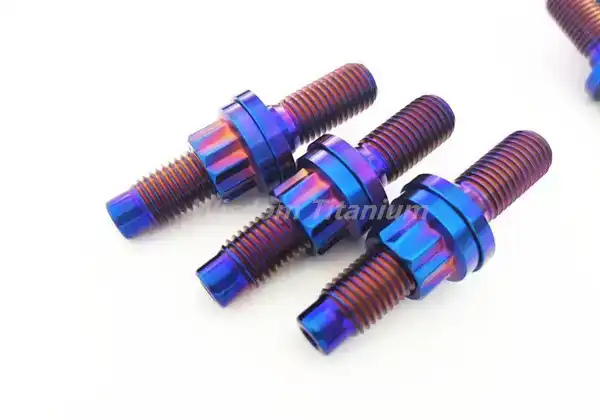
Your exhaust manifold hardware faces one of the harshest environments in your entire vehicle. Extreme heat cycles, corrosive gases, moisture intrusion, and constant vibration—these conditions destroy ordinary fasteners within years, sometimes months. When it comes time to replace broken or corroded studs, the question inevitably arises: what material should you choose?
The answer matters more than most enthusiasts realize. Using factory exhaust manifold bolts and studs with an aftermarket turbo can result in stripped or broken bolts and inadequate sealing force, which will result in an exhaust leak. Poor material selection leads to seized threads, snapped studs, expensive cylinder head repairs, and frustrating exhaust leaks that never seem to stay fixed. The right material eliminates these headaches permanently.
After decades of manufacturing titanium fasteners at Baoji Wisdom Titanium, we can confirm what motorsport engineers discovered long ago: titanium offers superior corrosion resistance over steel and stainless steel, all while being lighter and significantly stronger as well. Let us examine why titanium exhaust manifold stud kits represent the optimal solution—and how different materials compare in real-world exhaust applications.
Common Materials Used in Exhaust Manifold Hardware
Manufacturers produce exhaust studs from several different metals. Each material offers distinct advantages and limitations. Understanding these differences helps you make an informed decision that matches your performance goals, maintenance preferences, and budget requirements.
Mild Steel: The Budget Option with Major Drawbacks
Original equipment manufacturers typically install mild steel studs because they cost almost nothing to produce. For accountants calculating per-unit savings across millions of vehicles, this makes financial sense. For the owner who must eventually remove a rusted, seized stud from an aluminum cylinder head? The calculus changes dramatically.
Lessor engines fail before they have a chance to have age related manifold stud failure. Factory steel hardware works adequately for a few years under normal conditions. Problems emerge as vehicles age, particularly in humid climates, coastal regions, or areas where road salt accelerates corrosion. Steel studs expand and contract differently than aluminum heads during thermal cycling. Over time, galvanic corrosion bonds the dissimilar metals together. Removal becomes nearly impossible without drilling, extraction, or head removal.
Some mechanics advocate staying with mild steel since they are closer on the Galvanic scale when threaded into iron blocks. This argument loses validity with modern aluminum cylinder heads, where the galvanic potential between steel and aluminum creates exactly the corrosion problems owners want to avoid.
Stainless Steel: Better Corrosion Resistance, Different Problems
304 Stainless Steel is one of the most commonly used materials in exhaust systems due to its cost effective, high strength, and corrosive resistant properties. These attributes make stainless steel appear attractive for exhaust fasteners. Reality proves more complicated when considering the specific demands of manifold hardware.
The primary concern with stainless? Stainless steel is worse than bolt steels at everything other than corrosion resistance and strength at high temperatures. It's far weaker, so you can't get the same clamping load at room temperature. Austenitic stainless grades commonly used in fasteners have lower yield strengths than quality bolt steels. This means you cannot achieve the same clamping force without risk of stretching or failure.
Thread galling presents another serious issue. The stainless can gall if it is not lubricated with anti seize. When stainless threads contact other stainless or aluminum surfaces under pressure and heat, micro-welding can occur. Threads fuse together, making removal without destruction nearly impossible. Proper anti-seize application helps, but adds another variable that many installers forget or neglect.
Weight also works against stainless. Performance applications where every gram matters cannot justify the additional mass when lighter alternatives exist. For dedicated track cars, competitive racing, and weight-conscious builds, stainless steel represents a compromise rather than an optimal solution.
Titanium: The Premium Choice for Performance Applications
Titanium is becoming a very popular choice of materials for exhaust systems for a few reasons. Beyond exhaust tubing itself, titanium exhaust stud kits deliver compelling advantages that justify their premium positioning. The material combines properties that address every weakness of steel and stainless alternatives.
Grade 5 Titanium intake and exhaust studs can replace Grade 8.8 steel studs, offering an excellent strength-to-weight ratio and weight savings of approximately 45% compared to equivalent steel bolts. This dramatic weight reduction matters for competitive applications. More importantly, titanium's inherent properties solve the corrosion and maintenance problems that plague ferrous fasteners throughout their service life.
At Baoji Wisdom Titanium, we manufacture our titanium exhaust manifold stud kits from genuine Ti-6Al-4V Grade 5 material. Known as the "workhorse" of the titanium alloys, Titanium 6Al-4V or Grade 5 Titanium, is the most commonly used of all titanium alloys. It accounts for 50 percent of total titanium usage the world over. This aerospace-grade alloy delivers proven performance in the most demanding applications imaginable.
Why Grade 5 Titanium Excels as Exhaust Manifold Hardware?
Selecting titanium for your exhaust manifold stud kit is not merely about following trends or achieving an exotic appearance. The material's physical and chemical properties directly address the failure modes that destroy conventional exhaust hardware. Understanding these advantages reveals why serious performance builders increasingly specify titanium fasteners.
Exceptional Corrosion Resistance in Harsh Environments
Ti-6Al-4V (UNS designation R56400), also sometimes called TC4, Ti64, or ASTM Grade 5, is an alpha-beta titanium alloy with a high specific strength and excellent corrosion resistance. Unlike steel or stainless, titanium does not depend on protective coatings or surface treatments to resist corrosion. The metal itself is inherently immune to the oxidation and galvanic processes that destroy ferrous fasteners.
Titanium, however, actually outperforms stainless in corrosion resistance – it won't rust at all, even in harsh conditions. Titanium also handles heat better, dissipating it quickly to reduce heat soak. Exhaust gases contain water vapor, sulfur compounds, and other corrosive elements. Combined with external moisture, road salt, and temperature cycling, this environment attacks conventional fasteners relentlessly. Titanium remains unaffected.
Our titanium exhaust manifold stud kits will not rust after repeated heat cycles, and will be easily removed when needed. This removability factor often gets overlooked. Performance enthusiasts regularly service headers, manifolds, and turbo systems. When studs break during removal—a common occurrence with corroded steel—repair costs multiply. Titanium studs come out cleanly, even after years of service and thousands of heat cycles.
Superior Strength-to-Weight Ratio for Performance Applications
Ti6Al4V alloy is as strong as steel but 45% lighter. This property matters enormously for serious performance applications. Competitive racing teams obsess over weight reduction because every kilogram affects acceleration, braking, and handling. Even for street-driven performance cars, lighter components improve driving dynamics.
Titanium 6-4 has an exceptional tensile strength of 1,170 MPa. Its high tensile strength, combined with a low density of 4.43 g/cm3, makes it ideal where strength and low weight are critical. This tensile strength exceeds most steel grades while weighing far less. The result? Adequate clamping force with proper torque specifications, without the mass penalty of conventional fasteners.
This high-strength alloy can be used at cryogenic temperatures to about 800°F (427°C). Titanium 6Al-4V can be used in welded construction at service temperatures of up to 600°F. Exhaust manifold temperatures regularly approach these limits during aggressive driving. Grade 5 titanium maintains its mechanical properties throughout this temperature range, ensuring consistent clamping performance regardless of thermal conditions.
Thermal Compatibility with Modern Cylinder Heads
Modern engines predominantly use aluminum cylinder heads for their superior heat dissipation and weight savings. This creates challenges when selecting fastener materials. The alloy combines its good mechanical strength and low density (4.42 kg/dm³) with excellent corrosion resistance in many media. Titanium's thermal expansion characteristics work well with aluminum, reducing the stress concentrations that develop when dissimilar metals expand and contract at different rates.
Ti 6Al 4V instantaneously produces a ceramic oxide layer on its surface, which protects it from corrosion in all but the most severe of environments. Because of this, grade 5 Titanium is widely used in salt water applications, as well as humid environments. This passive oxide layer prevents the galvanic reactions between fastener and head that cause conventional steel studs to seize. The titanium remains isolated from the aluminum, chemically neutral even under extreme temperature cycling.
Practical Considerations When Choosing Titanium Exhaust Stud Kits
Performance advantages mean nothing if the product does not fit your application or budget. Understanding the practical aspects of titanium exhaust manifold stud kits helps you determine whether they represent the right investment for your specific needs.
Installation Requirements and Best Practices
Proper installation ensures titanium fasteners deliver their full performance potential. A touch of anti-seize is recommended for installation. While titanium resists galling better than stainless, applying anti-seize compound to the threads protects both the studs and the cylinder head threads during installation and future removal.
Exhaust manifold to head torque specs: 18-22 ft. lbs. Always consult your engine manufacturer's specifications, as torque requirements vary by application. Titanium's high strength means you achieve proper clamping force at these moderate torque values. Over-torquing serves no benefit and risks thread damage.
Our titanium exhaust manifold stud kits include all necessary hardware: studs, nuts, and washers matched for your application. We offer multiple nut configurations—12-point, hex flange, and lock nuts—to suit different access requirements and aesthetic preferences. Available sizes include M8×1.25×45mm and M10×1.25×45/54mm, covering most popular applications.
Color Options for Custom and Show Applications
Titanium is a stronger material and can be heat-treated to create a range of vivid colors on the material which some folks just can't live without! Beyond raw natural titanium, heat treatment produces spectacular burnt blue, gold, and other finishes through controlled oxidation. These colors develop as part of the titanium's surface oxide layer—they cannot peel, chip, or fade like paint or plating.
At Baoji Wisdom Titanium, we offer titanium exhaust stud kits in burnt blue, black, natural, and gold finishes. Show car builders appreciate how these colors accent engine bay aesthetics. At 1000 degrees the purple turns to a deeper blue that some would argue is even more appealing! This cannot be done with stainless steel. The visual impact of colored titanium hardware distinguishes serious builds from ordinary installations.
Value Proposition Compared to Repeated Replacements
Titanium exhaust stud kits cost more initially than steel or stainless alternatives. However, considering total cost of ownership changes the calculation significantly. Never have to worry about a broken or corroded stud again, these titanium components will outlast your engine.
Calculate the cost of one broken stud extraction. Factor in machine shop time, potential head damage, replacement gaskets, and labor. A single extraction can exceed the cost of a complete titanium stud kit. When you consider that steel studs frequently break during routine service—header removal, gasket replacement, turbo maintenance—the economics favor titanium decisively.
The kit is made from high quality components to ensure reliable performance and long life, This kit is a reliable replacement for lost or damaged or malfunctioning original hardware. Our kits provide factory pricing direct from China's Titanium Valley, making premium titanium hardware accessible for performance builders worldwide.
Upgrade to Titanium Exhaust Stud Kits Today
The evidence clearly demonstrates why titanium represents the best material choice for exhaust manifold stud kits. Superior corrosion resistance eliminates seized and broken studs. Exceptional strength-to-weight ratio delivers performance benefits. Thermal stability ensures consistent clamping through endless heat cycles. Aesthetic options enable customization that ferrous materials cannot match.
At Baoji Wisdom Titanium, we combine world-class titanium manufacturing capabilities with direct factory pricing. Our titanium exhaust manifold stud kits—crafted from genuine Ti-6Al-4V Grade 5 material—deliver aerospace-grade performance to automotive applications worldwide. With an experienced R&D service system, we also provide customized solutions for unique applications and specifications.
Ready to eliminate exhaust hardware failures permanently? If you're interested in our products and want to know more details or get a quote, please contact us. Simply send an enquiry to sales@wisdomtitanium.com. Our team provides prompt responses with competitive pricing, technical specifications, and shipping arrangements tailored to your requirements.
FAQ
Q1: Is titanium really worth the extra cost over stainless steel for exhaust studs?
A: Yes, when you consider total ownership costs. Titanium offers superior corrosion resistance over steel and stainless steel, all while being lighter and significantly stronger as well. Stainless studs can gall when not properly lubricated, making removal difficult or impossible. Titanium studs remain removable even after years of service. One seized stud extraction often costs more than a complete titanium kit, making titanium the economical long-term choice for engines that will require future service.
Q2: What sizes and configurations does Baoji Wisdom Titanium offer for exhaust stud kits?
A: Our titanium exhaust manifold stud kits are available in M8×1.25×45mm and M10×1.25×45/54mm sizes to fit most popular applications. Nut options include 12-point, hex flange, and lock nut configurations. Color choices span burnt blue, black, natural titanium, and gold finishes. Minimum order quantity is 100 sets, with competitive factory pricing and ample stock available for qualified buyers.
Q3: Will titanium studs work properly in an aluminum cylinder head?
A: Titanium actually works better with aluminum heads than steel does. Ti 6Al 4V instantaneously produces a ceramic oxide layer on its surface, which protects it from corrosion in all but the most severe of environments. This passive layer prevents galvanic corrosion between the titanium and aluminum. The metals remain chemically isolated, eliminating the seized-stud problems common with steel fasteners in aluminum heads after thermal cycling.
Q4: How does Grade 5 titanium compare to steel in terms of strength?
A: For Ti-6Al-4V, tensile strength ranges between 870 and 1200 MPa depending on the applied heat treatment, and therefore, it is considerably stronger compared to commercially pure titanium. This puts Grade 5 titanium on par with or exceeding many high-strength steels. It has excellent strength, low modulus of elasticity, high corrosion resistance, good weldability and it is heat treatable. You achieve full clamping force at proper torque specifications while saving approximately 45% weight compared to steel.
Q5: Do titanium exhaust studs require any special installation procedures?
A: Installation follows standard procedures with a few recommendations. A touch of anti-seize is recommended for installation. This protects threads during assembly and ensures easy future removal. Exhaust manifold to head torque specs: 18-22 ft. lbs. Always verify specifications for your particular engine. Do not over-torque titanium fasteners—their high strength means adequate clamping force develops at moderate torque values. Our kits include matched studs, nuts, and washers designed to work together.
References
1. "Ti-6Al-4V" - Titanium alloy composition and properties data
2. "All About Titanium Alloy 6-4: Definition, History, Properties, and Applications" - Technical specifications and tensile strength values
3. "Titanium vs Stainless Steel Exhaust Systems" - Material comparison for automotive applications
4. "Best material for exhaust manifold studs?" - Real-world user experiences and technical discussion
5. "Ti 6Al 4V (Grade 5) Titanium Alloy Data Sheet" - Mechanical and thermal property specifications