
When you choose exhaust fasteners, you're not just keeping things together; you're also making sure they will work reliably in harsh situations. The best material for exhaust nuts is titanium, especially Ti-6Al-4V (Grade 5). It works better than steel and stainless steel. Titanium exhaust bolts don't rust when heated, don't pose the risk of rust welding, and are 45% lighter than steel versions. Titanium is the best material for high-performance cars, race teams, and OEM makers who want to cut down on maintenance downtime and make systems last longer because it doesn't rust, doesn't change temperature, and is strong.
Understanding Exhaust Bolt Materials: An Overview
The exhaust system is one of the roughest places for bolts to work in any car or piece of machinery. They have to be able to handle temperature changes that go from room temperature to over 800°C (1472°F) and corrosive exhaust fumes that contain water vapor, sulfur compounds, and byproducts of burning. What kind of material is used decides whether screws will last through these conditions or break too soon.
Common Materials Used in Exhaust Fasteners
Steel nuts, especially carbon steel ones, are cheap and have a high tensile strength, so they are often used in situations where money is tight. However, they oxidize quickly at high temperatures, which causes rust to form and eventually seizes. The chromium in stainless steel makes it less likely to rust, but it still gets scaling and galling when exposed to high heat for a long time. Aluminum alloys are lighter than other metals, but they aren't strong enough for important load-bearing uses and become much softer above 300°C. The low density of titanium alloys makes them very strong even at high temperatures. They are also very resistant to rust and oxidation in the air.
Critical Performance Requirements
Exhaust screws need to meet a number of scientific requirements at the same time. Tensile strength makes sure that bolts can keep their binding force even when they are moving and expanding and contracting. Corrosion resistance keeps things from breaking down when they are exposed to acidic condensates and salt. Tolerance to heat keeps mechanical traits stable over many temperature cycles. When it comes to racing and other high-performance uses, weight has an effect on how well a car works overall. Procurement teams can better match specifications with practical needs and legal compliance needs when they know how different materials meet these needs.
Titanium Exhaust Bolts: Properties and Benefits
Because of its unique metallurgical qualities, Titanium Grade 5 (Ti-6Al-4V) has become the best choice for exhaust bolts. This alpha-beta metal has about 6% aluminum and 4% vanadium in it. It has the best mix of strength, ductility, and thermal stability, and it works better than most materials in many ways.
Exceptional Strength-to-Weight Ratio
Tensile strength of titanium Grade 5 is between 895 and 930 MPa, and its mass is only 4.43 g/cm³, which is about 45% less than steel. This decrease in weight directly leads to better performance, which is especially helpful for racing, where every gram affects speed, handling, and gas mileage. Because the material has a high specific strength, engineers can ask for smaller bolt sizes without losing binding force. This lets them make exhaust designs that are more compact.
Superior Corrosion and Heat Resistance
Titanium fasteners make a stable, self-passivating oxide layer that heals itself when they are harmed, while steel fasteners rust and break down quickly. This natural shield keeps out sulfuric acid condensates, chloride, and oxidizing conditions without the need for extra coats. Titanium keeps its mechanical qualities at temperatures above 500°C, which is much higher than the point at which stainless steel starts to lose its strength and start to scale. This thermal stability stops the common issue of bolts "seizing" or "rust-welding" into manifolds, which is a critical failure mode that makes bolts break when they're being removed and needs expensive cutting and helicoil fixes.
Grade 5 Specifications and Product Availability
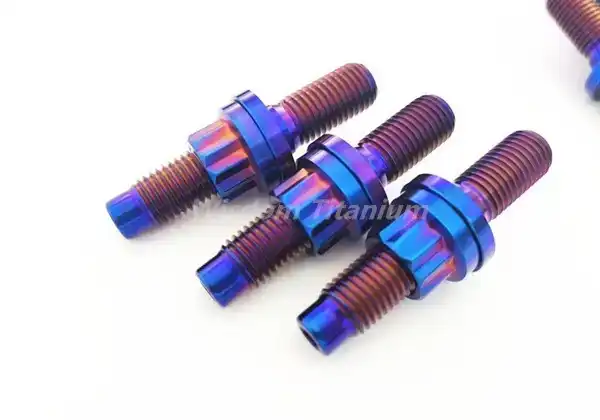
Titanium exhaust bolt made by Wisdom Titanium are made up of a stud, a 12-point nut, and a washer. They are made from Grade 5 titanium. The lengths that are available are M8 (1.25 mm x 45 mm) and M10 (1.25 mm x 45 mm or 54 mm), and they can be customized to fit the needs of each application. There are different finishes, such as natural titanium (silver-gray) and burnt blue anodized coats. The latter makes uncovered parts look better. The low minimum order number of 100 pieces allows for both testing prototypes and buying in bulk, giving OEMs and aftermarket sellers more options for how they buy things.
Titanium Exhaust Bolts vs Alternative Materials: A Data-Driven Comparison
Quantitative performance data shows that titanium has big benefits over other fastener materials in exhaust uses. These differences lead to measured increases in the total cost of ownership, the frequency of upkeep, and the reliability of the system.
Mechanical Performance Metrics
Titanium Grade 5 has a tensile strength of 895 to 930 MPa, while 304 stainless steel has a strength of 515 MPa and mild steel has a strength of 400 to 550 MPa. Furthermore, titanium keeps about 90% of its strength at room temperature at 500°C, while stainless steel loses a lot of its strength above 400°C. Titanium has an amazing fatigue resistance—it can withstand over 10 million cycles under normal exhaust loading conditions, which is a lot better than stainless steel. The lower coefficient of thermal expansion (8.6 µm/m·K vs. 17.3 µm/m·K for stainless steel) of the material keeps the holding force constant and minimizes thermal stress buildup during heating and cooling cycles.
Lifecycle Cost Analysis
Titanium screws usually cost three to five times more than stainless steel ones when they are first bought. When you look at the total cost of ownership, though, this extra becomes less important. In exhaust uses, steel and stainless steel bolts usually need to be replaced every two to three years because they rust and seize up. Titanium fasteners, on the other hand, usually last the entire life of the car. Having trouble removing stuck steel bolts costs more in work, needs special extraction tools, and could damage expensive manifold threads. Performance shops and racing teams say that moving to titanium gets rid of unplanned maintenance and cuts down on the time it takes the pit crew to change parts. When titanium fasteners keep things from breaking in the field, OEM makers save money on warranties and get better customer happiness scores.
Real-World Performance Validation
Motorcycle race teams that work in tough conditions—where exhaust systems are constantly subjected to high loads, thermal cycling, and vibration—have seen failure rates drop by more than 95% after switching from stainless steel to titanium screws. Similar gains in dependability have been reported by high-performance car shops that work on track-focused vehicles. Titanium exhaust bolts have eliminated the problem of snapped studs during regular repair. Titanium exhaust fasteners are being used more and more by electric vehicle makers to place heat exchangers. Their corrosion resistance and low weight directly support efficiency goals and longer service intervals.
Procurement Insights: Where and How to Buy Titanium Exhaust Bolts
To strategically source titanium fasteners, you need to know how the market works, find dependable providers, and negotiate terms that meet both quality needs and price limits.
Market Overview and Pricing Dynamics
Titanium fastener markets around the world have grown up a lot, and now there are established supply lines that serve uses in aerospace, industry, and cars. Prices depend on the cost of raw materials, how hard the product is to make, and how many orders there are. Grade 5 titanium screws, nuts, and washers will cost between $8 and $15 per assembly for normal sizes and small to medium quantities (100 to 500 pieces). If you buy more, you can get a discount. Premiums are charged for custom specs, unique finishes, and fast delivery. Prices on the market change based on the abundance of titanium sponge and the demand cycle for aerospace parts. To keep costs stable, long-term supply deals are helpful.
Identifying Reputable Manufacturers
Quality control starts with choosing the right provider. Manufacturers should be encouraged to keep their ISO 9001 certification and written quality control systems. This method is used by Baoji Wisdom Titanium Industry and Trading Co., Ltd., which was founded in 2016 and is based in Baoji Titanium Valley, which is China's biggest titanium industry center. They have full material tracking, in-process inspection processes, and final product testing. For each production lot, suppliers should give material certificates that list the chemicals that were used and their mechanical qualities. Before committing to production orders, ask for sample evaluation amounts. This lets engineering teams make sure that the dimensions are correct, the finish is good, and the thread specs meet the needs of the application.
Customization and Volume Procurement
Catalog items can be used for a lot of different things, but unique solutions are better for solving specific tech problems. Companies that do CNC cutting can make parts with non-standard lengths, thread sizes, head styles, and assembly arrangements. Talk about the minimum order quantity early on in the specification process. For normal goods, Wisdom Titanium can handle minimums of 100 pieces, but for custom tools, bigger beginning commitments may be needed. Strategies for buying in bulk should weigh the costs of keeping goods against the benefits of lower prices. For example, yearly blanket orders with planned releases can save money while still allowing for production flexibility. Include quality hold points, review standards, and acceptance testing methods in buy deals to make sure that goods always meet the requirements.
Conclusion
The choice of material has a big impact on how reliable exhaust fasteners are, how much upkeep they need, and how much they cost over their whole time. Titanium exhaust bolts made from Grade 5 metal are vastly superior to steel and stainless steel options because they are less likely to rust, keep their strength at high temperatures, and are much lighter. Because of these qualities, there will be fewer maintenance tasks, no more failures caused by seizures, and longer service intervals in industrial, motorcycle, and automobile settings.
Understanding the total cost equation is helpful for procurement workers. For example, titanium has a higher original investment, but its lifetime value is higher because it doesn't need to be replaced as often and labor costs are lower. Titanium's high strength-to-weight ratio gives engineers more design options, which lets them make better exhaust systems that improve car performance. Buying from ISO-certified companies with well-established quality systems makes sure that the materials are consistent and that the rules are followed.
Partner with a Trusted Titanium Exhaust Bolt Manufacturer
Wisdom Titanium offers high-quality titanium screws that were designed to work with exhaust systems. Our Grade 5 titanium stud kits come in M8 and M10 sizes and can be finished in either natural or burnt blue. They are made with precise CNC machinery and strict quality control procedures. We are in the Baoji Titanium Valley in Shaanxi Province, which gives us access to the world's most complete titanium supply chain. This lets us track materials from the ingot to the finished product.
We can do more than just sell standard catalog things. We can also fully create solutions to fit your needs. We can take orders as low as 100 pieces, whether you need a few prototypes for validation testing or a lot of them for OEM assembly lines. ISO 9001 certification and full inspections of the raw materials make sure that the standard of every package is the same. Talk to our engineering team about what you need for your application, ask for detailed datasheets, or get quotes for standard or custom setups. Get in touch with us at sales@wisdomtitanium.com to find out how working with an experienced titanium exhaust bolt supplier can make your buying process easier and the quality of your products better.
FAQ
What advantages do titanium exhaust bolts offer over stainless steel?
Titanium exhaust bolts have three very important benefits. They get rid of the rust-welding issue that makes stainless steel studs get stuck in pipes, which saves money on extraction costs and thread damage. Titanium's high strength-to-weight ratio lets it lose 45% of its weight while keeping its tensile strength the same or better. Titanium's thermal stability means that it keeps its mechanical qualities at temperatures where stainless steel breaks down. This means that the binding force stays the same through many thermal cycles.
How should installation procedures differ for titanium fasteners?
Use an anti-seize substance that works with titanium to stop galling, a unique way that titanium surfaces can wear down where they stick together under pressure. Due to lower friction coefficients, power requirements should be cut by about 10 to 15 percent compared to steel versions. Install fasteners slowly using measured torque tools and apply the final torque in several steps rather than all at once. These changes keep the threads from getting damaged and make sure that the tightening force is spread out correctly.
What pricing should procurement teams expect?
For normal M8 and M10 sizes, 100 to 500 pieces of grade 5 titanium stud kits with nuts and washers cost between $8 and $15 each. Most of the time, 15–25% discounts are secured through volume promises and long-term supply deals. Custom specs cost more because they require more tools and are more complicated. When figuring out how much something costs, you should think about its lifecycle value. Titanium's longer service life and lack of upkeep requirements often make up for its higher original cost by lowering the total cost of ownership.
References
1. Davis, J.R. (2000). ASM Specialty Handbook: Nickel, Cobalt, and Their Alloys. ASM International Materials Park.
2. Donachie, M.J. (2000). Titanium: A Technical Guide (2nd Edition). ASM International.
3. Society of Automotive Engineers (2019). AMS 4928: Titanium Alloy Bars, Wire, Forgings, Rings, and Drawn Shapes, 6Al-4V, Annealed.
4. Boyer, R., Welsch, G., & Collings, E.W. (1994). Materials Properties Handbook: Titanium Alloys. ASM International.
5. Peters, M., Kumpfert, J., Ward, C.H., & Leyens, C. (2003). "Titanium Alloys for Aerospace Applications." Advanced Engineering Materials, 5(6), 419-427.
6. Lutjering, G. & Williams, J.C. (2007). Titanium (2nd Edition). Springer-Verlag Berlin Heidelberg.