
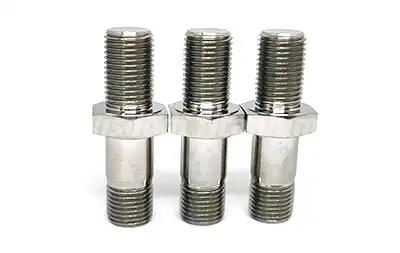
A titanium stud is a fastener threaded at both ends. One end screws into a tapped hole, and the other end takes a nut that clamps parts together. Titanium studs are made from titanium or titanium alloy, so they weigh about 40 percent less than steel and resist corrosion from seawater, chlorides, and many acids. We supply double end titanium studs in Gr2, Gr5, and Gr7 from M3 to M24. In this guide, I explain how they work, how the grades differ, and what to check before you order.
What Is a Titanium Stud and Where Is It Used?
Definition and Double End Design
A rod with threads on both ends is called a double end stud. Along the length of some kinds, the shank is plain, while threads run through most of them. One end has a tapped hole, and the other end has a nut. Then the nut can be taken off without hurting the hole with the threads. This helps when you need to open up a joint to fix it. Titanium studs are laid out the same way as steel studs, but the metal changes how they work. As another word for earrings, "titanium stud." This article is only about industrial fasteners.
Where Titanium Studs Are Used
Titanium studs are useful for tasks that require strength, light weight, and resistance to rust. It is often used in vehicles, medical equipment, spacecraft, the military, and sports equipment. A lot of our clients also work in the energy, oil and gas, and chemical industries, which are all places where studs come into contact with salt, chlorides, or acidic materials. Titanium's surface gets a thin, stable oxide film. During these times, this film is what keeps the metal strong. Sometimes it's hard to do maintenance on stainless steel, and sometimes a lighter unit makes a building stronger. This is when project teams switch from stainless steel to titanium. Always make sure that the grade and size are right for the job.
Wisdom Titanium Product Specifications
Here are the core specifications of our titanium double end stud:
| Item | Detail |
|---|---|
| Product type | Titanium double end stud |
| Material | Titanium Gr2, Gr5 |
| Thread size | M3–M24 |
| Length | 5 mm–100 mm |
| Surface finish | Polished, anodized, or customized |
| Application | Aerospace, marine, medical, military, automotive, sports equipment, and more |
| Certification | ISO 9001 |
| MOQ | 200 pcs |
| Package | Carton, bag, or customized |
This range lets a project buyer cover many line items on a material list with one supplier.
What Are Gr2, Gr5 Titanium Studs?
Grade 2: Commercially Pure Titanium
Grade 2 titanium is clean enough to use for work. The tensile strength must be at least 345 MPa, according to ASTM B348. That's less than alloyed grades, but Gr2 is easy to shape and doesn't rust in salt water or many chemical baths. It's often picked for work at sea and in process pipes with light loads. Not many alloying elements are added to Gr2, so the oxygen, iron, and other elements in its mill certificate are low. Before the titanium studs are sent out, look at the material test report to see what the chemistry and mechanical numbers are if your specs say Gr2.
Grade 5: Ti-6Al-4V Alloy
The metal in Grade 5 is called Ti-6Al-4V, and it has about 6% aluminum and 4% vanadium. It says in ASTM B348 that the lowest tensile strength is 895 MPa, which is a lot more than Gr2. Grade 5 is often used for high-load studs in big tools, race cars, the military, and spaceships because of this. Some reducing acids can make Grade 7 work better, but it doesn't rust very often. You also need to use the right amount of pressure and grease the threads to make them stronger. Because they change based on the thread size, joint design, and lubricant, I think you should stick to the torque numbers your design engineer gives you.
How Do Titanium Studs Compare With Stainless Steel and Other Materials?
Corrosion in Seawater and Chlorides
Ocean water that is warm and places with a lot of salt can rust stainless steel. Titanium's oxide coat is strong enough to protect it from these attacks, and if air or water is present, it heals quickly after being scratched. This is why titanium is used a lot in equipment and systems that cool seawater and are used offshore. The metal titanium can only do so much. There are strong acids that need Grade 7 to break it down, and hydrofluoric acid can do that. Instead of relying on broad claims, compare the grade to the actual medium, temperature, and concentration that are written down in your project data sheet.
Weight and Strength Differences
Steel is about 7.85 g/cm³ dense, while titanium is about 4.5 g/cm³ dense. That's about 40% lighter than that. Grade 5 is about as strong when pulled apart as a lot of alloy steel fasteners. In other words, it loses weight without getting weaker too much. Grade 2 isn't as strong as high-strength steel studs, so it's best for jobs that don't need to hold weight. Also, titanium isn't as stiff as steel, so a joint might bend a little more. They think about this, and if you need to ask a seller a question, you should always send them load data.
Galvanic Effects and Total Cost
It's important to remember that titanium is at the top of the galvanic series. When the less valuable metal comes into contact with carbon steel or aluminum in a salty, wet place, it can rust more quickly. A lot of the time, designers add insulating washers, sleeves, or coatings to keep this from happening. Another difference is that titanium studs cost more than stainless steel studs. That price is worth it because it means the product will last longer, need fewer fixes, and be lighter in acidic work. You should compare the total life cost of three to five providers instead of just the unit price when you have that many to choose from.
How Do I Choose and Install Titanium Studs?
Thread Size, Length, and Grade
Make a list of the things you want to get rid of. Note down the thread size, pitch, length, and grade that were given. The threads come in sizes from M3 to M24 and lengths from 5 mm to 100 mm. Then add up the length of the joint, the washer, the nut, and any threads that stick out past the nut. This includes the threads that are in the tapped hole and the width of the joint. Your expert decides how deep the engagement goes and what the limits are. Our in-house R&D team often works with customer samples and ideas. That means we can make the part from just a drawing or a sample.
Choosing a Surface Finish
The finish on a surface changes how it looks, how it's used, and how it's recognized. It looks clean and smooth after being polished. A controlled oxide layer forms on top of titanium when it is anodized. When you use different voltages, you get different colors. That's one way some buyers can tell right away the difference between grades or sizes. If the job calls for it, we can also make finishes just the way you want them. Write down the finish, color, and any finishing limits when you get the price. Once the order is ready, a clear note keeps things from getting messy when more than one person looks it over.
Installation and Care Tips
Titanium studs can galleen when they get hot and are rubbed together. This means they stop moving. When the project's rules allow it, use an anti-seize or lube product. People often say to put a light graphite grease on the threads. Hit tools shouldn't be used on titanium because it's not as strong as steel. The threads might break. First, clean the threads. Then, put the nuts on by hand and tighten them until your engineer tells you to stop. It's not hard to take care of titanium, but I suggest that you wash off salt and dirt and replace any studs with broken threads every so often.
What Should B2B Buyers Check Before Ordering Titanium Studs?
Certificates and Traceability
The most important thing for project work is the record of the material test. Chemistry and mechanics should be able to be linked to a heat or lot number through the box's fasteners. This is how to find the mill batch. You should ask to see a sample of the certificate before you place your order. It is important to remember that an ISO 9001 certificate does not change the need for a test certificate for every batch. The only thing it shows is that the service company has a written quality system. People who own things and EPC teams often also hire inspectors from SGS, BV, or TUV. Before you start the job, make sure you understand how your seller will visit and deliver papers.
MOQ, Delivery, and Packaging
We need at least 200 items to process an order. Send us the whole list, not just a few items, and we'll look it over with you. Project lists often have small amounts. Because project goals don't change often, writing down the times for batch deliveries is a good idea. Figure out how to ship and pay for the order before it goes through. We can pack in bags, boxes, or boxes that are made just for you. Ask for tags that say what size and grade the items are. Clear signs make getting checks on the job site faster and less likely to get mixed up.
How Wisdom Titanium Supports Project Buyers
Wisdom Titanium makes and sells both standard and custom CNC parts. We are in Shaanxi Province's Baoji Titanium Valley. The biggest and best titanium industry center in China is here. This is one of the most important places in the world to make titanium. As part of the local industry chain are titanium ingots, bars, plates, tubes, forgings, and high-performance titanium alloys. Our bolts and nuts are made from great titanium pieces, and we make sure they are good before we send them out. We always have standard parts and raw materials on hand, and during the whole process, we keep an eye on detection.
Conclusion
Titanium studs are fasteners that have threads on both sides. Titanium studs don't rust and are very light. Titanium is used to make Grade 2, and it doesn't rust. It gets stronger with Grade 5, and better resistance to chemicals and chlorides is gained with Grade 7. When it comes to salt water damage, titanium is better than stainless steel. It also weighs about 40% less. It costs more up front and needs more attention when it comes to force, friction, and greasing. Keep your shipments from being turned down by making sure the grade fits the specification, the size and finish are right, and that the certificates have batch numbers that can be followed. Making a written list of what you want to buy and how to get it is helpful when you're shopping.
FAQ
What does a double end titanium stud look like?
It's a stick with threads on both ends. One end has a tapped hole, and the other end has a nut.
Which titanium grade should I choose?
Do what your project tells you to do. In terms of value, Grade 2 is the purest metal, Grade 5 is stronger, and palladium has been added to Grade 7 to make it more resistant to chemicals.
What sizes and finishes do you offer?
The threads come in sizes from M3 to M24 and lengths from 5 mm to 100 mm. You can create, shine, or anodize the finish.
What is the minimum order quantity?
We need at least 200 items to process an order. We'll look over your whole list with you if you send it to us.
Do titanium studs rust?
Titanium does not rust like steel does. Water and many chemicals don't rust the oxide film on it, but hydrofluoric acid can damage it.
Request Titanium Studs from Wisdom Titanium
A company in Baoji, China, called Wisdom Titanium and sells titanium studs. Send your list of things that need to be taken off. Our Gr2, Gr5, and Gr7 double end studs have a minimum order quantity (MOQ) of 200 pieces and come in lengths ranging from 5 to 100 mm. They range in size from M3 to M24. You can go to wisdomtitanium.com or email us at sales@wisdomtitanium.com, and we'll look over your needs, finish, and shipping plan.
References
- ASTM International, Standard Specification for Titanium and Titanium Alloy Bars and Billets (ASTM B348/B348M), 2019
- Donachie, M. J., Titanium: A Technical Guide, 2nd Edition, ASM International, 2000
- Leyens, C. and Peters, M., Titanium and Titanium Alloys: Fundamentals and Applications, Wiley-VCH, 2003
- ASM Handbook, Volume 13B: Corrosion: Materials, ASM International, 2005
- Boyer, R., Welsch, G., and Collings, E. W., Materials Properties Handbook: Titanium Alloys, ASM International, 1994
- ISO 9001: Quality Management Systems – Requirements, International Organization for Standardization, 2015