
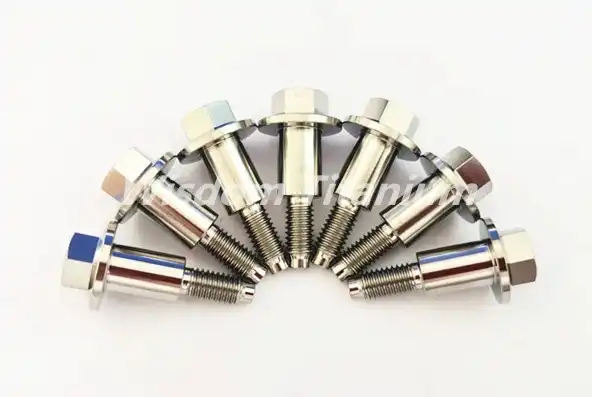
A titanium shoulder bolt is a precision-machined fastener with a smooth, cylindrical shoulder section that sits between the head and the threaded portion. This shoulder acts as a locating pin, spacer, or pivot point, providing exact alignment in mechanical assemblies. Unlike standard bolts, the shoulder diameter and length are the critical dimensions — not just the thread. When made from titanium, particularly Grade 5 (Ti-6Al-4V), these fasteners deliver tensile strength of 895–1,000 MPa at roughly 4.43 g/cm³ density, making them a preferred choice in precision-critical industries.
Understanding Titanium Shoulder Bolts
What Makes the Shoulder Design Unique
There is a fully-ground cylinder that is not threaded between the bolt head and the threaded shank. This is the shoulder. It holds shear loads and controls where the rotating parts are placed. As little as ±0.005 mm in the shoulder width can tell you if a part fits right or throws hundreds of optical tools, semiconductor equipment, and automation machines out of alignment.
Grade 2 vs. Grade 5 Titanium
In the business world, grade 2 titanium is very pure. It doesn't conduct electricity or magnetism and can pull apart at 345 MPa. For heavy loads, Grade 5 (Ti-6Al-4V) is the best choice. It can be pulled apart up to 950 MPa and doesn't wear out as quickly as steel or aluminum of the same weight. Most OEM engineers who make tools that work well pick Grade 5 by default.
Standard Specifications and Custom Sizes
The threads on most titanium shoulder bolts are either ISO or DIN. The catalog doesn't have all the shoulder sizes and lengths that most precision OEM users need, though. If you send us a picture, we'll make it to perfection, and you can change any size to fit your needs. The smallest amount that can be ordered is 200 pieces per drawing, which is about the same as the range of 200 to 2,000 pieces that are usually bought by European OEMs each year.
Advantages of Titanium Shoulder Bolts Over Other Materials
It's simple to find stainless steel shoulder nuts, but sometimes they don't work as well. It's not just a matter of preference to move to titanium; the numbers support it.
Because I want you to remember the most important changes, here they are:
- Weight reduction: Titanium Grade 5 weighs approximately 56% of stainless steel 316 at equivalent volume. In moving assemblies or robotic arms, reducing fastener mass directly lowers inertia and energy consumption over thousands of cycles.
- Galvanic corrosion control: When stainless steel contacts aluminum or carbon fiber structures, electrochemical potential differences accelerate corrosion. Titanium sits at a compatible potential with both materials, making it the correct choice for mixed-material assemblies in optical and semiconductor equipment frames.
- Non-magnetic behavior: Titanium's magnetic permeability is approximately 1.00005 — effectively non-magnetic. This matters in medical imaging hardware, electron microscopy stages, and any instrument where ferromagnetic interference affects measurement accuracy.
- Thermal stability: Titanium shoulder bolt retains its mechanical properties from cryogenic temperatures up to around 400°C, covering virtually all industrial equipment operating ranges.
How to Choose the Right Titanium Shoulder Bolt for Your Project?
What does the shoulder do in your assembly? That will help you choose the right fastener. It could be to find a bearing, act as a pivot, or control the preload in a clamped stack, among other things.
Match Grade to Application Load
Spec 5 is the right one for your assembly if it has to deal with vibration, cyclic loading, or high shear forces. Sometimes Grade 2 is enough for parts that aren't meant to be structural or that will be used in chemical settings where corrosion protection is more important than strength. Make sure with your design engineer before you change grades.
Tolerance and Surface Finish Requirements
For example, h6 or h7 according to ISO 286 is a shoulder diameter range. You should also tell them how centered the thread is and how rough the surface is (Ra or Rz according to DIN EN ISO 1302). The way things are machined and inspected are based on these values. Dimensional risk comes from suppliers who can't say for sure that they have read and understood your GD&T callouts, which include German DIN standard notes.
Certifications and Traceability Requirements
To buy from a certified OEM, you need a Material Test Certificate (MTC) with a heat batch number that confirms the material's chemical make-up and mechanical properties according to ASTM B265 or AMS 4928 for Grade 5. It is common for European supply chains to have First Article Inspection (FAI) records that include full-dimensional measurement data. Make sure your source can do both before you send out a drawing.
Best Practices for Using and Maintaining Titanium Shoulder Bolts
Most of the time, fasteners fail too soon because of bad fitting, even when the hardware is explained correctly.
Torque and Galling Prevention
It happens a lot with titanium that the threads get stuck when they rub against each other. This is called galling. Always use the right anti-gall lubricant, such as Molykote 1000 or something similar, before installation. Use a torque wrench that has been measured and follow the manufacturer's torque specs for the thread size and grade. If the threads are already dry, do not re-torque them.
Assembly Tooling
If the surface of the shoulder bolts is Ra ≤ 0.8 µm, you should use tools that won't leave lines. If you scratch the shoulder surface on a precision bore, it changes how well it fits and works. It is important to wear nitrile gloves in a clean room assembly area so that surfaces that have been exactly ground don't get dirty.
Inspection and Maintenance Intervals
When it's time for maintenance, look at the shoulder bolts for signs of fretting, thread damage, or changes in the size of the shoulder from wear. In places where rust is popular, titanium doesn't usually need any extra work on the outside. But you should look to make sure that there aren't any cracks or corrosion where two different materials meet. You can change any bolt whose shoulder width has shrunk.
Where and How to Buy Titanium Shoulder Bolts
Direct from a Certified Manufacturer
Going straight to an ISO 9001-certified titanium shoulder bolt maker and buying from them will save you time and money. You can also get technical help from the engineering team. As of 2016, Wisdom Titanium has been in business and is based in Baoji Titanium Valley, Shaanxi Province. This is China's major combined titanium production base. They make titanium fasteners that are precisely machined and come with full MTC documentation and FAI reporting.
Quantity Tiers and Lead Times
being the first). For simple tasks, air freight wait times are typically between 4 and 6 weeks. People can choose sea freight for bigger items when lead time flexibility lets them. Quotes come with bulk pricing levels for 200, 500, and 1,000 pieces, which helps buyers find the best mix between price and stock levels.
NDA and Drawing Confidentiality
Drawings belong to the people who own them. Before they look over any drawings or give quotes, Wisdom Titanium signs an NDA. No one else is given information about your designs.
Conclusion
Titanium shoulder bolt solves a specific set of engineering problems that other materials cannot address at equivalent weight: galvanic compatibility with aluminum and carbon fiber, non-magnetic behavior for sensitive instruments, and high fatigue life in cyclic load environments. Grade 5 titanium provides the strength-to-weight performance that justifies the material choice in precision OEM equipment. Custom sizing starting at 200 pieces, full MTC documentation, and FAI reporting make the procurement process compatible with rigorous European engineering standards. If your current supply chain is running 10–14 week lead times on non-standard shoulder bolts, a certified alternative source is worth qualifying.
FAQ
Why does titanium resist galvanic corrosion better than stainless steel?
This grade of titanium is strong enough for its weight, so it's a good choice for high-precision OEM gear. We follow strict European engineering standards when we buy things. That's why we offer custom sizes starting at 200 pieces, full MTC documentation, and FAI reporting. If getting the shoulder bolts you need from your current supplier takes 10 to 14 weeks, you might want to find a valid alternative source.
What documentation should I require when ordering custom titanium shoulder bolts?
Titanium, carbon fiber, and aluminum all have the same electrochemical potential. In other words, there isn't a lot of electricity at the contact to cause galvanic corrosion. Because stainless steel 316 has a different potential, aluminum that comes into contact with it faster when it's wet or near conductive fluids.
Can Grade 5 titanium shoulder bolts be used in clean room or MRI environments?
Before you send drawings, make sure you have a signed Non-Disclosure Agreement (NDA), a full-dimensional First Article Inspection (FAI) report with all the drawing callouts, and a Material Test Certificate (MTC) that shows heat and batch tracking. These three pieces of paper are always on hand in the qualified supply lines for aerospace and precision equipment. Shoulder nuts made of Grade 5 titanium can be used in clean rooms or MRIs.
What is the minimum order quantity for custom sizes?
Wisdom Titanium needs at least 200 pieces of each drawing number as a minimum order quantity (MOQ). This is the same number of non-standard shoulder bolts that OEMs buy every year to make high-precision tools.
How do I verify a supplier's machining capability for tight tolerances?
Ask them to show you a CMM (coordinate measuring machine) report from a job that was similar to the one you want them to do. Also, check to see if they do optical projection and hardness tests, and see if they can read DIN/ISO GD&T callouts that have marks for Rz surface roughness and concentrates.
Get a Quote on Custom Titanium Shoulder Bolts from Wisdom Titanium
We at Wisdom Titanium make Grade 5 titanium shoulder bolts in our plant in Baoji Titanium Valley, China. These bolts are approved by ISO 9001. We offer full MTC and FAI paperwork, handle plans in a way that protects NDAs, and air freight wait times of 4 to 6 weeks. We can make special sizes starting at 200 pieces. You can send your drawing to sales@wisdomtitanium.com or go to our website at wisdomtitanium.com to get a technical review and a tiered quote.
References
- ASM International. Titanium: A Technical Guide. 2nd ed. ASM International, 2000.
- ASTM International. ASTM B265: Standard Specification for Titanium and Titanium Alloy Strip, Sheet, and Plate. ASTM International, 2020.
- DIN Deutsches Institut für Normung. DIN EN ISO 1302: Indication of Surface Texture in Technical Product Documentation. Beuth Verlag, 2002.
- Lutjering, G., and Williams, J.C. Titanium. 2nd ed. Springer, 2007.
- Bickford, J.H. An Introduction to the Design and Behavior of Bolted Joints. 4th ed. CRC Press, 2007.
- ISO. ISO 286-1: Geometrical Product Specifications — Limits and Fits. International Organization for Standardization, 2010.