
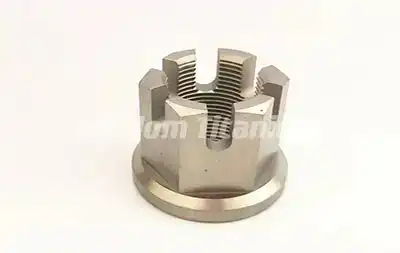
A titanium castle nut is a special hexagonal fastener with holes or notches cut into the top surface. It is meant to be locked securely with cotter pins or safety wire. These screws are made from aerospace-grade titanium metals and have very high tensile strength while being very light. The special castellated design keeps them from coming loose by mistake in places with a lot of vibration. This makes them important safety features in race cars, high-performance bikes, and airplane parts where failure is not an option.
Understanding Titanium Castle Nuts: Definition and Core Properties
The engineering behind castle nuts shows how far fastener technology has come over the years. Castle nuts made of steel have worked well for many years, but the switch to titanium is a big step forward in performance fastening options.
What Makes Titanium Grade 5 the Preferred Material
Titanium Grade 5, which is also called Ti-6Al-4V, is used a lot in high-performance uses because it has such great qualities. This metal is made up of about 6% aluminum and 4% vanadium. Its microstructure gives it a tensile strength of over 900 MPa while keeping its mass at only 60% that of steel. When racing teams switch from steel to titanium castle nuts in M22 and M24 sizes, they notice a noticeable decrease in unsprung weight. This directly leads to better suspension response and turning stability.
Titanium is better than stainless steel at resisting rust in places with a lot of salt. Titanium fasteners form a steady passive oxide layer that heals itself when scratched, while zinc-plated steel rivets break down when exposed to salt. This feature is very helpful for speed cars that drive near the coast or have to deal with winter road salt.
Engineering Advantages in High-Stress Applications
Titanium metals stand out in repetitive loading situations because they don't wear down easily. Tests done in the lab show that titanium castle nuts that are properly torqued keep their holding force even after millions of vibration cycles without galling or thread damage. In the same brake caliper uses, racing groups have found cases where titanium fasteners lasted 300% longer than steel versions.
Another important benefit is that it is thermally stable. Steel bolts can lose preload tension because of differences in their coefficients of thermal expansion, but titanium's coefficient of thermal expansion is very close to that of aluminum race parts. This flexibility keeps the bolt tightness the same at temperatures ranging from -40°F to 400°F, so the car will work reliably whether it's cold when it starts or after a long session on the track.
Procurement Insights: Buying Titanium Castle Nuts for Your Business
To find good titanium screws, you need to know how they are made and what the supplier can do. Buying choices often explain the difference between parts that work well and ones that might not.
Evaluating Manufacturers and Suppliers
Working directly with ISO 9001-certified makers gives you quality security and traceability that you might not get from providers in the middle. This method is used by Baoji Wisdom Titanium Industry and Trading Co., Ltd, which has full control over the whole production process, from inspecting the raw titanium rods to testing the finished products. The facility is in Baoji Titanium Valley in Shaanxi Province, which is China's biggest titanium industry cluster. It has integrated supply lines that make sure consistent materials and low prices.
Make sure that sellers give you certifications for all of the materials in each batch. Test reports that show the chemical makeup and mechanical qualities of genuine titanium Grade 5 material are included. A big problem in the business is fake or poorly graded titanium. This risk is eliminated by only buying from verified makers.
Minimum Order Quantities and Customization Options
A lot of the time, racing teams and shops that make modifications need sizes that aren't in normal listings. Manufacturers like Wisdom Titanium can make changes to your order as long as you buy at least a fair minimum of 100 pieces for custom setups. Because these sizes are easy to get, performance shops can keep M22 and M24 sizes in stock for common wheel and brake uses without having to make huge investments in inventory.
When buying something, you should think about the different surface finishing choices. Titanium that has been polished gives it a classic metal look and a smooth finish that keeps dirt from sticking to it. Anodizing makes something more resistant to rust and wear while also adding the ability to color-code it. PVD coating is very durable and hard, almost like tool steel. This makes it perfect for fasteners that will be used in rough race conditions.
Pricing Dynamics and Value Assessment
Titanium castle nuts are priced based on the cost of the raw materials, how hard they are to machine, and how many are ordered. Grade 5 titanium rod material is traded like any other good, and its prices change based on how much titanium sponge is made around the world. Precision CNC cutting of castle nut features and thread types needs specialized tools and knowledge, which adds to the cost of production.
When you buy in bulk, you save a lot of money per unit. When automakers buy standard fasteners for production cars in large quantities, they can arrange bulk discounts that can cut costs by 30 to 40 percent compared to buying in small amounts. Performance shops that need to regularly restock should build relationships with providers that offer tiered pricing systems that reward consistent volume.
Why Titanium Castle Nuts Are the Future: Industry Trends and Benefits
Titanium screws are becoming more popular at the same rate as other industries that are trying to make things lighter and better at what they do. Knowing about these trends helps buying managers put their companies in a good situation.
Automotive Industry Lightweighting Initiatives
Making new energy vehicles is under a lot of pressure to get the batteries as light as possible in order to get the longest range possible. For every kilogram taken off of a vehicle's mass, the drive range or battery capacity goes up by the same amount. More and more, companies that make high-end electric vehicles are using titanium screws in the frame and suspension systems. They are willing to pay more for these parts because they improve the performance of the whole system.
Similar adoption trends are caused by rules for racing. When competition groups set minimum weight rules, they force teams to use unusual materials whenever the rules allow it. Titanium castle nuts used to be rare and unusual, but now they are commonplace in professional racing to secure brake pads, wheel hubs, and suspension parts.
Manufacturing Innovation and Surface Treatment Advances
Advanced CNC cutting now makes it possible to make complicated titanium parts cheaply, which was once thought to be too expensive for general use. Five-axis machining centers can make castle nuts in a single setup, which cuts down on production time and keeps standards higher. The price difference between titanium and other materials is slowly closing because of these improvements in efficiency.
Surface cleaning methods keep getting better. Plasma electrolytic oxidation adds layers of ceramic-like material to the surface of titanium that make it much more resistant to wear than regular anodizing. These processes make it possible for titanium fasteners to work without anti-seize chemicals in some situations, which makes installation easier.
Long-Term Value Proposition
Titanium screws' return on investment estimates are more complex than just comparing prices. Less frequent upkeep, no more breakdowns caused by corrosion, and better performance all create value that must be captured by financial analysis. Racing teams that keep track of the total cost per race weekend find that titanium parts lower general running costs, even though they cost more to buy.
The resell value factor is especially important for high-end car changes. In enthusiast markets, where buyers know they're investing in quality and speed, cars with titanium parts fetch higher prices. This kept value more than makes up for the starting cost than steel parts that are thrown away.
Conclusion
Titanium castle nuts have been used successfully in challenging car, motorbike, and racing situations where reducing weight, increasing strength, and resisting corrosion are all important factors. Grade 5 titanium is a great material for performance-focused uses because it has a high strength-to-weight ratio, great resistance to fatigue, and better stability in harsh environments. When installed correctly and in accordance with the manufacturer's torque recommendations and upkeep instructions, these fasteners will provide solid service for a long time. Titanium fasteners are changing from specialty items to common performance parts as manufacturing technologies improve and production volumes rise. This gives procurement managers and engineering teams real competitive advantages in efforts to make things lighter and lower long-term operational costs.
Partner with a Trusted Titanium Castle Nut Manufacturer
For tuning cars and race uses, Wisdom Titanium specializes in manufacturing precision-engineered titanium castle nuts in M22 and M24 sizes. Our Grade 5 titanium parts are made to be very light without sacrificing the high strength that performance settings need. We offer a wide range of surface finishing choices, such as polished, anodized, and PVD coatings, so you can get the look and performance you need. We can work with both race teams and repair shops that need trusted titanium fastener suppliers because the minimum order size is only 100 pieces.
We use China's most complete titanium industry environment, which is in Baoji Titanium Valley, to provide uniform quality that is backed by ISO 9001 certification. Our experienced engineering team helps with customization for unique uses, making sure they work with your car systems. Get in touch with us at sales@wisdomtitanium.com to talk about bulk prices, technical details, and how our titanium castle nuts can make your performance builds better.
FAQ
Can titanium castle nuts withstand high-temperature racing environments?
Titanium Grade 5 keeps its mechanical qualities up to 400°F, which means it can be used in brake calipers and exhaust systems. The low thermal conductivity of the material actually keeps threads safer from heat damage than steel does in many situations.
Are titanium castle nuts compatible with steel studs and bolts?
When the right anti-seize chemicals are used, titanium nuts do work properly with steel studs. The difference in galvanic potential is very small, and it doesn't cause any rusting problems in vehicle settings. To keep things from galling during fitting, always use the right oils.
How does corrosion resistance compare to zinc-plated steel?
Titanium screws work much better in corrosive settings than zinc-plated ones. Zinc coatings give up their own protection to protect the steel underneath, but titanium's passive oxide layer keeps growing back, giving lasting protection without coating wear or upkeep needs.
References
1. Boyer, R., Welsch, G., & Collings, E.W. (1994). Materials Properties Handbook: Titanium Alloys. ASM International.
2. Donachie, Matthew J. (2000). Titanium: A Technical Guide, 2nd Edition. ASM International.
3. Society of Automotive Engineers (2019). SAE J429 Mechanical and Material Requirements for Externally Threaded Fasteners. SAE International Standards.
4. American Society for Testing and Materials (2021). ASTM F467 Standard Specification for Nonferrous Nuts for General Use. ASTM International.
5. Schutz, R.W. & Thomas, D.E. (1987). Corrosion of Titanium and Titanium Alloys. ASM Handbook Volume 13: Corrosion. ASM International.
6. Campbell, F.C. (2008). Elements of Metallurgy and Engineering Alloys. ASM International.