
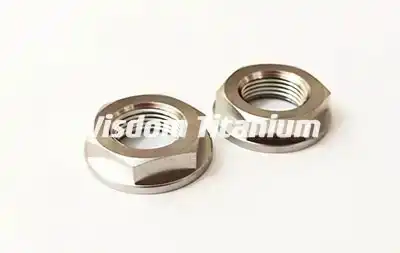
A jam nut is a thin, low-profile hexagonal fastener that is meant to hold a standard nut in place and keep it from coming away when there is shaking or dynamic load. Compared to regular nuts, jam nuts are only about half as tall. This makes them easier to fit in small areas while still locking in place mechanically through thread friction. Tightening a titanium jam nut against a primary nut makes a "jamming" affect that keeps threaded links safe in tough conditions. Most of the time, this locking device is needed in high-performance settings where saving weight, resistance to rust, and a strong connection are important.
Titanium Jam Nut Specifications and Material Properties
Professionals in procurement need accurate technical data to check for suitability and performance. Titanium jam nuts are made according to international standards like DIN 439, DIN 936, and ISO 4035. These standards define the mechanical qualities, thread pitch, and size limits. The most common metric thread sizes are M6 through M20. For older tools, fractional inch sizes from 1/4"-20 to 3/4"-16 are also available.
Mechanical Performance Characteristics
The technical benefits of Grade 5 titanium make it better for use in binding situations. With a yield strength of more than 830 MPa, these nuts don't bend or deform when loaded and unloaded over and over again, which would forever stretch steel bolts. Fatigue resistance is very important for motorbike brake disc bolts and sprocket nuts, which are stressed millions of times over the course of their lives.
Hardness levels between 30 and 36 HRC give the surface enough strength to keep threads from galling during installation while still allowing for unique changes. This hardness range strikes a balance between two different needs: the nut needs to be tough enough to spread gripping loads without digging into softer mating surfaces, but not too soft that it can't be used with controlled force without stripping the threads.
Installation Parameters for Optimal Performance
To fix something correctly, you need to pay attention to the torque requirements that take titanium's unique friction qualities into account. Because titanium has a lower coefficient of friction than steel, the suggested torque for an M10 titanium jam nut when paired with a normal nut is usually between 15 and 18 Nm. Under-torquing can cause the closing force to be insufficient, while over-torquing can loosen the threads or damage the oxide layer, which lowers the resistance to rust.
Surface treatments make things more useful in certain settings. When parts are polished, they have less aerodynamic drag and are easier to clean in medical or food processing equipment. Anodizing makes bright, durable coats that do two things: they make parts stand out visually so they can be identified, and they make the surface harder up to 60 HRC. PVD coats put down very thin layers of ceramic that make things even more resistant to wear and reduce friction, which makes them last longer in high-cycle uses.
Titanium Jam Nut vs. Other Materials: Comparative Analysis
Knowing how titanium stacks up against other materials can help you make business choices and figure out the best ways to use titanium. Steel jam nuts are most common in low-cost situations where weight and rust aren't a big deal. Carbon steel is very strong and only a third of the price of titanium, but it starts to rust within hours of being exposed to water. Steel bolts corrode in brake systems and chassis uses, even with zinc plating or phosphate coatings. They need to be checked and replaced on a frequent basis.
Material-Specific Trade-Offs
The 304 and 316 types of stainless steel are more resistant to rust than carbon steel, but they are still not too expensive. But stainless steel is almost as heavy as steel, and it tends to gall when it's being installed. Because austenitic steel grades have a lot of nickel, the male and female threads rub against each other, which can cause screws to seize when pressure is applied. Anti-seize chemicals stop galling, but they can make precision parts more likely to get contaminated.
Brass and nylon insert locknuts meet specific needs but limit how they can be used. Brass is easy to work with and doesn't rust in drinkable water systems, but its tensile strength of about 350 MPa means it can only be used for non-structural links. Nylon insert locknuts reliably lock through polymer friction instead of mechanical jamming. However, the nylon breaks down above 120°C, so they shouldn't be used near engine parts, brake pads, or exhaust systems.
Long-Term Value Proposition
Titanium jam nuts have a higher starting cost, but their longer useful life and lower upkeep requirements pay for themselves over time. A racing team might spend $200 a year on screws alone to replace steel wheel hub nuts after every race because they are rusting or wearing out. When you switch to titanium, you don't have to replace it for more than one season. This cuts down on direct costs and avoids the indirect costs of trackside fails or safety issues.
Certification and quality assurance tell the difference between sources you can trust and those who aren't. Reputable makers use ISO 9001 quality systems that make it possible to track materials from the mill certificates to the final inspection. Professionals in charge of buying things should make sure that sellers check the sizes of samples from each production lot using a tension tester, a thread gauge, and other methods. This paperwork is very important for fields like aircraft and medical devices that have to follow rules that require supply lines to be able to be checked.
Procurement Guide: How to Source Titanium Jam Nuts Effectively
Knowing the pros and cons of each sourcing route is important for navigating the supplier market. Online markets are convenient and let you compare prices, but they often don't have expert help for questions about specs or requests for changes. Direct relationships with manufacturers offer the most knowledge and freedom, especially when large purchases require minimum order numbers that are usually between 200 and 500 pieces of each size and finish.
Evaluating Supplier Capabilities
If you buy directly from a well-known maker, you can be sure of quality control and consistent production, which you can't get from middlemen. When looking at possible providers, you should check to see if they can do more than just basic cutting. Can they give you material approvals that show where the titanium bar stock came from? Do they keep their testing tools set to make sure the dimensions and mechanical properties are correct? These skills show that the process is mature and that the company is committed to quality, which means that supplies can be trusted.
Lead times are very different depending on whether the parts are from a regular list or are made to order. If you order standard titanium jam nuts in common sizes and finishes, they might ship within two weeks from stock. But if you need specific metals, special coats, or non-standard sizes, it could take six to eight weeks. Smart buying planning takes these facts into account by keeping extras of important fasteners on hand and planning custom orders well ahead of when they are needed for production.
Building Reliable Supply Relationships
Before making big purchases, sample orders are a great way to make sure everything is working out. By asking for samples, you can check the quality of the cutting, the finish on the surface, and the accuracy of the measurements in real-world situations. Testing how well your specific parts fit and work with each other finds compatibility problems before they get too big to fix. Suppliers with a good reputation see sample requests as chances to show off their quality and build relationships with customers that will last.
Specifications can't show how reliable a provider is, but customer comments and case studies can. How quickly does expert help answer questions? Do supplies show up on time and in the right way? These operational issues are often more important than small price differences, especially when production plans rely on parts arriving on time.
Conclusion
Titanium jam nuts are an engineering answer that solves important problems in high-performance uses today. Because they are made of light materials, are very strong, and don't rust, they solve problems that lower reliability and raise upkeep costs in the automobile, motorcycle, aircraft, and marine industries. Procurement experts can make choices that improve both short-term performance and long-term value by knowing the technical specifications, material properties, and correct installation methods. As long as businesses want mechanical systems to work better and last longer, titanium fixing solutions will go from being used in a few specific situations to being standard wherever weight reduction and resistance to weather factors are important for design.
Source Premium Titanium Jam Nuts from Wisdom Titanium
Wisdom Titanium is an expert at making high-performance titanium fasteners that meet the demanding needs of shops that modify cars, race teams, and people who build precise machines. We are in Baoji Titanium Valley in Shaanxi Province, which is China's main titanium production hub. This gives us access to the world's largest titanium supply chain, which includes everything from making titanium sponges to developing new alloys and CNC cutting with great accuracy.
Our titanium jam nut line is made from Grade 5 (Ti-6Al-4V) material and comes with a variety of styles, such as polished, anodized, and PVD-coated, so you can get the look and function you want. We support both well-known performance brands and new ones by having an easy-to-reach minimum order number of 200 pieces and quality systems that are ISO 9001-certified. Every package comes with full paperwork for material traceability, dimensional proof, and mechanical testing. This makes sure that all regulations are followed and gives you peace of mind.
Our experienced technical team is here to help you with engineering throughout the whole procurement process, whether you need standard sizes for quick delivery or custom specs for unique uses. Get in touch with our team at sales@wisdomtitanium.com to talk about your needs with a titanium jam nut provider that is dedicated to providing high quality products and dependable service.
FAQ
Why do titanium jam nuts outperform steel alternatives in racing applications?
When compared to steel, titanium jam nuts are about 45% lighter while still being as strong as or stronger than steel nuts. By lowering the unsprung weight in the suspension parts and the rotating mass in the wheel components, this mass reduction directly improves the way the car moves. Less drag makes the vehicle easier to control when changing speeds and stopping. Titanium's fatigue resistance keeps it from breaking like steel bolts do when they are loaded and unloaded over and over again by engine vibrations and road hits. Corrosion protection makes sure that the performance stays the same even when it's exposed to brake dust, road salt, and harsh cleaning chemicals used in racing maintenance.
Can titanium jam nuts withstand extreme temperature environments?
Grade 5 titanium keeps its mechanical qualities from very cold temperatures to about 400°C. This is much higher than the thermal safety of polymer-locking mechanisms, which soften above 120°C. Because of this, titanium lock nuts can be used to connect brake calipers, exhaust system gear, and engine bay assemblies that would be damaged by heat. As the temperature changes, the material's low thermal expansion rate keeps the clamp loads stable by minimizing changes in size during thermal cycles.
How do I choose the right size and torque specification for titanium jam nuts?
When choosing a thread size, it should match the width of the bolt or threaded shaft that goes with it. For optimal strength, the minimum engagement length should be 1.5 times the standard diameter. Because titanium has a high friction level, its torque requirements are usually 15% lower than those for steel. For exact numbers, look at the manufacturer's data sheets. Coatings or anodizing on the surface can change the friction coefficients. When you use calibrated torque tools, you can be sure that the fitting will go smoothly every time without overstressing the threads or undertightening the locking mechanism.
References
1. Boyer, R., Welsch, G., & Collings, E.W. (1994). Materials Properties Handbook: Titanium Alloys. ASM International.
2. Budinski, K.G. & Budinski, M.K. (2010). Engineering Materials: Properties and Selection (9th ed.). Pearson Education.
3. Bickford, J.H. (2007). Introduction to the Design and Behavior of Bolted Joints (4th ed.). CRC Press.
4. Donachie, M.J. (2000). Titanium: A Technical Guide (2nd ed.). ASM International.
5. Shigley, J.E., Mischke, C.R., & Budynas, R.G. (2004). Mechanical Engineering Design (7th ed.). McGraw-Hill.
6. Schutz, R.W. & Watkins, H.B. (1998). Recent developments in titanium alloy application in the energy industry. Materials Science and Engineering: A, 243(1-2), 305-315.