
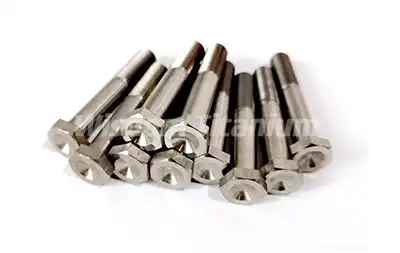
A hex bolt is a threaded fastener with a six-sided head that you tighten with a wrench or socket. The bolt passes through aligned holes and usually pairs with a nut, plus a washer when the joint needs one. As the nut turns, the shank stretches slightly, and that stretch creates clamping force between the parts. Engineers use a bolt in machinery, steel structures, vehicles, pipe flanges, and marine equipment. At Wisdom Titanium, we make titanium versions in Grade 2 and Grade 5, so I will cover the basics first and then the choices that matter when you buy.
How a Hex Bolt Works and Which Standards Apply
Clamping Force and Joint Loads
A fixed joint works because of the preload. When you turn the nut all the way down, the bolt acts like a stiff spring to pull the pieces together. The sides rub against each other because of the force in the middle. When the joint is well-made, most of the shear load is carried by friction, while most of the tension is felt on the bolt itself. When the joint shakes, it may slip or become loose if there isn't enough loading. The bolt or thread could break if it's too high. Because of this, a hex bolt definition needs more than just the item's name. You can tell how the joint works by its diameter, length, thread, grade, coating, and head size.
Hex Bolt vs. Hex Screw vs. Cap Screw
A bolt, hex screw, or cap screw are all names that people use to describe the same thing when they buy it. What is ISO 4014? It's a hexagon-shaped bolt with a partial thread. What is ISO 4017? It's a hexagon-shaped screw with a thread throughout the head. In everyday life, both are sold as hex bolts. In the US, a "hex cap screw" usually means an ASME B18.2.1 hex head fastener that is finished. There is a hex drive inside a socket head cap screw, which makes it different from other screws. The standard number should be written on every order so that everyone gets the same part.
DIN 933, DIN 931, and ISO Equivalents
There are two types of hex head screws in DIN 933 and 931. The first has a fully threaded head, while the second has a plain shank with only some threads on it. In their place came ISO 4017 and ISO 4014, but people still want to know the DIN numbers, so many catalogs still list them. The wrench size is different for some sizes, even though the parts look the same. The DIN versions of M10, M12, and M14 have bigger across-flats sizes than the ISO models. With a DIN number order, I check the drawing to make sure it's right before I start making something.
Hex Bolt Sizes, Dimensions, and Thread Selection
Key Dimensions on a Hex Bolt
Number of threads, length, threaded length, width across flats, and head height are the six measurements that most hex bolts have. Titanium hex bolts that meet DIN 933 and DIN 931 standards are available from us, and we can also make custom designs. The pitch is the distance between the thread crests, and the standard diameter is the thread's biggest width. To find the right wrench size, measure the width across the flats. The height of the head tells you how much space you need. The following table shows the DIN 933 values for three common metric sizes.
| Size | Coarse pitch (mm) | Width across flats (mm) | Head height (mm) |
|---|---|---|---|
| M8 | 1.25 | 13 | 5.3 |
| M10 | 1.5 | 17 | 6.4 |
| M12 | 1.75 | 19 | 7.5 |
You can use these numbers as a guide. Check the current standard or your picture before you place your order.
Metric and Imperial Size Formats
If you multiply the diameter by the length, you get the metric size. The head of an M10 × 60 bolt is 10 mm wide, and the body is 60 mm long. Unless it says otherwise on the label, the coarse pitch is 1.5 mm. The width, length, and amount of threads per inch are all shown in inches. In this case, 1/2-13 × 2 in. means a half-inch bolt with 13 threads per inch and a length of 2 inches. Plenty of people in the US buy both, but they can't be used together. A 1/2-inch bolt and an M12 bolt look the same, but their threads are different. ASME B18.2.1 tells us what an inch hex bolt size should be, while ISO 4014 and ISO 4017 tell us what sizes metric parts should be.
Coarse, Fine, and Partial Threads
When you need to use thread, coarse threads are better because they go in faster and can handle dirt and small damage. It is easier to make small changes to fine threads because they have a larger tensile stress area. This helps when the walls are thin or when the setup is exact. Full-threaded long bolts grip well and work well in short joints. Partially threaded bolts have a plain shank that holds parts in place. The part that isn't threaded is bigger, so it can handle bending loads better. The thread was cut to the right length so that it doesn't touch the shear plane. Rolling threads are best for cyclic loads because they keep the grain moving and make the material less likely to wear out.
Titanium Hex Bolt Materials, Grades, and Coatings
Steel Property Classes vs. Titanium Grades
The property classes for steel hex bolts are 4.6, 8.8, 10.9, and 12.9, according to ISO 898-1. The theoretical tensile strength in MPa is found by multiplying the first amount by 100. The return ratio is shown by the second number. That is, Class 8.8 means that the strength to pull apart is 800 MPa and the strength to stretch is 80% of that. For inch bolts, SAE Grade 2, 5, and 8 are used. SAE Grade 5 is the same as titanium Grade 5. ASTM standards, such as ASTM B348, decide what grades of titanium bars are available. You should check the design requirements since cross-system changes only give you a rough idea of how things compare.
Grade 2 or Grade 5 Titanium Hex Bolt
Ti₂O₃ in Grade 2 is pure enough to be used in business. It's not very strong, but it doesn't rust. ASTM B348 says that bar stock must have a tensile strength of at least 345 MPa. It works well for parts that need to be strong but also resistant to rust, like those used in chemical jobs and the marine industry. Grade 5, which is also called Ti-6Al-4V, can hold its shape for at least 895 MPa, which is about the same as class 8.8 to class 10.9 steel. Because titanium weighs about 4.5 g/cm³ and steel weighs about 7.8 g/cm³, a titanium bolt is about 40% lighter than a steel bolt. In a very important part, you should not use a Grade 5 bolt instead of a Class 12.9 bolt until experts say it's okay.
Surface Finish, Anodizing, and Galvanic Compatibility
It is possible to protect steel hex bolts from corrosion in three ways: zinc plating, hot-dip galvanizing, and black oxide. Titanium doesn't need those covers because it already has a stable oxide film on it. There is no need for anodizing. It can make colors like blue, purple, and gold without using dyes by changing how thick the oxide is. You can also use it to label sizes or torques with different colors. When titanium threads rub against each other, they can get stuck. But, an anti-seize compound or a custom DLC coating can make this less likely to happen. Ti and carbon fiber work well together. Titanium and aluminum can rust faster if they touch each other and there is water around, so keep them away from each other.
Measuring, Installing, and Applying Hex Bolts
How to Measure a Hex Bolt Correctly
Use tools to measure across the main thread width to find the standard size. To find the length of a standard hex bolt, measure from the floor under the head to the tip. It doesn't matter what the head is. To find out what size wrench you need, measure first the threaded part and then the width across the flats. A thread pitch gage can tell you the pitch, and a known-to-fit nut can set you free on the thread system. Go/no-go thread gages and hardness checks quickly find mixed lots as parts come in. If you write down the standard, size, grade, coating, quantity, and packaging on the same line, you won't make as many mistakes when you reorder.
Torque and Installation Practice
The torque is almost the same as the preload, but most of the power used to tighten is lost to contact. Grease, anti-seize, coatings, dirty threads, machine type, and refill are some of the things that can change the result. Because steel is more elastic than titanium, a normal steel torque chart might not show the right amount of torque. You can use values from the OEM, an engineering standard, or the provider to find the right fastener and lubricant for you. Use a measured torque wrench to tighten the joints of more than one bolt, and make sure that at least one full thread goes past the nut. Do not move the bolt any further in case it gets stuck. When you cross-thread or gall, you can hurt both parts.
Hex Bolt vs. Other Fasteners
A hex bolt fits a lot of industrial joints and makes it easy to use an outside wrench. A carriage bolt is hard to turn in steel or wood with slots because it has a square neck and a domed head. There are places where a hex key or wrench can't go, but a socket head cap screw, like the DIN 912, can. A lag bolt can go through wood without any problems. When you put together a DIN 6921 hex flange bolt, the washer face spreads the load and saves a part. What you wear on your head is more important than how it looks when you're in salt water, chemicals, or on the road. Titanium can handle these temperatures.
Applications and Common Mistakes
Some industries that use titanium hex bolts are aircraft, racing, military, chemical processing, and bicycle parts. These industries care a lot about weight and corrosion. In motorsport, they take away some of the mass that isn't moving from suspension links and brake caliper mounts. Titanium is used in subsea frames and processing equipment because it doesn't rust or pit in salt water. Size, thread, grade, and head size don't matter when you only know the diameter and length. This is where most issues start. People also get it wrong when they use the wrong torque table, put together a strong bolt and a weak nut, or think that stainless steel is always better than other materials. Look at the plans first before you switch DIN, ISO, ASTM, and ASME parts.
Buying Titanium Hex Bolts for B2B Procurement
Specification Checklist Before You Request a Quote
A clear request cuts down on emails that go on for days. It's important to write down the type of product, the standard (DIN 933 or DIN 931), the size, the pitch, the length, the thread length, the grade, the surface finish, the tolerance, the number, and the inspection papers. Let us know if you want Grade 5 or Grade 2 or both. Please also let us know how you'd like the parts to be packed and named. Give them a price list that breaks down the things by size, grade, and number. Also, let them know how many of each item you want to buy. The landed cost is most accurate when all the information is given, like the raw material, the work that needs to be done, the heat treatment, the inspection, the packaging, the ship size, and the freight.
What Wisdom Titanium Offers
Grade 2 and Grade 5 titanium hex bolts that are in line with DIN 933 and DIN 931 are what we sell. At a good price, you can buy them from our plant. The fewest things you can buy are 200, and each one is made from a unique picture, sample, or idea. Strong titanium rods are used to make our bolts and nuts, and they are checked for quality before they are sent out. Goods and standard parts that don't change in price are always in stock at our company. So prices don't change too much, this helps sellers plan when to restock. Custom orders are welcome, and our in-house R&D team can help. We follow ISO 9001 at every step of the way. As well as metal screws, we make ones out of nickel, tantalum, and zirconium.
Baoji Titanium Valley and Our Quality Process
Baoji Wisdom Titanium Industry and Trading Co., Ltd. has been in business since 2016 and is ISO 9001 approved. They make and sell typical and unique CNC parts. Baoji Titanium Valley is one of the most important places in the world to make titanium. It is in Shaanxi Province, where we work. It is the largest and most complete titanium industry hub in China. High-performance alloys, bars, plates, tubes, forgings, and titanium waste are all linked in the local chain. In other words, the raw materials are not far from our studio. Every order goes through a process check, and we value customer feedback. Some of our clients work in medicine, cars, motorcycles, bikes, space, energy, oil and gas, and medicine.
Conclusion
There are more than two types of hex bolts, and the best one is not just the biggest one. Hex bolt has heads with six sides that clamp by preloading. Rules like DIN 933, DIN 931, ISO 4014, and ISO 4017 decide what shape it should be. Size, pitch, length, and thread length all affect how well it fits. Threads come in different types that work well with various joints. Ti Grade 2 doesn't rust as easily as Ti Grade 5, which is stronger than steel but lighter. You can avoid making most mistakes if you measure correctly, install with the right amount of force and anti-seize, and write down all the requirements in full. Anyone who buys something checks the standard, grade, size, and finish to make sure it works and fits right.
FAQ
What is the difference between a hex bolt and a hex screw?
A bolt and nut go together sometimes, and a screw goes into a tapped hole other times. ISO 4014 talks about bolts that only have a partial thread, and ISO 4017 talks about screws that have a full thread. In trade brochures, both are often listed as hex bolts.
Does titanium Grade 5 match SAE Grade 5?
No, the Ti-6Al-4V alloy that ASTM talks about is Titanium Grade 5. Not too much or too little carbon is in SAE Grade 5 steel. The two have nothing to do with each other.
Can metric and inch threads mix?
No, the threads may start to fit but not finish because they are different sizes and shapes. This can damage the other part.
Can a hex bolt go into a tapped hole without a nut?
Yes, as long as the design lets you and the thread can fit through the hole. Put titanium anti-seize on the galling to stop it.
What is your MOQ?
Our minimum order quantity is 200 pieces, and we can make patterns just for you.
Send Your Hex Bolt Inquiry to Wisdom Titanium
For hex bolts, Wisdom Titanium makes Grade 2 and Grade 5 titanium hex bolts that are in line with DIN 933 and DIN 931. They need at least 200 pieces to place an order, and they can help with unique creations. Please email us at sales@wisdomtitanium.com with your sizes, grades, quantities, and drawings. After that, we'll help you pick the right size, grade, and delivery plan for you. Wisdomtitanium.com is where you can find out more about this product.
References
- ASME B18.2.1, Square, Hex, Heavy Hex, and Askew Head Bolts and Hex, Heavy Hex, Hex Flange, Lobed Head, and Lag Screws (Inch Series), 2012
- ISO 4014, Hexagon Head Bolts: Product Grades A and B, 2011
- ISO 898-1, Mechanical Properties of Fasteners Made of Carbon Steel and Alloy Steel: Bolts, Screws and Studs, 2013
- ASTM B348, Standard Specification for Titanium and Titanium Alloy Bars and Billets, 2019
- Machinery's Handbook, Industrial Press, 2020
- Titanium: A Technical Guide, ASM International, 2000