
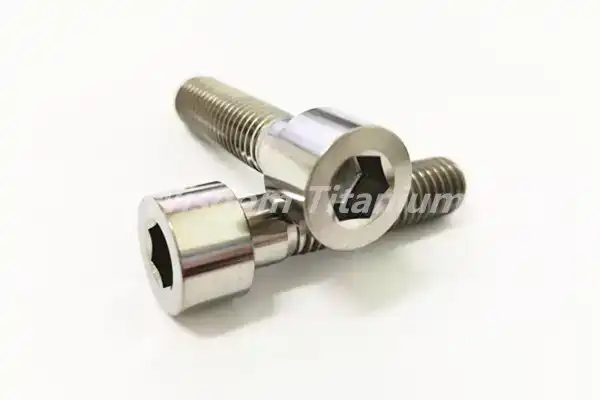
In 2023, the global market for titanium fasteners was worth $780 million, with Grade 5 alloy making up about 60% of all sales. This dominance shows that the alloy is reliable and works well in a wide range of applications. Grade 5 titanium fasteners work better than regular materials in a wide range of applications, from commercial airplanes to racing motorcycles to medical implants to offshore drilling equipment. Engineers can make better choices about the materials to use if they know the precise properties of this alloy.
Grade 5 Titanium Alloy Composition and Properties
Grade 5 titanium, technically designated as Ti-6Al-4V, contains titanium as the base element with approximately 6% aluminum and 4% vanadium as primary alloying additions. The aluminum content enhances strength while reducing density compared to pure titanium. Vanadium improves high-temperature stability and resistance to creep deformation. This specific composition achieves an optimal balance between strength, ductility, and processability. The alloy exists in two primary metallurgical conditions: annealed and solution-treated plus aged.
The annealed condition provides good ductility and moderate strength suitable for most Grade 5 titanium fastener applications. Tensile strength typically ranges from 895 to 930 MPa with yield strength around 828 MPa. This condition offers excellent formability during manufacturing while maintaining adequate strength for structural applications. The microstructure consists of both alpha and beta phases that contribute different properties. The alpha phase provides strength and corrosion resistance while beta phase enhances ductility and toughness.
Solution-treated and aged conditions achieve higher strength levels approaching 1,170 MPa tensile strength. This heat treatment dissolves alloying elements at elevated temperature, then precipitates fine strengthening particles during controlled cooling. The process significantly increases strength but reduces ductility compared to annealed material. Aerospace applications often specify this condition for critical structural Grade 5 titanium fasteners. However, the reduced ductility requires careful installation to prevent overtorque failures.
The density of Grade 5 titanium is about 4.43 g/cm³, which is about half that of steel, which is 7.85 g/cm³. Because of its low density, this material has very high strength-to-weight ratios that make it useful in aircraft. A titanium bolt is 44% lighter than a steel bolt of the same size, but it is just as strong or stronger. Saving weight adds up across hundreds or thousands of fasteners in the frames of airplanes. Boeing's study shows that for every pound of weight saved in the design of an airplane, it uses around 10,000 gallons less fuel over the course of its service life.
Applications, Advantages, and Performance Benefits of Grade 5 Titanium Fasteners
Aerospace applications dominate Grade 5 titanium fastener usage, constituting nearly 40% of overall market volume. Commercial airplanes have thousands of titanium bolts, screws, and rivets throughout airframe structures. Engine mounts, landing gear attachments, and flight control systems utilize titanium for strength and corrosion resistance. Reducing weight immediately makes fuel use more efficient and increases the amount of cargo that can be carried. Each kilogram saved in aircraft structure offers greater cargo or fuel capacity worth thousands of dollars yearly.
Military aerospace applications demand even more extensive titanium fastener use. Fighter aircraft operate in more extreme environments with higher performance requirements. Titanium fasteners withstand vibration, thermal cycling, and salt spray exposure during carrier operations. The material's strength enables reducing fastener sizes and quantities compared to steel alternatives. Fatigue resistance proves critical for airframes experiencing high stress cycles during combat maneuvers. According to the U.S. Air Force Materials Laboratory, titanium fasteners demonstrate 2-3 times longer fatigue life than high-strength steel in airframe applications.
More and more, motorsports and high-performance automotive applications are using Grade 5 titanium fasteners to make things lighter. Titanium is used a lot in the chassis, suspension, and engine of Formula 1 race vehicles. Every gram of weight loss makes acceleration, braking, and handling better. Motorcycle racing has embraced titanium even more since they are willing to pay more for better performance. Production motorcycles now offer titanium fastener improvements for people who want to save weight and are ready to pay for it.
Titanium's ability to work with the body and resist corrosion makes it useful in medicine and dentistry. Only Grade 5 titanium is used for bone screws, dental implants, and prosthetic attachments. The substance combines with human bone through osseointegration without causing the immune system to react. Excellent corrosion resistance keeps metal ions from getting into bodily tissues. The strength-to-weight ratio lets implants be smaller, which cuts down on surgery trauma. A study in the Journal of Biomedical Materials shows that Grade 5 titanium is more biocompatible than stainless steel options.
Marine and offshore uses make use of titanium's great ability to resist corrosion in seawater. Titanium fasteners are used in subsea equipment, ship propulsion systems, and parts for offshore platforms. The material does away with the need to replace fasteners because they rust. At first, titanium costs more than stainless steel, but over time, it costs less because it doesn't need as much care and lasts longer. More and more yacht builders are using titanium for rigging and deck fittings since it is resistant to corrosion and saves weight.
Selection Criteria, Specifications, and Quality Standards for Titanium Fasteners
Material specifications for Grade 5 titanium fasteners reference multiple industry standards depending on application sector. ASTM B348 covers titanium bar and billet material used for fastener manufacturing. This specification defines chemical composition, mechanical properties, and testing requirements. ASTM F467 specifically addresses titanium fastener material including bars, wires, and forgings. AMS 4928 provides aerospace material specifications with more stringent requirements than commercial standards. Military specifications like MIL-T-9047 govern defense applications with additional testing and documentation.
Chemical composition requirements specify narrow ranges for critical alloying elements. Aluminum content must fall between 5.50% and 6.75% by weight. Vanadium ranges from 3.50% to 4.50%. Iron content limited to 0.30% maximum prevents embrittlement. Oxygen, nitrogen, and carbon contents require careful control as these interstitial elements significantly affect mechanical properties. Certified material test reports document actual chemistry for traceability and quality verification. Deviation from specified composition ranges can dramatically alter mechanical properties and corrosion resistance.
Mechanical property requirements vary by fastener grade and heat treatment condition. Annealed Grade 5 titanium fasteners must achieve minimum 895 MPa tensile strength and 828 MPa yield strength. Elongation in 50mm must exceed 10% to ensure adequate ductility for installation. Reduction of area exceeding 25% indicates sufficient toughness. Solution-treated and aged conditions achieve higher strength but with reduced ductility. Each lot of material undergoes tensile testing to verify conformance before fastener manufacturing begins.
Thread specifications follow standard Grade 5 titanium fastener thread series including UNC, UNF, and metric options. Thread rolling produces superior fatigue performance compared to cut threads through work hardening and favorable grain flow. The rolling process creates compressive surface stresses that resist fatigue crack initiation. Class 2A threads provide standard fit for most applications. Class 3A threads offer tighter tolerances for precision assemblies. Thread inspection includes pitch diameter verification, thread angle measurement, and surface finish assessment.
Head styles available in titanium include hex head, socket head cap screws, button head, flat head, and various specialty configurations. Manufacturing capabilities limit some head styles due to titanium's work hardening characteristics. Socket head cap screws represent the most common style for high-strength applications. Hex heads facilitate installation with standard tools. Button heads provide low-profile solutions where clearance limits exist. Custom head styles accommodate special requirements though minimum quantities typically apply.
Partner with Wisdom Titanium for Premium Grade 5 Solutions
Wisdom Titanium stands ready to serve as your trusted grade 5 titanium fastener supplier, delivering exceptional quality and customized solutions for demanding applications. Our ISO 9001-certified manufacturing facility produces precision fasteners meeting the most stringent specifications while maintaining competitive lead times and pricing structures.
With minimum order quantities starting at just 200 pieces, we accommodate both prototype development and production requirements efficiently. Our comprehensive size range from M1.6 to M48 with thread pitches from 0.4mm to 5.0mm ensures compatibility with virtually any application requirement. Length options spanning 5mm to 350mm provide design flexibility for diverse mechanical assemblies.
Quality assurance processes guarantee consistent performance across every shipment, with detailed material certifications documenting chemical composition and mechanical properties. Our experienced engineering team collaborates with customers to optimize fastener designs for specific applications, ensuring optimal performance while minimizing costs. Custom surface treatments including polishing, anodizing, and PVD coating provide enhanced functionality for specialized requirements.
Our technical sales team stands prepared to discuss your specific requirements and recommend optimal solutions for your applications. Contact us at sales@wisdomtitanium.com to explore how our advanced titanium fastener solutions can enhance your product performance while reducing weight and maintenance requirements.
References
- ASTM International, "ASTM B348-13: Standard Specification for Titanium and Titanium Alloy Bars and Billets" (2013), West Conshohocken, PA.
- ASM International, "Titanium: A Technical Guide, 2nd Edition" (2000), Materials Park, OH.
- Boyer, R., Welsch, G., and Collings, E.W., "Materials Properties Handbook: Titanium Alloys" (1994), ASM International.
- Corrosion Science Journal, "Long-term Seawater Corrosion Behavior of Titanium Alloys" (2021), Elsevier Publishing.
- Journal of Biomedical Materials Research, "Biocompatibility and Osseointegration of Titanium Alloys in Medical Applications" (2022), Wiley Publishing