
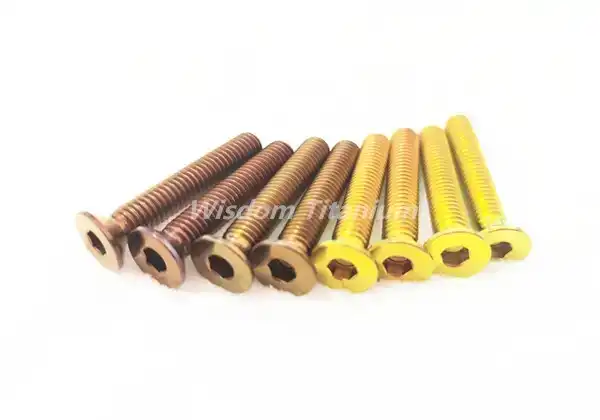
A flat head bolt is a specialized fastener distinguished by its countersunk head design, engineered to sit flush or below the surface of the material it secures. This unique profile eliminates protruding edges, creating a smooth, aerodynamic finish that enhances both functionality and visual appeal. In bicycles, titanium flat head bolts for bikes deliver exceptional performance through their lightweight construction and corrosion-resistant properties, making them indispensable for high-performance builds, racing applications, and premium custom projects where every gram matters.
Understanding Flat Head Bolts and Their Role in Bikes
Design Characteristics That Define Flat Head Bolts
Flat head bolts are different from regular hex head or button head screws because their heads are countersunk. The underside angle is tapered, usually 82 degrees or 90 degrees depending on ISO or DIN standards. This makes it possible for the bolt to fit perfectly into countersunk holes that have already been drilled. This integration keeps the parts from snagging on cables, clothing, or other parts nearby. This is especially helpful for cycling, where space is limited and safety is the most important thing.
Flat head bolts spread tightening forces over a larger circular contact area than raised-head bolts. This load spread lowers stress levels in specific areas on carbon fiber frames or lightweight metal parts. This lowers the chance that the material will wear out or crack over time. The flush mounting also makes the bike more aerodynamic, which is important for elite road riders and time trial experts who are looking for small gains.
Key Applications in Bicycle Assembly
Many parts of a bike depend on flat head nuts to work properly. Brake caliper mounts need to be tightened precisely and without vibration, and the flush profile keeps the rotor clearance from being affected. The streamlined look is good for handlebar stems, and they stay strong even when steering loads are put on them. Titanium flat head bolts for bikes provide the fasteners that don't damage the material or add extra weight at frame joints, especially in carbon fiber and titanium frames.
Flat head bolts are also used in bottle cage mounts, seatpost clamps, and derailleur clips where a clean surface finish is important. These fasteners are chosen by racing teams and speed repair shops because they keep aerodynamic profiles without losing holding power. Knowing these uses helps buying professionals match the right bolt specs to the right assembly needs, making sure that everything works together and reliably.
Differentiating Flat Head Bolts from Alternative Fastener Types
When compared to hex head bolts, flat head bolts don't have the open hexagonal shape that can catch on gear or make the vehicle less aerodynamic. Even though button head bolts have a low profile, they still stick out from the surface and don't fit flush like countersunk designs do. Cap screws have a strong clamping force, but their cylindrical heads mean they can't be used in countersunk holes.
Which of these types of fasteners to use relies on the objectives of the assembly. When surface consistency, weight savings, and mechanical efficiency all come together, flat head bolts are the best choice. But when they are made, they need to be precisely countersunk, which is an extra step that button or hex head bolts don't need. This trade-off is fine when making high-end bikes, where the extra accuracy is needed for better speed.
Why Choose Titanium Flat Head Bolts for Bikes?
Superior Strength-to-Weight Ratio
Titanium Grade 5 (Ti-6Al-4V) alloy has a tensile strength of more than 900 MPa and a density of only 4.43 g/cm³, which is about 45% less than steel. This edge in strength compared to weight directly leads to better performance for professional cyclists. Getting rid of extra weight in the wheel assemblies makes them more responsive to acceleration, and getting rid of extra weight in the frame makes it easier to climb without affecting the structure's strength.
Racing teams that have to follow strict weight limits use titanium screws to keep bike weights low while also making the most of the strength reserves of individual parts. When compared to stainless steel bolts, a full titanium bolt kit for a road bike can save 80 to 120 grams. This is a big difference in races where seconds separate podium positions. This idea of minimising weight also applies to mountain bikes. Reducing the amount of unsprung mass makes the suspension more sensitive and the rider more in control on rough terrain.
Exceptional Corrosion Resistance Across Climates
Titanium's passive oxide layer forms on its own when it is exposed to air, protecting it from things that can damage it. Unlike stainless steel, which can rust in chloride-rich environments, titanium stays strong in coastal areas, places where it is exposed to winter road salt, and humid subtropical climates. This makes the parts last a lot longer, which lowers the cost of upkeep and makes the system more reliable in the long run.
Titanium flat head bolts for bikes get rid of guarantee claims related to corrosion for bike makers who send their bikes to a wide range of markets, from dry deserts to warm monsoon regions. Custom bike makers who work with clients on the coast like how maintenance-free the performance is because titanium bolts don't need any coats or regular checks for rust. This reliability factor improves the reputation of the company and the level of customer happiness.
Comparative Analysis: Titanium versus Alternative Materials
In Grade 12.9 classes, steel nuts have higher absolute strengths, but they are much heavier. Even though aluminum screws are light, they are not strong enough for high-stress uses like brake mounts and stem bolts. While stainless steel is somewhat resistant to corrosion on its own, it can still be damaged by galvanic corrosion when combined with carbon fiber or aluminum parts.
Even though carbon fiber bolts are light, they break easily when hit and need to be checked for stress cracks often. Titanium is the perfect metal because it is 90% as strong as steel but less than half as heavy. It is also more resistant to rust than any other metal. This is why titanium is so popular in professional racing, high-end custom builds, and high-end OEM standards where speed cannot be sacrificed.
Real-World Performance in Demanding Applications
During messy winter races, professional cyclocross teams put bikes through a lot of shaking, impact loads, and quick changes in temperature. Titanium flat head bolts keep their clamping strength in these conditions without coming loose or breaking down. In time trials, where every watt saved helps them move up in the rankings, road racing teams use the aerodynamic advantages to their advantage.
Enduro mountain bike racers use titanium fasteners in their suspension linkage systems because they can handle the repeated compression processes that would break less durable materials. Grade 5 titanium has a wear resistance limit of about 510 MPa, which means that these important screws will last all season without breaking. These real-world examples show why titanium has become the material of choice for high-performance uses.
How to Choose the Right Titanium Flat Head Bolts for Bikes?
Understanding Titanium Alloy Grades and Certifications
Grade 5 titanium (Ti-6Al-4V) is the standard for aerospace and speed cycling uses because it is the strongest and easiest to work with. Its 6% aluminum and 4% vanadium alloying elements make it stronger in tension while keeping it flexible enough to avoid breaking into brittle pieces when it hits something. ISO 9001 certification makes sure that the manufacturing processes meet international standards for quality management, which is important for making sure that each batch of OEM production is the same.
The properties of bar stock materials are governed by ASTM B348 and AMS 4928 standards, which ensure that they work mechanically within very tight limits. Material certificates and documentation from third-party tests should be used by procurement teams to make sure that suppliers are following these standards. Grade 2 titanium has lower strength but better cold-forming properties, making it good for non-structural uses where weight reduction is more important than strength.
Critical Dimensional and Thread Specifications
M6×35 is a popular size for brake caliper and stem uses because it allows the threads to engage properly without sticking out too far. The thread pitch must exactly match the pitch of the components that fit together. Metric wide threads (1.0mm pitch for M6) work well in most situations, while fine threads keep joints from vibrating in high-stress areas. When compared to cut threads, rolled threads are 30% stronger against wear because the grains flow more smoothly along the thread roots.
Countersink angle compatibility makes sure that the parts fit correctly; before buying, check to see if the parts need 82-degree or 90-degree head angles. The under-head width changes the bearing surface area and how the load is distributed. This is especially important for carbon fiber frame uses where localized stress can cause the fibers to separate. Suppliers who can make custom dimensions can meet the non-standard needs that come up a lot in prototype development and specialty builds.
Surface Treatment Options and Performance Benefits
Anodizing makes a thicker metal layer in different colours, like gold, blue, and purple. This makes it easier to see the sizes of different bolts while only adding a small amount of thickness (5–25 microns). Type II anodizing is popular in custom builds where physical differences are important because it adds a stylistic touch without affecting the thread tolerances. For titanium flat head bolts for bikes, Type III hard anodizing makes the surface 1,500 HV harder, which lowers the risk of galling during installation.
Physical Vapour Deposition (PVD) coatings, such as titanium nitride (TiN) or diamond-like carbon (DLC), lower friction even more. This stops titanium screws from cold welding when they are put into aluminum or titanium frames. These coatings protect threads from abrasive wear during repeated installation cycles, which extends service intervals. This is helpful for mechanics who work on a lot of bikes.
Matching Bolt Specifications to Application Requirements
Mountain bikes are more likely to be damaged by vibrations than road bikes, so they need bolts with vibration-resistant features like nylon inserts or thread-locking patches. When it comes to road bikes, aerodynamics are very important, so flush-mount flat head designs are necessary for both frame looks and wind tunnel performance. Racing bikes need to be as light as possible, which means that every extra millimeter of bolt length is a waste of grams.
When you apply the brakes hard, the bolts on the brake caliper are loaded and unloaded quickly, which means they need more setup torque than static frame mounts. In stem bolts, where handlebar forces create side loads that are perpendicular to the bolt shaft, shear strength is very important. Engineers have to figure out the right safety factors for each job. For example, for recreational bikes, the factors are usually 2.5, and for competitive racing, they are 4.
Supplier Evaluation and Procurement Optimization
Reliable providers show consistent batch quality by using statistical process control and full material tracking. Minimum order numbers (MOQs) of 200 pieces are good for production runs with a moderate amount of items. This is because economies of scale keep costs low. Acceptance of a custom design allows for the creation of a prototype and the creation of unique specifications, which helps a brand stand out in competitive markets.
OEM production capabilities, such as CNC machining tolerances of within ±0.05mm, guarantee the accuracy of dimensions that are necessary for countersunk applications. When planning production schedules, stable lead times are important. Suppliers who keep raw materials in stock in a range of titanium rod diameters can respond faster to urgent orders. Logistics skills include knowing how to package things so that threads don't get damaged while being shipped and how to follow international rules for fasteners so that customs approval goes smoothly.
Conclusion
It is possible to get a unique answer with titanium flat head bolts for bikes that combines technical performance, weight optimisation, and good looks. Their countersunk design gets rid of aerodynamic drag, and the Grade 5 titanium material gives them unbeatable strength-to-weight ratios and resistance to corrosion. Professional race teams looking for a competitive edge and custom makers making high-end bikes both use these fasteners to solve important problems that steel and aluminum options can't. It takes scientific knowledge and careful thought to choose the right specs, such as the alloy grade, size, surface treatment, and supplier capabilities. Installing and maintaining things the right way will make them last longer and work more reliably, protecting your investments and keeping up performance standards during tough operating cycles.
FAQ
1. Can titanium flat head bolts replace Grade 12.9 steel bolts in all applications?
With a tensile strength of about 900 to 950 MPa, Grade 5 titanium is about the same as Grade 10.9 steel in terms of performance. Since Grade 12.9 steel is stronger than 1,200 MPa, it can't be directly substituted without an engineering study to make sure there are enough safety gaps. The possibility of replacement is determined by structural calculations that take into account the real load conditions. Titanium is better than steel for non-critical uses where weight reduction is more important than maximum strength.
2. How do I prevent thread galling when installing titanium bolts?
Galling happens when the hardness of titanium's surface makes it friction weld when it is under pressure. Before installing, put anti-seize compounds on the threads that contain molybdenum disulphide or ceramic particles. PVD coats, such as DLC or titanium nitride, also make friction coefficients much lower. Never use anti-seize that has already been installed; a new application will ensure the right thickness of the lubrication film. When torque is controlled correctly, too much friction heat is not created.
3. What torque specifications should I use for M6×35 titanium flat head bolts?
For structural uses, M6 titanium bolts usually need 8–10 Nm of torque, but exact values depend on the materials they are paired with and the design of the joint. For safety reasons, carbon fiber frames may need less force, while metal-to-metal joints can handle more stress. Always look at the part manufacturer's instructions if they are available. Assuming that anti-seize is used correctly, torque values may need to be lowered by 20% for dry installations to avoid damaging the threads.
4. Are color-anodized titanium bolts weaker than natural finish bolts?
Type II anodizing only adds 5–25 microns of oxide layer, which has almost no effect on the hardness. Instead of applying an outside coating, the process changes the surface titanium into titanium dioxide, which keeps the properties of the base material. Type III hard anodizing goes deeper, but it stays well within the acceptable ranges for fastener uses. Colour changes happen because the thickness of the oxide layer affects how light bends, not because the material itself changes.
Partner with Wisdom Titanium for Superior Titanium Flat Head Bolts for Bikes
Wisdom Titanium stands as a trusted titanium flat head bolts for bikes supplier, delivering precision-engineered fasteners that meet the exacting demands of professional cycling and high-performance applications. Located in Baoji Titanium Valley, Shaanxi Province—China's largest and most comprehensive titanium industry cluster—we leverage a fully integrated ecosystem covering titanium sponge, ingots, bars, and high-performance alloys unmatched by most global counterparts. Our ISO 9001-certified manufacturing processes ensure consistent quality across production batches, while our experienced R&D team provides customized solutions tailored to your specifications. We maintain complete raw material inventories and offer competitive MOQs starting at 200 pieces with flexible anodizing and PVD coating options. Whether you require M6×35 Grade 5 bolts for racing applications or custom dimensions for proprietary designs, our stable production capacity and rigorous quality control guarantee reliable delivery and performance. Contact our team at sales@wisdomtitanium.com to discuss your project requirements and discover how our expertise can elevate your product differentiation and performance outcomes.
References
1. Boyer, R., Welsch, G., & Collings, E.W. (1994). Materials Properties Handbook: Titanium Alloys. ASM International, Materials Park, Ohio.
2. Donachie, M.J. (2000). Titanium: A Technical Guide, 2nd Edition. ASM International, Materials Park, Ohio.
3. Bickford, J.H. (2007). Introduction to the Design and Behavior of Bolted Joints: Non-Gasketed Joints, 4th Edition. CRC Press, Boca Raton, Florida.
4. Peters, M., Kumpfert, J., Ward, C.H., & Leyens, C. (2003). "Titanium Alloys for Aerospace Applications." Advanced Engineering Materials, Vol. 5, No. 6, pp. 419-427.
5. Lutjering, G. & Williams, J.C. (2007). Titanium, 2nd Edition. Springer-Verlag, Berlin, Heidelberg.
6. ISO 10642:2004. Hexagon Socket Countersunk Head Screws. International Organization for Standardization, Geneva, Switzerland.