
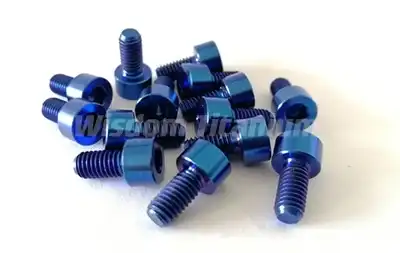
Titanium allen head bolts exist in a variety of different head types, all tailored to particular load, space, and installation needs. Common choices include the socket cap head (cylindrical, high-profile), the flat countersunk head (flush-mount), the button head (low-profile, rounded), the fillister head (deep-drive, thin), and the tapered head (reduced footprint, aerodynamic). These hex-socket fasteners come in Grade 2 and Grade 5 (Ti-6Al-4V), in sizes from M1.6 to M18 and with a tensile strength of over 950 MPa, offering reliable performance in aerospace, marine, chemical, and energy uses.
Overview of Titanium Allen Head Bolts and Their Key Characteristics
What Makes Titanium the Right Material
Titanium weighs in at 4.51 g/cm3 and is around 43 percent lighter than steel. Produced in Grade 5 (Ti-6Al-4V), it has a tensile strength in excess of 950 MPa. Procurement engineers in the aerospace and offshore energy sectors usually pick titanium hex socket screws over stainless steel ones because titanium is one of the few structural metals that is both light and strong.
Grade 2 vs. Grade 5: Knowing the Difference
Titanium grade 2 is economically pure, with excellent corrosion resistance and good ductility. This makes it the preferred option for chemical processing and marine uses where formability is critical. Grade 5 (or Ti-6Al-4V) adds aluminum and vanadium to the alloy. This gives it a substantially greater tensile strength and makes it the norm for heavy-load aerospace and racing usage. Both grades may be PVD coated or anodized, which gives the surface a longer life and prevents it from galling during installation.
Why Head Style Selection Matters
The design of a fastener’s head influences the clamping, positioning, and torque response of the fastener. An incorrect head style may harm the surface, the clamp load might not be sufficient, or tight-clearance assemblies can fail. Also, purchasing in bulk as a wholesaler. Matching the head style to the application retains your customers' confidence and saves you money on returns.
Common Head Styles of Titanium Allen Head Bolts and Their Specifications
Knowledge of each head type gives procurement teams confidence in matching fasteners to application drawings. Here are the primary styles and what makes each one special.
- Socket Cap Head: Most common kind with a cylinder head and a regular hex socket. It is defined in DIN 912 and ISO 4762 and has the largest torque capacity of the usual varieties of titanium allen head bolts. Ideal for structural connections where high torque loads are required and a higher head is allowed, such as engine mounts and aerospace brackets.
- Flat Countersunk Head: This type is meant to be flush or below the mating surface. This style is DIN 7991 / ISO 10642. The countersink angle is a conventional 90; however, 82° countersinks are also available. It is often used in aircraft panels, bicycle frames, and consumer electronics when a smooth surface is needed to minimize snagging or fulfill aerodynamic tolerances.
- Button Head: A low-profile, rounded head that spreads the load over a larger bearing surface than a cap head. Made to ISO 7380, it is used in applications where the fastener is visible and aesthetics matter, such as racing bodywork and precision instruments. The larger head lowers the pressure on the tip on softer materials.
- Fillister Head: Features a small diameter, tall, cylindrical shape that fits a deeper hex socket. This allows engineers improved tool engagement in recessed holes when lateral space is at a premium. It is often used in optical equipment and medical devices where accuracy is required.
- Tapered Head (Conical Cap): The tapering shape of the head minimizes the physical volume and weight of the bolt, making it a feasible alternative for drone frames and racing parts. This type is often PVD coated or anodized for surface hardness and to minimize galling of titanium on titanium in repeat-assembly operations.
These five models meet most of the demands of the industrial customer. Cataloging titanium fasteners, distributors have to concentrate on selling high-volume socket cap and flat countersunk designs, with button and tapered heads added for specific channels.
How to Identify and Verify Genuine Titanium Allen Head Bolt Head Styles
Material Certification and MTR Review
A real Grade 5 or Grade 2 titanium bolt should always come with a Material Test Report (MTR) that says what chemicals are in it. People who want to buy Grade 5 material should compare the Al (5.5–6.75%) and V (3.5–4.5%) numbers. In industries like energy or marine, where material failure can have serious effects, accepting fasteners without an MTR from a traceable heat number is a risk that is not needed.
Dimensional Inspection Against DIN/ISO Standards
The socket's size, head height, and thread type must all be in line with DIN 912, DIN 7991, or ISO 7380. To check the thread class 6g, use calibrated GO/NO-GO gages. To check the head geometry, use a laser micrometer or CMM. Misidentifying the head style is a common reason for assembly mistakes. This happens a lot when flat and button heads are mixed up on a drawing.
Visual and Drive-Socket Inspection
Check the hex recess for burrs, deformation, or depths that are too small. Cam-out under force can happen if the drive socket is damaged, which is especially bad in settings where the part is only used once. X-Ray Fluorescence (XRF) testing is a quick and safe way to prove the grade of an alloy when papers aren't available or when getting the first package from a new source.
Comparative Analysis: Titanium Allen Head Bolt Styles vs Other Materials
Titanium vs. Stainless Steel
The most popular option is grade 316 stainless steel. It has a density of 7.9 g/cm3, about 75% greater than titanium. Stainless steel is good in slightly corrosive circumstances, but it becomes pitted in locations with a lot of chloride or not much air, such as underwater cages or pipes in a chemical factory. Titanium hex socket fasteners hold buildings together under the same circumstances without increasing weight.
Titanium vs. Aluminum and Carbon Steel
Aluminum screws are lighter, but they are weaker when pushed apart. Grade 5 titanium is 300% more resistant to pulling apart than aluminum. Carbon steel is robust and inexpensive, but may rust if not covered; therefore, maintenance is a little more difficult throughout the life of the product. Titanium is the ideal material for the task if you want corrosion resistance and weight reductions at the same time, even if it costs more per unit.
Cost-Benefit Perspective for Distributors
Titanium allen head bolts cost extra, but the total cost of ownership frequently compensates for it. Lower maintenance, longer service life, and minimal possibility of coating failure in chemical or marine environments mean a far reduced life cycle cost. When procurement managers provide this information to the individuals who purchase from them, they present titanium as a value decision, not simply an upgrade.
Procurement Guide: Selecting the Right Head Style for Your Project Needs
Matching Head Style to Industry Application
Aerospace and UAV applications frequently need socket cap or tapered heads to balance strength and weight. In terms of rust resistance, the chemical and marine sectors choose to utilize flat countersunk or button head Grade 2 titanium. Tapered or button heads are popular in motorsports and cycling for their lower weight. If you pair these patterns with stocked SKUs, your consumers can receive what they need quicker.
MOQ, Lead Time, and Certification for B2B Buyers
Wisdom Titanium has standard head sizes from M3 through M12 and can accept a trial order as little as 500 pieces. This allows you to evaluate how well the product is before you place an order for full volume. Orders of 1000 or more pieces ship in 15 to 30 days. Each package comes with complete MTR, REACH/RoHS declarations, and ISO 9001 certification, covering the documentation requirements for both European and American import channels. Packaging is to export standards and protected against moisture and rust in each box.
Supplier Qualification Checklist
Prior to ordering your first titanium fastener from any supplier, ensure they possess an ISO 9001 certification that is current, a batch traceability system including heat numbers, a written process for dimensional inspection in accordance with DIN/ISO standards, and a transparent pricing structure for bulk purchases. These four elements address the major sources of risk that might impact the supply chain.
Conclusion
When you purchase titanium allen head bolts, the head type is not an afterthought; it decides how well they will operate, how well they will fit, and how dependable they will be in the long run. Each design is for a different function. High-torque socket cap, flush-mount flat countersunk, weight-saving tapered head. Titanium grades 5 and 2 are suitable for all styles since they are not subject to corrosion and have a strong strength-to-weight ratio. They span sizes M1.6 to M18 and fulfill DIN 912, DIN 7991, and ISO 7380 requirements.
FAQ
1. What factors should I prioritize when choosing a head style?
Consider three things: available installation space, required clamp load, and whether the fastener must sit flush with the surface. High-torque structural joints call for socket cap heads; flush-surface assemblies need flat countersunk; low-clearance applications benefit from button or fillister heads.
2. Can flat countersunk titanium bolts handle high torque applications?
Flat countersunk heads have a smaller bearing surface than cap heads, so they are not the first choice for extreme torque applications. They perform well in shear-loaded joints and panel assemblies. If torque is the primary demand, a socket cap head with the same thread size will provide a more secure connection.
3. How do I verify aerospace-grade compliance for titanium hex socket bolts?
Request the MTR from the supplier and verify the chemical composition against AMS 4928 (for Grade 5) or ASTM B348 standards. Confirm thread class by gauge testing, and ask for Dye Penetrant Inspection (DPI) reports on samples if the application is safety-critical.
4. Does head style affect corrosion resistance?
The base titanium alloy determines corrosion resistance, not the head geometry. However, surface treatments like anodizing or PVD coating apply equally well to all head styles and add an extra layer of protection against galling and surface oxidation.
5. What is the standard lead time for bulk orders of titanium Allen bolts?
At Wisdom Titanium, bulk orders of 1,000 pieces or more typically ship within 15–30 days, depending on the head style and size. Standard socket cap and flat countersunk heads in common sizes carry buffer stock to support shorter lead times.
Request a Quote from Wisdom Titanium — Your Trusted Titanium Allen Head Bolts Supplier
There are three things to think about: the room you have for fitting, the clamp load you need, and whether the titanium allen head bolts need to sit flush with the surface. Socket cap heads are best for high-torque structural joints, flat countersunk heads are best for flush-surface assemblies, and button or fillister heads are best for low-clearance applications. To get a sample or a price, email us at sales@wisdomtitanium.com.
References
1. ASTM International. ASTM B348: Standard Specification for Titanium and Titanium Alloy Bars and Billets. ASTM International, 2019.
2. Deutsches Institut für Normung. DIN 912: Hexagon Socket Head Cap Screws. DIN, 2014.
3. International Organization for Standardization. ISO 4762: Hexagon Socket Head Cap Screws — Product Grade A. ISO, 2004.
4. Leyens, C., & Peters, M. (Eds.). Titanium and Titanium Alloys: Fundamentals and Applications. Wiley-VCH, 2003.
5. International Fastener Institute (IFI). Fastener Standards and Engineering Data Handbook. IFI, 2020.
6. Donachie, M. J. Titanium: A Technical Guide, 2nd ed. ASM International, 2000.




