
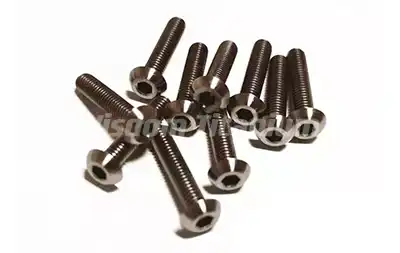
Most M3 titanium bolts are made of Grade 5 (Ti-6Al-4V) titanium metal, but Grade 2 titanium is also used in some situations. The industry standard for making M3 titanium bolts is Grade 5 titanium metal, which has a great strength-to-weight ratio, excellent rust resistance, and biocompatibility properties. This alpha-beta titanium alloy has 6% aluminum and 4% vanadium in it. It has tensile strengths of 895–1000 MPa and is still lightweight, which is important for high-performance uses in the aircraft, automobile, and precise machinery industries.
Titanium Alloy Grades Used in M3 Titanium Bolts
Which of the different types of titanium for M3 screws to use depends on the application needs and performance goals. Grade 2 titanium, which is also known as "commercially pure titanium," is very resistant to rust and easy to shape, but it is not very strong. This grade is made up of 99.2% pure titanium and very few alloying elements. It can be used in situations where formability and weldability are more important than final strength.
Grade 5 Titanium: The Premium Choice
Because it has such great engineering qualities, Grade 5 titanium metal controls the M3 bolt market. Adding aluminum makes it stronger and less dense, and adding vanadium makes it easier to strengthen and keep its strength at high temperatures. This mix makes bolts with tensile strengths about twice as high as Grade 2 titanium. This makes them perfect for important fixing jobs where dependability can't be sacrificed.
Grade 5 titanium has tight limits on the amount of oxygen, nitrogen, carbon, and iron that it contains. These elements have a big effect on the mechanical qualities. The amount of oxygen has the most important effect on strength and flexibility. For uniform performance across production batches, manufacturing processes must keep tight control over the makeup of the materials they use.
Grade 2 Titanium Applications
Even though Grade 5 titanium is the most common, Grade 2 titanium has its place in the M3 bolt market. It is useful for uses that need complicated shapes or special production methods because it can be cold-formed very well. The lower strength values, which range from 345 to 483 MPa tensile strength, work well for non-critical uses where resistance to rust is more important than strength.
Biocompatibility is another benefit of Grade 2 titanium. This means that it can be used in medical devices where M3 bolts hold parts in place that come into touch with living things. Because the material is non-toxic and doesn't mix with body fluids, it can be used for a long time without any problems.
M3 Titanium Bolt Specifications and Dimensions
Standard M3 titanium bolts have a standard thread width of 3 mm and a wide pitch of 0.5 mm, which is what ISO 262 says a metric thread should have. These measurement standards make sure that foreign manufacturing systems can work together while still keeping the level of accuracy needed for binding to work properly.
Technical Specifications Overview
Our M3 titanium bolts are made from Grade 5 titanium metal and have rolled threads and polished heads. This gives them better wear resistance while still being made with precision. The cutting process makes sure that the dimensions are correct and the surface is smooth. The rolling process makes the threads hard, so they don't wear down or hurt when they're used.
Lengths range from 5 mm to 30 mm, so they can be used for a wide range of assembly needs, from fragile electronic housings to strong mechanical links. The hexagonal head style makes it easy to secure the tool while evenly spreading the tightening loads across the attached parts.
Production times are usually between 7 and 15 days, but they rely on how many items you order and how you want them to be customized. This plan shows the precise manufacturing steps that are needed to keep quality standards high and meet delivery deadlines for projects that need to be done quickly.
Weight and Performance Advantages
Titanium is lighter than steel because it has a lower mass. This is especially useful in situations where more than one tool is needed. M3 titanium nuts are about 45% lighter than stainless steel screws that do the same job. This means that they can be used in aircraft situations where every gram counts when it comes to speed and fuel economy.
For M3 uses, thread contact strength is still very important, especially in thin-wall systems that are popular in electronics and precision tools. When you roll threads instead of cutting them, you get better thread patterns that are stronger against pull-out and wear under repeated loading conditions.
Benefits of Choosing the Right Grade for M3 Titanium Bolts
Choosing the right titanium types has a direct effect on how well they work in the long run, how much upkeep they need, and the total cost of ownership. Grade 5 titanium bolts work great in harsh conditions where normal screws would fail because of mechanical stress, changing temperatures, and exposure to corrosion.
Enhanced Mechanical Performance
Because Grade 5 titanium is stronger than Grade 4 titanium, designers can use smaller fixings while still keeping the structure strong. In situations where room is limited, this feature is especially useful because standard steel nuts would need to be bigger to work the same way.
Fatigue resistance is a very important benefit in situations where the same load is applied over and over again. The texture of Grade 5 titanium makes it very resistant to cracks spreading, which means it lasts longer than other materials in the same working conditions. This quality is very important in spinning machinery, automobile uses, and aircraft systems where a broken bolt could have terrible results.
Corrosion Resistance Benefits
Titanium surfaces naturally form an oxide layer that protects them from rusting very well without the need for any other surface treatments. This ability to fix itself ensures long-lasting performance in naval settings, equipment used for chemical processing, and outdoor setups where regular screws would need to be replaced often.
Chemical compatibility includes harsh chemicals like acids, alkalis, and organic solvents that are often used in industrial settings. Titanium is neutral, so there are no worries about galvanic rust when joining metals that are not the same. This makes planning easier and increases the life of the assembly.
Because they are temperature stable, Grade 5 titanium bolts can keep their mechanical qualities over a wide range of temperatures, from very cold environments to temperatures close to 400°C in service. This thermal stability is useful in flight uses, exhaust systems for cars, and industrial process equipment where changing temperatures can be hard for other fastener materials.
Procurement Considerations for M3 Titanium Bolts
To buy M3 titanium bolts successfully, you need to pay close attention to the qualifications of the seller, their quality certifications, and their production capabilities. Because handling titanium is so specialized, it needs suppliers who have experience making titanium alloys and setting up quality control systems.
Supplier Evaluation Criteria
ISO 9001 approval is the basic quality system standard for companies that sell titanium fasteners. It makes sure that processes are recorded and that companies are always looking for ways to improve. For military uses, extra certifications like AS9100 or ISO 13485 may be needed. For medical uses, it may be necessary without these certificates.
To meet the needs of different projects, manufacturing should be able to do both standard and unique production. Traceability standards are common in controlled industries, and being able to provide material licenses, measurement records, and mechanical property paperwork helps meet those needs.
Ordering and Customization Options
Standard M3 titanium bolt setups work for most general uses, but for more specialized systems, you may need to get them made to order. Changes can be made to the length, head style, and thread to get the best results for a given purpose.
Payment terms usually include PayPal and telegraphic transfers, which gives buyers and sellers around the world more choices. Lead times of 7 to 15 days are necessary for the precise manufacturing processes that are needed, but urgent project plans can be met by speeding up the production process.
Material proof, measurement inspection, and mechanical testing should all be part of quality control processes to make sure they meet standards. For controlled uses, documentation packages that meet tracking standards make it possible to integrate them into quality management systems.
The Baoji Wisdom Titanium Industry and Trading Co., Ltd. is in the Baoji Titanium Valley in Shaanxi Province. It is part of China's biggest and best titanium industry area. This important spot gives people access to the whole titanium supply chain, from raw materials to produced goods. This makes sure that foreign customers get stable quality and low prices.
Conclusion
Due to its excellent mix of strength, resistance to rust, and light weight, Grade 5 titanium metal is the best material for M3 titanium nuts. The makeup of Ti-6Al-4V has better mechanical properties than most fastener materials and has the specific qualities needed for challenging uses in the aircraft, automobile, and precision machinery industries. When buying workers know the differences between titanium types, they can make decisions that improve performance while keeping costs low. Buying high-quality titanium screws is an investment that pays off in the long run because they require less upkeep, last longer, and make the system more reliable.
Partner with Wisdom Titanium for Premium M3 Titanium Bolt Solutions
Wisdom Titanium delivers exceptional M3 titanium bolt quality backed by ISO 9001 certification and comprehensive manufacturing capabilities. Our expertise in Grade 5 titanium processing ensures consistent mechanical properties and dimensional accuracy for critical applications across automotive, aerospace, and precision machinery sectors. Located in Baoji Titanium Valley, we leverage China's most comprehensive titanium industry cluster to provide competitive pricing without compromising quality standards. Contact our technical team at sales@wisdomtitanium.com to discuss your M3 titanium bolt requirements and discover why leading manufacturers choose Wisdom Titanium as their trusted supplier for premium titanium fastener solutions.
FAQ
What titanium grade offers the best balance of strength and corrosion resistance for M3 bolts?
Grade 5 (Ti-6Al-4V) titanium provides the optimal balance of mechanical strength and corrosion resistance for M3 bolt applications. This alloy delivers tensile strengths approaching 1000 MPa while maintaining excellent resistance to environmental degradation across diverse operating conditions.
Can M3 titanium bolts withstand high-temperature applications?
Yes, Grade 5 titanium M3 bolts maintain structural integrity and mechanical properties at temperatures up to 400°C. The thermal stability and low expansion coefficient make them suitable for aerospace, automotive exhaust, and industrial process applications involving elevated temperatures.
What are typical lead times for standard versus custom M3 titanium bolt orders?
Standard M3 titanium bolt configurations typically require 7 to 10 days for production and shipping, while custom specifications may extend lead times to 12 to 15 days depending on the complexity of modifications required.
How do M3 titanium bolts compare to stainless steel in magnetic applications?
M3 titanium bolts exhibit non-magnetic properties with permeability values less than 1.001, making them ideal for electronic instrumentation and medical devices where magnetic interference must be eliminated. Stainless steel fasteners can cause signal distortion in sensitive equipment.
Are M3 titanium bolts suitable for medical device applications?
Yes, Grade 5 titanium's biocompatibility and corrosion resistance in biological environments make M3 bolts excellent choices for medical device assembly. The material's non-toxic nature and resistance to bodily fluids ensure long-term compatibility without adverse reactions.
References
1. Boyer, R., Welsch, G., & Collings, E.W. "Materials Properties Handbook: Titanium Alloys." ASM International, Materials Park, Ohio, 1994.
2. Donachie, Matthew J. "Titanium: A Technical Guide, 2nd Edition." ASM International, Materials Park, Ohio, 2000.
3. Lütjering, Gerd, and James C. Williams. "Titanium Engineering Materials and Applications." Springer-Verlag Berlin Heidelberg, 2003.
4. American Society for Testing and Materials. "Standard Specification for Titanium and Titanium Alloy Bars and Billets." ASTM B348-19, West Conshohocken, PA, 2019.
5. International Organization for Standardization. "Fasteners - Mechanical Properties of Titanium Fastening Systems." ISO 26352:2020, Geneva, Switzerland, 2020.
6. Schutz, Robert W., and Harry B. Bomberger. "Corrosion of Titanium and Titanium Alloys." Metals Handbook, Volume 13: Corrosion, ASM International, Materials Park, Ohio, 1987.