
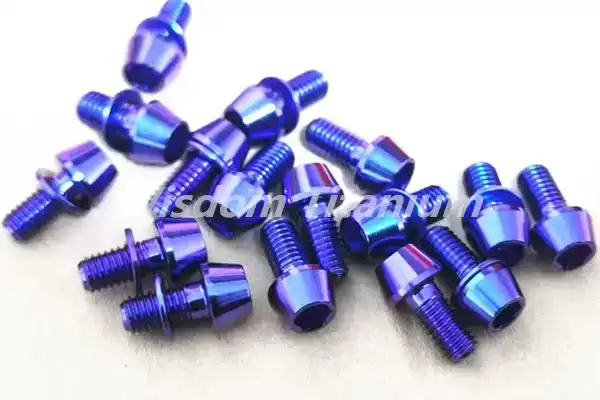
Bicycles today rely heavily on titanium fasteners for bicycles, particularly in high-performance and custom builds. The most common grades include Grade 2, Grade 5 (Ti-6Al-4V), and Grade 9 (Ti-3Al-2.5V). Grade 5 dominates the market for load-bearing applications like stem bolts, brake mounts, and bottom bracket hardware due to its exceptional yield strength of approximately 830 MPa. Grade 9 offers a balanced profile for weight-sensitive components such as seatpost clamps and derailleur hangers. Grade 2, though softer, excels in non-structural fasteners where corrosion resistance outweighs strength demands. Understanding these material distinctions empowers procurement managers to optimize component selection.
Understanding Titanium Grades Used in Bicycles
Chemical Composition and Mechanical Properties
Titanium fasteners for bicycles are used extensively in modern bicycles, especially in high-performance and custom builds. There are many different types of titanium alloys used in these components. Grade 5 is composed of 90% titanium, 6% aluminum, and 4% vanadium. This creates a strong matrix capable of handling high-stress cycling situations. This metal possesses a tensile strength exceeding 900 MPa and a density of only 4.43 g/cm³. Grade 9 lowers the vanadium content to 2.5%, which decreases final strength but increases cold formability—a critical factor when manufacturing fasteners with complex geometries. Grade 2, the commercially pure version, lacks alloying elements and excels in flexibility and corrosion resistance in salt-spray or marine environments.
When procurement teams evaluate these grades, they must consider the application setting. Due to repetitive impact loads on mountain bike parts, the fatigue resistance of Grade 5 is essential. In road racing, where weight reduction is a priority, Grade 9's 15% lower density compared to Grade 5 provides measurable performance gains without sacrificing structural integrity.
Thread Rolling Technology and Fatigue Life
Premium manufacturers of titanium bolts utilize thread rolling rather than cutting processes. This cold-working method compresses the material's grain structure along the thread profiles, making the fatigue life 30% longer than machined threads. The process also work-hardens the surface, increasing its hardness from 32 HRC to approximately 38 HRC in Grade 5 alloys.
This manufacturing approach directly impacts safety-critical fasteners like brake caliper bolts and handlebar stem hardware. Thread rolling eliminates the micro-fractures associated with cutting, preventing crack propagation under cyclic loading. Engineering teams specifying fasteners for racing should ensure suppliers utilize rolled threads, particularly for M5 and M6 sizes subjected to torque values exceeding 8 Nm.
Surface Treatment Options
Titanium's natural oxide layer provides baseline corrosion protection, but advanced surface treatments enhance both aesthetics and performance. Physical Vapor Deposition (PVD) coatings add a ceramic layer 2 to 4 microns thick, lowering the friction coefficient from 0.4 to 0.15 and preventing galling during installation. Anodizing creates a controlled oxide layer up to 25 microns thick, allowing for color customization and increasing surface hardness to approximately 60 HRC.
These treatments serve functional purposes beyond appearance. PVD-coated fasteners simplify the assembly of carbon fiber frames by eliminating the need for anti-seize compounds that can damage composite structures. Type II anodizing increases wear resistance on frequently adjusted components like saddle rail clamps and bottle cage mounts. Wisdom Titanium offers both anodizing and PVD coating options on fasteners from M3 to M10 sizes, with a minimum order quantity of just 200 pieces per specification.
Titanium Fasteners vs. Other Materials in Bicycles
Strength-to-Weight Ratio Analysis
Strength-to-weight ratio analysis shows that titanium fasteners for bicycles are far superior to traditional materials. Grade 5 titanium fasteners are four times as strong as 316 stainless steel but weigh only 45% as much. A standard M6x20mm DIN912 socket head cap screw in Grade 5 titanium weighs 2.8 grams, compared to 6.1 grams for a steel equivalent. This 3.3-gram saving per fastener translates to a total weight reduction of 130 to 200 grams on a complete bicycle without compromising performance.
Aluminum fasteners approach the weight of titanium but lack sufficient strength. Al-7075 yields at approximately 500 MPa, requiring larger thread engagement or increased bolt sizes to match titanium's clamping force, which complicates frame design. While carbon steel fasteners are strong, they corrode rapidly in wet conditions, especially when galvanic coupling occurs with aluminum frames or carbon fiber parts.
Corrosion Resistance and Lifecycle Value
Titanium instantly regenerates its passive oxide layer when exposed to oxygen, providing immunity to chloride-induced pitting common in stainless steel. Studies in coastal cycling environments show that titanium fasteners maintain structural integrity after five years of salt spray exposure, while 304 stainless steel threads show degradation within 18 months.
The material remains inert when exposed to cleaning products and environmental contaminants, including degreasers, road salts, and lubricants containing molybdenum disulfide. This durability reduces replacement frequency, offsetting initial procurement costs when evaluated over a five-year service lifecycle.
Total Cost of Ownership Considerations
Procurement professionals must weigh upfront costs against maintenance and replacement expenses. While titanium hardware typically costs 300 to 400% more than stainless steel, fleet operators report 60% fewer fastener-related maintenance events when using titanium in high-wear areas.
For performance applications, the calculation shifts dramatically. Replacing corroded steel brake caliper bolts mid-season involves equipment downtime and expedited shipping costs. Titanium's extended service life eliminates these hidden expenses while maintaining consistent torque retention—a critical factor for precise alignment in hydraulic brake systems.
Selecting the Right Titanium Fasteners for Different Bike Types
Mountain Bike Applications
Off-road cycling subjects titanium fasteners for bicycles to shock loads exceeding 15g during landing impacts and rock strikes. These conditions demand Grade 5 titanium bolts with fully rolled threads to resist fatigue cracking. Critical attachment points include shock mounting hardware, brake rotor bolts (typically M5x10mm DIN7991 countersunk), and through-axle assemblies.
Rotor bolts require particular attention. The T-25 Torx drive pattern distributes installation torque evenly, preventing cam-out damage during repeated wheel changes. Grade 5 material withstands the 6 Nm torque specification and maintains thread integrity through 50+ removal cycles, which is essential for riders who frequently switch wheelsets. Derailleur hanger bolts are another vulnerability; Grade 5 fasteners prevent shear failures while their non-magnetic properties avoid interference with electronic shifting systems.
Road Bike Specifications
Road cycling prioritizes aerodynamics and weight optimization, making Grade 9 titanium ideal for non-structural components. Bottle cage bolts (M5x12mm ISO7380 button head) benefit from Grade 9's lighter weight while meeting the 3 Nm clamping force requirement. Seat binder bolts similarly leverage this alloy's favorable strength-to-density ratio.
Brake caliper bolts present a different challenge. Direct-mount rim brakes exert lateral forces during hard braking, requiring Grade 5 material in M6x20mm configurations. The higher shear strength prevents bolt bending that causes brake rub. Carbon frame interfaces demand extra care; PVD-coated Grade 5 fasteners eliminate galvanic corrosion while protecting delicate carbon fiber layups. Handlebar and stem hardware in M5 and M6 sizes provide the necessary clamping force for aluminum and carbon components when properly torqued with calibrated tools.
Custom and Boutique Builds
Custom frame builders increasingly specify titanium hardware to complement titanium or steel framesets. Matching material properties between frame tubes and fasteners prevents differential thermal expansion issues. A complete custom fastener kit typically includes 35 to 45 pieces, covering all attachment points including adjustable dropout hardware and integrated cable stops.
Wisdom Titanium supports custom builders through low-volume production runs. A 200-piece minimum order quantity accommodates boutique operations requiring specific combinations of DIN912, DIN7991, DIN6921, and ISO7380 styles across M3 through M10 sizes. Custom anodizing allows builders to match brand color schemes while enhancing surface hardness.
Maintenance and Longevity of Titanium Bicycle Fasteners
Proper Installation Techniques
The proper installation of titanium fasteners for bicycles requires adjusting torque specifications due to titanium's lower modulus of elasticity compared to steel. Over-tightening can crush carbon fiber or crack aluminum components. Most titanium fasteners require a 20-25% torque reduction versus steel; for example, an M5 bolt specification typically drops from 6 Nm to 4.5 Nm.
Thread preparation is essential to prevent galling, a cold-welding phenomenon where fasteners seize in aluminum or titanium threads. Applying a thin coat of copper-based anti-seize to male threads eliminates this risk. While PVD-coated fasteners reduce galling tendencies, proper installation practices remain essential for components requiring frequent adjustment. Torque wrench calibration is also critical, as improperly torqued bolts experience significantly shorter fatigue lives.
Cleaning and Corrosion Prevention
Despite inherent corrosion resistance, contaminants can degrade performance. Road grime containing metal particles creates galvanic cells when trapped against titanium surfaces. Quarterly cleaning with isopropyl alcohol and nylon brushes removes these deposits without scratching the protective oxide layer.
In coastal environments, salt spray crystallizes in thread valleys and acts as an abrasive during bolt removal. Riders should flush fasteners with fresh water and apply light penetrating oil to engagement areas to flush contaminants. Anodized fasteners require gentler handling with pH-neutral cleaners to preserve the colored oxide layer, which is only 15-25 microns thick.
Long-Term Performance Monitoring
Visual inspection of titanium fasteners should focus on thread crests; shiny areas indicate work hardening from repeated installation. If threads show visible deformation or become difficult to thread by hand, they should be replaced to prevent mid-ride failure.
Torque retention testing provides a quantitative assessment. A properly installed bolt should maintain 95% of its specified torque after 24 hours. Values below 90% suggest improper installation or damaged threads. This permanent weight reduction of 150-200 grams provides "free" performance enhancement that accumulates over thousands of training kilometers without requiring ongoing adjustment.
Procurement Guide: Buying Titanium Fasteners for Bicycles
Supplier Evaluation Criteria
When evaluating a titanium fasteners for bicycles supplier, procurement managers must look beyond pricing. ISO 9001 certification indicates systematic quality control, and legitimate suppliers should provide mill test reports (MTRs) documenting chemical composition via spectroscopy. It is vital to verify aluminum and vanadium content for Grade 5 alloys.
Manufacturing location influences quality; 60% of global titanium capacity is concentrated in China's Baoji region. Suppliers in this cluster, like Wisdom Titanium in Baoji Titanium Valley, access superior raw materials and specialized equipment. Lead time reliability is another key factor; established manufacturers maintain raw material inventory enabling 2-3 week production cycles for standard fasteners, while custom specifications may require 4-6 weeks.
Customization Capabilities
Standard DIN and ISO specifications cover most applications, but custom designs optimize specific frame geometries. Low-profile rotor bolts prevent interference in tight clearances, while extended derailleur hanger bolts accommodate carbon frame inserts. Specialized thread pitches are often required for proprietary bottom bracket and headset designs.
Wisdom Titanium's CNC machining capabilities support customized part development from customer samples or drawings. This iterative prototyping process prevents costly tooling investments in incompatible designs and accelerates time-to-market. Minimum order quantities of 200 pieces per specification allow small manufacturers to access titanium technology without the burden of high inventory.
Certification and Compliance
While the bicycle industry lacks mandatory fastener certification, quality-conscious manufacturers adopt aerospace standards like AMS 4928 for Grade 5 bar stock. Suppliers offering certified materials demonstrate a commitment to verifiable quality. Third-party testing, including hardness and tensile verification, builds trust and provides documentation for liability protection.
Environmental compliance, such as ISO 14001, is increasingly important. While titanium production is energy-intensive, the material's longevity and recyclability offset its initial impact. Responsible manufacturing practices appeal to environmentally conscious consumers and satisfy corporate sustainability mandates.
Bulk Purchasing Strategies
Volume commitments unlock pricing advantages and supply security. Annual purchase agreements can reduce per-unit costs by 15-25% while guaranteeing availability during peak production seasons. Consignment inventory programs can further shift warehousing costs to suppliers while maintaining just-in-time delivery flexibility.
Component kitting streamlines assembly by providing pre-packaged fastener sets for specific bicycle models. This reduces line-side complexity and prevents assembly errors. Kitted parts typically include installation instructions, torque specifications, and traceability documentation supporting quality management systems.
Conclusion
In conclusion, titanium fasteners for bicycles represent a careful balance of strength, weight, and corrosion resistance. Grade 5 dominates high-stress structural components, while Grade 9 optimizes weight-sensitive applications. The material's superior properties justify its premium pricing across racing, mountain, and custom segments. Proper installation, surface treatments, and supplier selection are critical to delivering full performance potential. Procurement teams must evaluate these components based on lifecycle value, considering reduced maintenance and the weight advantages that compound over years of service.
FAQ
What titanium grade works best for mountain bike applications?
Grade 5 (Ti-6Al-4V) is the preferred choice for mountain biking due to its superior fatigue resistance and high yield strength of approximately 830 MPa. This alloy withstands repetitive shock loads from jumps and rough terrain without developing stress cracks. Critical components like rotor bolts and shock hardware require these mechanical properties to ensure safety and prevent mid-ride failures.
How do titanium bolts compare to steel for rust resistance?
Titanium fasteners for bicycles offer complete immunity to rust through rapid oxide layer regeneration. Unlike stainless steel, which can break down in chloride environments, titanium's passive layer is self-healing. Field testing shows titanium maintains full strength after five years in coastal conditions, whereas 304 stainless steel can develop thread corrosion within 18 months.
Can I verify titanium fastener authenticity?
Authentic titanium is non-magnetic; a simple magnet test can identify steel fasteners misrepresented as titanium. Density measurement provides further verification, as titanium's density of 4.43 g/cm³ is distinct from steel's 7.8 g/cm³. For professional verification, spectroscopic analysis confirms elemental composition, specifically the aluminum and vanadium content that distinguishes Grade 5 from commercially pure grades.
Partner With Wisdom Titanium for Premium Bicycle Fastener Solutions
Wisdom Titanium delivers certified titanium fasteners for bicycles that meet the exacting demands of manufacturers across the United States. Our ISO 9001-certified facility in Baoji Titanium Valley provides direct access to aerospace-grade raw materials and specialized manufacturing equipment. We supply M3 through M10 fasteners in DIN912, DIN7991, DIN6921, and ISO7380 configurations with anodizing or PVD coating options. Our engineering team supports custom development from concept through production to ensure compatibility with your specific frame geometries. Contact our team at sales@wisdomtitanium.com to discuss how our titanium solutions can enhance your product line's performance.
References
- Boyer, R., Welsch, G., & Collings, E.W. (1994). Materials Properties Handbook: Titanium Alloys. ASM International, Materials Park, Ohio.
- Donachie, M.J. (2000). Titanium: A Technical Guide, 2nd Edition. ASM International, Materials Park, Ohio.
- Lutjering, G., & Williams, J.C. (2007). Titanium, 2nd Edition. Springer-Verlag, Berlin Heidelberg.
- Schutz, R.W., & Watkins, H.B. (1998). Recent developments in titanium alloy application in the energy industry. Materials Science and Engineering A, 243(1-2), 305-315.
- Veeck, S., & Hurtado, J. (2013). Fatigue performance of threaded titanium connections for biomedical implants. Journal of Materials Engineering and Performance, 22(3), 789-801.
- Zwicker, U. (1974). Titan und Titanlegierungen. Springer-Verlag, Berlin Heidelberg New York.




