
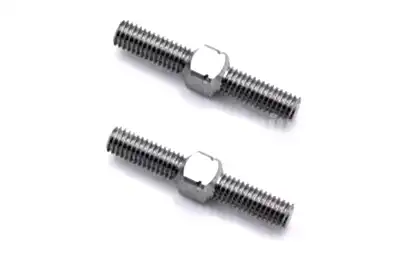
When looking for the best material to make turnbuckles out of, one issue often comes up: which grade of titanium strikes the best balance between strength, weight, and durability? The solution changes how the industry thinks about precise fastening systems. Grade 5 6Al-4V titanium is the most common material used to make titanium turnbuckles. This material is well-known in the aerospace, automotive, and marine industries.
Knowing the specs of materials isn't only technical information; it's also the key to making informed buying selections. The titanium quality you choose has a direct effect on how long your suspension systems on RC vehicles or important aerospace parts last. This in-depth article looks at why Grade 5 titanium is the most popular choice for turnbuckles and what makes it the best choice for tough jobs.
Grade 5 Titanium: The Industry Standard for Turnbuckles
Titanium Grade 5, which is also known as Ti-6Al-4V, is the most common titanium alloy in the world. This alloy has 6% aluminum and 4% vanadium, which makes it strong, resistant to corrosion, and light. What is this material different from commercially pure titanium grades? The alloying elements make a two-phase microstructure that greatly improves the mechanical characteristics.
Chemical Composition and Material Properties
The exact way Ti6Al4V is made isn't random. Aluminum is an Alpha stabilizer, which means it makes the material stronger and better at high temperatures. Vanadium is a Beta stabilizer, which means it lets some of the crystal structure stay in the Beta phase at normal temperature. This combination gives it an amazing tensile strength of 1000 MPa, or around 145,000 psi, which is far higher than stainless steel options.
To make titanium turnbuckles, the materials must have certain properties. Titanium is around 50% lighter than steel, which makes it very useful in situations where lowering mass enhances performance. This weight advantage doesn't make the part weaker; it actually makes the strength-to-weight ratio that engineers look for in precision parts stronger.
Why Grade 5 Outperforms Other Titanium Grades
There are important differences in titanium grades when you compare them. Grade 5 is around three times stronger than Grade 2, which is the purest option on the market. Grade 2 titanium is more resistant to corrosion, but it can't be used in load-bearing applications since it has a lower tensile strength. Grade 5 has great corrosion resistance and mechanical qualities that can handle very high stress cycles.
The way Grade 5 is made makes it better. Cold-formed threads are rolled into shape, which improves the flow of the metal's grain and makes the structure stronger and more even. This practice of rolling threads, as opposed to cutting them, preserves the material's integrity and makes the parts last longer.
Performance Advantages in Real-World Applications
Grade 5 titanium turnbuckles provide demonstrable benefits in a variety of fields. Their performance profile solves several technical problems at once, making them a strategic investment instead of just a high-end part.
Strength and Durability Under Stress
Mechanical testing confirms that Grade 5 has great performance qualities. Grade 5 has a tensile strength of at least 895 MPa and a yield strength of at least 828 MPa. It is as strong as steel yet only weighs 60% as much. Its feature is very important for things that have to deal with repeated loading cycles. Turnbuckles are always under mechanical stress since they are used in racing cars, aeronautical control systems, and maritime rigging.
Titanium that doesn't bend when you leap, or crash, protects against damage better than steel and aluminum. This strength means that replacements happen less often and safety margins are higher. Parts made from different materials that can flex or break during manufacturing stay stable in size and shape throughout their service life.
Corrosion Resistance in Harsh Environments
Exposure to the environment speeds up the breakdown of components, especially in marine and chemical processing applications. Titanium has an oxide coating that grows on its surface naturally. This layer protects the metal from the elements in the environment, making it very resistant to corrosion, even under harsh conditions when it is exposed to moisture, seawater, or chemicals. This passive layer heals itself when it is injured, giving you self-healing protection.
Saltwater settings are very hard on metal parts. Titanium is very resistant to corrosion from seawater, thus it is utilized in sections of boats that are exposed to seawater, such propeller shafts and rigging. This resistance is quite helpful for marine applications since it gets rid of the galvanic corrosion problems that stainless steel and aluminum fittings have in electrolytic circumstances.
Temperature Stability and Thermal Performance
Thermal cycling stresses most materials, causing dimensional changes and mechanical property degradation. Grade 5 retains 80% of room-temperature strength at 450°C and is used in jet engines and high-temperature exhaust systems. This thermal stability ensures consistent performance across temperature ranges that would compromise alternative materials.
Automotive and aerospace applications particularly value this characteristic. Engine bay components experience significant temperature fluctuations, from ambient cold starts to operational temperatures exceeding 300°C. Titanium turnbuckles maintain precise adjustment throughout these cycles, preventing the loosening and dimensional changes that occur with thermal expansion mismatches.
Industrial Applications and Market Sectors
The versatility of Grade 5 titanium turnbuckles extends across multiple industries. Each sector leverages specific material properties to solve unique engineering challenges, demonstrating why this material grade has become the industry benchmark.
Aerospace and Defense Systems
Ti6Al4V accounts for over 70% of all alloy grades melted, with uses spanning aerospace airframe and engine component applications. Aircraft control systems require components that deliver reliable performance under extreme conditions. Turnbuckles in flight control rigging systems must maintain precise tension throughout temperature extremes, vibration loads, and decades of service.
Grade 5 has many uses in aerospace, medical, automotive, and marine engineering fields. Defense applications demand materials that won't corrode in salt spray environments yet provide the strength needed for weapons systems and vehicle suspension components. The combination of properties makes Grade 5 irreplaceable in military specification components.
High-Performance Automotive and Racing
Motorsports engineering pushes material limits further than standard automotive applications. In the automotive industry, titanium alloys are used in exhaust systems, engine components, and other parts where high-temperature resistance, strength, and corrosion resistance are crucial. Racing vehicles benefit from every gram of weight reduction, particularly in suspension components where unsprung mass directly affects handling dynamics.
Professional racing teams recognize that titanium turnbuckles provide adjustment precision that aluminum components cannot match. The material's hardness prevents thread galling and wear during frequent adjustments. This durability reduces maintenance time and ensures consistent vehicle geometry throughout competition seasons.
Marine Equipment and Offshore Engineering
Ocean environments represent one of the most corrosive conditions any material can face. Titanium alloys' resistance to corrosion in saltwater environments makes them suitable for components such as propeller shafts and hulls. Rigging systems, tensioning hardware, and adjustable linkages all benefit from titanium's seawater resistance.
Offshore oil platforms and subsea equipment face additional challenges from biofouling and chemical exposure. Grade 5 titanium resists biological growth better than stainless steel alternatives while maintaining structural integrity in high-pressure, chemically aggressive environments. This resistance translates to extended service intervals and reduced platform maintenance costs.
Medical Device Manufacturing
Biocompatibility requirements restrict material choices in medical applications. TAV-ELI is the most commonly used medical implant-grade titanium alloy due to its excellent biocompatibility, corrosion resistance, fatigue resistance, and low modulus of elasticity, which closely matches human bone. While medical devices typically use the Extra Low Interstitial (ELI) variant of Grade 5, standard Grade 5 titanium finds applications in surgical instruments and external fixation devices.
Baoji Wisdom Titanium: Your Trusted Manufacturing Partner
As an ISO 9001:2015 certified company, Baiji Wisdom Titanium Industry and Trading Co., Ltd makes and sells standard and bespoke CNC parts. Since we started in 2016, we've made precise parts for the aerospace, energy, oil & gas, medical, electronics, chemical, marine, automotive, motorcycle, and cycling sectors.
Comprehensive Product Specifications
Our titanium turnbuckles are made to exact specifications for tough jobs. We make parts in sizes M3, M3.5, M4, M4.5, and M5. All of them are made from Ti6Al4V material that fulfills international aircraft requirements. There are both UNC and UNF thread types, so they may be used with a wide range of assembly needs.
Surface finishing choices provide beauty and usefulness to a surface. We have polished finishes and anodized hues including red, blue, black, rainbow, purple, gold, burned blue, and green. These finishes aren't only for looks; anodized coatings make surfaces harder and prevent them from rust in certain conditions.
Competitive prices and a large inventory make it possible to fill orders quickly. With a minimum purchase of 100 pieces, we can offer high-quality titanium turnbuckles for both prototype and production runs. Customization services may meet your special needs, making sure that parts fit perfectly into your assemblies.
Manufacturing Excellence and Quality Assurance
Mature production technology makes sure that the quality of the parts stays the same. We have a full stock of raw materials and standard parts, which keeps prices stable and stops supply problems. Whole-process follow-up detection finds problems before parts get to your plant. Our workforce is steady and competent, and they know how to do precise titanium machining.
All procedures meet ISO 9001:2015 standards, which ensures quality and good customer service after the sale. We value client input and take inquiries seriously. We use this contact to make our products better all the time. We always meet and surpass customer and market expectations through this iterative approach.
Experienced R&D and Custom Engineering Support
Our in-house research and development service system makes individual solutions that meet the needs of each application. Our technical team has decades of expertise working with titanium, whether it's making new goods or making references from your samples or ideas. We make unique titanium parts and provide associated solutions. When applications need different materials, we also make fasteners out of nickel, tantalum, and zirconium.We sell more than just fasteners; we also supply titanium rods, flanges, and forgings for larger assemblies. You can buy everything you need from one spot because there are so many different goods to choose from. This makes it easy to keep track of the supply chain and makes sure that all the parts are created using the same materials.
Choosing titanium turnbuckles made from Grade 5 Ti6Al4V material is a smart way to invest in the dependability of the parts and the performance of the system. The material's high strength-to-weight ratio, resistance to corrosion, and thermal stability solve a number of technical problems at the same time. Even if the initial expenditures are higher than those of other materials, the longer service life and lower maintenance costs make up for the higher price.
Getting parts from well-known manufacturers with thorough quality processes makes sure that the materials are real and the measurements are correct. With its integrated production infrastructure and decades of metallurgical experience, Baiji Titanium Valley is the best place in the world to make titanium. Companies like Baoji Wisdom Titanium take advantage of this geographical advantage while keeping their ISO 9001:2015 accreditation and putting the needs of their customers first.
Knowing the standards for titanium grades helps you choose the right materials, whether you're updating old systems or making new applications. Grade 5 titanium turnbuckles offer clear performance benefits in the aerospace, automotive, marine, and industrial industries. Their demonstrated track record in tough situations proves the technical rationale behind choosing materials.
For detailed specifications, technical consultation, or quotation requests for titanium turnbuckles and custom CNC components, contact Baoji Wisdom Titanium directly. Our experienced team provides application-specific guidance to ensure optimal component selection for your requirements. Send inquiries to sales@wisdomtitanium.com to discover how premium titanium components enhance your product performance and reliability.
FAQs
Q1: Why is Grade 5 titanium preferred over commercially pure grades for turnbuckles?
A: Grade 5 titanium has three times the tensile strength of commercially pure Grade 2 titanium and exceptional corrosion resistance. This strength advantage is crucial in load-bearing situations where turnbuckles undergo continual stress. The alloyed composition allows heat treatment for strengthening, unlike pure titanium grades. Grade 5's strength-to-weight ratio benefits high-strength, low-weight applications.
Q2: Can titanium turnbuckles be used in marine saltwater environments?
A: Grade 5 titanium resists seawater corrosion well. The passive oxide layer regenerates when injured. Titanium turnbuckles are used in rigging, sailing, and offshore equipment. Titanium resists crevice corrosion and pitting in stagnant saltwater, unlike stainless steel. Combine this corrosion immunity with carbon fiber or other modern materials to eliminate galvanic corrosion.
Q3: What thread types work best with titanium turnbuckles?
A: Titanium turnbuckles work with UNC and UNF threads. Coarse threads make assembly easier and tolerate contamination and mild damage. For optimal strength, fine threads have finer adjustment increments and larger tensile stress area. Manufacturing thread rolling improves fatigue resistance over machined threads. Precision adjustment prefers fine threads, whereas field serviceability prefers coarse threads.
Q4: How does Grade 5 titanium performance compare to high-strength steel?
A: Grade 5 titanium achieves comparable strength to many high-strength steels while weighing approximately 50% less. Its tensile strength of 1000 MPa approaches that of heat-treated alloy steels. However, titanium's elastic modulus (110 GPa) remains lower than steel (200 GPa), meaning titanium components deflect more under equivalent loads. Corrosion resistance vastly exceeds even stainless steels in most environments. Temperature performance also favors titanium, maintaining properties at elevated temperatures where steel strength degrades.
Q5: What minimum order quantities and customization options does Baoji Wisdom Titanium offer?
A: Baoji Wisdom Titanium maintains a 100-piece minimum order quantity for titanium turnbuckles, accommodating both prototype development and production requirements. Customization services include specific lengths, thread types (UNC/UNF), and surface finishes ranging from polished to various anodized colors. Our engineering team develops custom designs from your specifications, samples, or concepts. Standard sizes include M3, M3.5, M4, M4.5, and M5, though custom dimensions are available for volume orders. ISO 9001:2015 certification ensures consistent quality across all custom and standard components.
References
- NeoNickel. (n.d.). Titanium Grade 5 vs Titanium Grade 2 Comparison - Between the Alpha Beta Alloy and the Workhorse of Commercially Pure Grade.
- Stanford Advanced Materials. (2025). Titanium Grade 2 vs Grade 5: How Titanium Powders Are Classified.
- Beska Mold. (2025). Titanium Grade 2 Vs Grade 5: Key Differences & Applications.
- IntechOpen. (2024). Titanium-Based Alloys: Classification and Diverse Applications.
- Wikipedia. (2025). Titanium Alloys.