
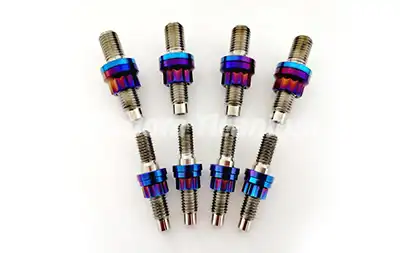
A titanium exhaust manifold stud kit is simple on paper, yet critical in real engines. It replaces the hardware that holds your exhaust manifold or header to the cylinder head. The typical kit includes three matched parts: 1 stud + 1 nut + 1 washer. That “small set” controls clamp load, sealing, and long-term serviceability. When buyers search for titanium exhaust stud kits, they usually want one thing: hardware that will not rust, seize, or snap during the next teardown.
This page explains what is inside the kit, what each piece does, and what you should verify before ordering. It also shows how Baoji Wisdom Titanium supplies Grade 5 titanium kits in common sizes for turbo manifolds and headers.
What is included in a titanium exhaust stud kit?
Most Google results for titanium exhaust stud kits describe the kit as a matched set that contains a stud, a nut, and a washer. This structure appears across multiple sellers and fitments, from single-piece kits to full engine sets. For example, Wisdom Titanium states each kit consists of a titanium stud, washer, and 12-point nut. Other product listings also show the “stud + nut + washer” pattern, including single-set packaging.
Stud (the anchor that protects your threads)
The stud threads into the cylinder head and stays there. You then install the manifold and tighten the nut on the exposed threads. This approach reduces repeated wear on the cylinder-head threads, because the stud can remain installed during service. Many stud designs also include an internal hex/Allen drive so you can seat the stud cleanly. Several titanium stud kits use a small Allen feature for installation, which helps installers avoid damaging the stud with locking pliers.
Nut (the clamp-load component)
The nut generates the clamping force that seals the manifold gasket and keeps the joint stable under vibration. Many aftermarket stud kits use a 12-point nut style for tool access and appearance, and product descriptions often call out “12-point nuts” as part of the kit. The key is not the number of points. It is the quality of threads and the consistency of fit across all pieces.
Washer (the surface protector and load spreader)
The washer sits under the nut. It spreads load, reduces surface galling, and helps keep torque more consistent. Some product pages specifically explain that larger washer diameters can reduce the chance of loosening over time, and they list washers as a standard included component. In exhaust environments, washers also help protect coated or machined manifold surfaces from the nut’s contact edge.
Why buyers choose titanium exhaust stud kits for manifolds and turbo headers
People rarely shop for exhaust studs because it is fun. They shop after a failure. A snapped bolt, a seized nut, or a leak that keeps coming back. Google product listings repeatedly position titanium exhaust stud kits as a replacement for rusty factory hardware and as a durability upgrade for turbo manifolds and aftermarket headers.
Corrosion resistance: the “next teardown” problem
Exhaust hardware lives in heat cycles, water spray, road salt, and chemical exposure. Grade 5 titanium (Ti-6Al-4V) is widely recognized for strong corrosion resistance in many environments, including seawater and a wide range of aggressive media, because it forms a stable, protective oxide film. That is why buyers often associate titanium with “no rust” behavior in automotive hardware marketing.
Strength-to-weight: strong hardware without the bulk
Grade 5 titanium is known for high strength at relatively low density, which is why it is used in demanding industries. A technical materials overview for Ti-6Al-4V notes high minimum yield strength values for bar products under certain specifications and describes the alloy as a high-strength grade. In practice, the weight difference on a few studs will not transform vehicle performance, but the strength and corrosion behavior can improve reliability and serviceability in harsh conditions.
Heat reality check: titanium is not a universal “hotter is better” answer
Buyers sometimes assume titanium always wins at heat. The truth is more specific. Technical references commonly describe Ti-6Al-4V as having acceptable oxidation resistance up to about 1000°F (538°C), and some sources describe typical service use around 800°F (427°C) depending on conditions and specification. Exhaust ports and manifolds can exceed these temperatures in extreme setups. That does not automatically mean titanium studs fail, but it does mean you should choose hardware based on the full system: manifold material, turbo heat load, shielding, and installation practices.
So what does Baoji Wisdom Titanium’s Titanium Exhaust Manifold Stud Kit include?
Baoji Wisdom Titanium supplies titanium exhaust stud kits as a matched set: Titanium Exhaust Manifold Stud Kits: 1pc stud + 1pc nut + 1pc washer. The kit is designed for exhaust manifold and header fastening where consistent fit matters.
Material: Titanium Grade 5 (Ti-6Al-4V)
Baoji Wisdom Titanium’s stud kits use Titanium Grade 5. Grade 5 (Ti-6Al-4V) is widely documented as a high-strength alpha-beta titanium alloy with strong corrosion resistance and broad industrial use. For buyers, that translates into a hardware choice that targets durability, stable performance, and clean appearance after repeated heat cycles.
Common sizes for exhaust manifolds and headers
Baoji Wisdom Titanium offers popular metric threads and lengths used in the exhaust space: M8×1.25×45 and M10×1.25×45/54. These sizes align with what you see on many aftermarket listings, where M8×1.25×45 appears repeatedly as a common exhaust manifold stud dimension. Getting thread pitch correct matters more than anything else, because it prevents cross-threading and clamp-load loss.
Color options: burnt blue or natural
Some buyers want a clean OEM-like look. Others want a visible “premium detail” in the engine bay. Baoji Wisdom Titanium provides natural and burnt blue color options. In Google results, burnt/blue finishes are frequently offered as anodized color choices for titanium exhaust stud kits, which indicates steady market demand for both appearance and corrosion-resistant finishes.
Commercial notes for sourcing teams: Baoji Wisdom Titanium supports competitive rates and sample inventory for fast evaluation. The typical MOQ is 100 sets. This structure fits distributors, performance shops, and importers who need stable supply and repeatable quality.
How to evaluate titanium exhaust stud kits before you buy?
Fitment checks: thread pitch, length, and nut access
Start with thread pitch. M8×1.25 and M10×1.25 are common exhaust-related pitches, and many kits list those exact sizes. Then verify length. Too short reduces thread engagement and clamp range. Too long can bottom out in blind holes or cause interference with heat shields. Also check nut style and tool clearance. Some kits use 12-point nuts, which can help access in tight manifolds.
Thread quality and packaging: small details that prevent big problems
Exhaust studs fail in boring ways. Threads gall. Nuts seize. Torque readings drift. Several commercial listings emphasize precise threads and clean, ready-to-use packaging. That focus is not marketing fluff. Clean threads reduce friction variability, which improves clamp-load consistency. Consistency matters more than peak torque numbers.
Heat, torque, and installation behavior
Some stud kits include an Allen drive for hand installation, which helps seat the stud without overdriving it. This design is explicitly described in titanium stud kit listings. Torque guidance varies by engine and gasket design, so installers often follow OEM or manifold manufacturer specs. As a reference point, an exhaust manifold stud kit page for a different material system (stainless) shows that sellers sometimes provide torque recommendations and even suggest a hot re-torque. That pattern highlights a broader truth: exhaust joints move with heat, so process control matters.
Why Baoji (China Titanium Valley) strengthens supply trust for global buyers?
When a buyer moves from interest to trust, they usually look beyond the part. They look at the supply chain. Baoji, in Shaanxi Province, is widely recognized as China’s “Titanium Valley,” with a concentrated titanium industry cluster and a full chain from primary materials to finished components. This matters for repeatability, lead times, and access to multiple titanium product forms for future projects.
For buyers in markets like North America and Europe, the practical value is simple: if your supplier operates inside a dense titanium ecosystem, they can typically move faster on raw material sourcing, machining capacity, and specification matching when your project shifts from samples to volume.
Baoji Wisdom Titanium Industry and Trading Co., Ltd. is an ISO 9001-certified manufacturer and supplier (founded in 2016) focused on titanium fasteners and customized CNC parts, serving industries that demand process control, including aerospace, energy, oil and gas, medical, marine, and automotive.
Practical Sourcing Path for Titanium Exhaust Stud Kits
Buyers often delay because they want a clean internal approval story. The fastest way to build confidence is to request a quote with clear technical inputs, then compare the response quality. You do not need a long email. You need a precise one.
For Baoji Wisdom Titanium, the most helpful inquiry typically includes: the size (M8×1.25×45 or M10×1.25×45/54), the color (burnt blue or natural), your target quantity, and any packaging or labeling requirements. If you plan to resell, include your expected reorder cadence.
If you want pricing or samples for evaluation, contact Baoji Wisdom Titanium here: sales@wisdomtitanium.com.
FAQ
Q1: What does a Titanium Exhaust Manifold Stud Kit include?
A standard kit includes 1 stud + 1 nut + 1 washer. Many listings across the market follow this exact structure, whether they sell single kits or full engine sets. Baoji Wisdom Titanium supplies the same matched set format for sourcing clarity.
Q2: Are titanium exhaust stud kits always M8×1.25×45?
No. M8×1.25×45 is common in many aftermarket offerings, but M10×1.25 is also widely sold, and lengths vary by engine, flange thickness, and manifold design. Baoji Wisdom Titanium supplies M8×1.25×45 and M10×1.25×45/54, which cover frequent use cases.
Q3: Is Grade 5 titanium a real engineering standard or just marketing?
Grade 5 usually refers to Ti-6Al-4V. It is broadly documented as a high-strength titanium alloy with strong corrosion resistance and wide industrial adoption. What matters for buyers is traceable material control and consistent manufacturing.
Q4: Will titanium studs solve exhaust leaks by themselves?
Not by themselves. Leaks often come from warped flanges, damaged gaskets, uneven torque, or thermal movement. Studs can help by improving serviceability and keeping hardware from rusting in place. Many sellers position stud kits as a way to avoid broken or corroded fasteners and to support sealing reliability. But sealing still depends on the full joint design and correct installation.
Q5: What is the MOQ for Baoji Wisdom Titanium’s titanium exhaust stud kits?
The MOQ is 100 sets. Baoji Wisdom Titanium also notes sample inventory availability, which helps buyers evaluate fit and finish before a volume purchase.
References
1. Titanium Exhaust Manifold Stud Kit (includes studs, nuts, washers; Grade 5; Allen tip).
2. Titanium Stud Kit M8×1.25 (each kit consists of stud, washer, nut; Grade 5).
3. Titanium Exhaust Manifold Stud Kit (what’s included for M8/M10; 12-point nut; washer).
4. Ti-6Al-4V (Grade 5) properties and temperature/corrosion notes.
5. Wikipedia – Ti-6Al-4V identifiers and general material description (Grade 5 / Ti64).