
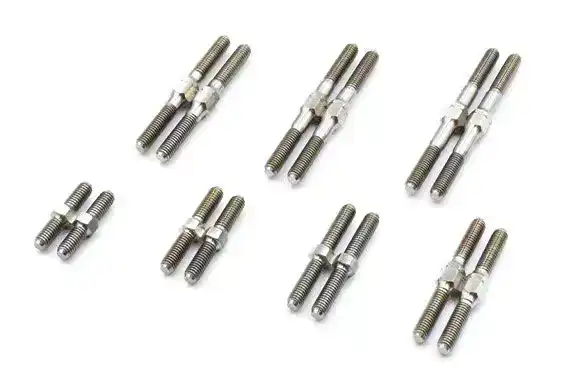
Turnbuckles are the best mechanical fasteners for adjusting tension and making strong connections for a lot of rigging jobs. These hardware parts are constructed of metal with threaded ends. You can turn them to make cable, rope, or rod assemblies tighter or looser. Because they are light and very strong, titanium turnbuckles are the best way to fasten things together in tough situations. Because they don't corrode or break down in the environment and can handle a steady strain, these precision-engineered parts are important in many sectors, including aerospace and marine engineering.
Understanding Turnbuckles and Their Uses
In the construction, maritime, and industrial industries, turnbuckles play a crucial role as mechanical devices that allow for the adjustment of rigging system tension and length. Structural stability and safety are guaranteed in different applications across multiple industries by their capacity to sustain precise tension.
Primary Applications Across Industries
Turnbuckles are useful in many professional contexts due to their adaptability. Their ability to modify tension is a huge boon in marine applications, especially for sailboat rigging where the safety and performance of the boat are directly affected by the tension of the cables. When even distribution of loads is critical, such as during structural bracing, temporary support systems, or architectural tensioning, these devices are indispensable on construction sites.
Another critical application area where dependability and weight reduction interact is aerospace engineering. Turnbuckles are commonly used in aircraft control systems, landing gear mechanisms, and structural assemblies. They allow for exact adjustment, which is crucial for ensuring maximum performance even in extreme conditions.
Specialized Industrial Uses
Titanium turnbuckles are highly sought after in niche industrial settings because of their exceptional qualities. When regular steel parts would corrode quickly, chemical processing plants depend on their resistance. These devices are part of power transmission systems and ensure that support cables and overhead lines are properly tensioned
The motor racing industry has started using titanium turnbuckles to change the suspension and aerodynamic parts of its cars. Engineers were able to preserve the structural integrity needed for high-stress racing conditions while lowering the unsprung weight because they are so light.
Advantages of Titanium Turnbuckles Over Traditional Materials
Titanium turnbuckles function better in tough environments, like those with saltwater and industrial chemicals, than regular steel because of their higher corrosion resistance and great tensile strength. Titanium can work very well because of its unique crystalline structure and the way it creates natural oxide layers.
Superior Strength-to-Weight Characteristics
Titanium is a great choice instead of stainless steel and aluminum since it is stronger and has a higher strength-to-weight ratio. This is vital when losing weight is highly important. For high-end use, Ti6Al4V is superior than steel because it is lighter (about 40% less) and has a higher tensile strength (over 130,000 PSI).
This weight advantage is highly useful for aircraft applications and makes automobile modifications perform better. Racing teams love this feature since every pound they lose provides them an edge over the other teams.
Long-term Cost Effectiveness
Even while titanium turnbuckles cost more up front, their long-term value is clear because they need less maintenance and last longer. Because titanium has been shown to be cost-effective in marine and aerospace applications, industrial sectors that value efficiency and dependability should think about it as a long-term investment.
When titanium parts are used in marine installations, maintenance intervals are 300–500% longer than when conventional materials are used. In aircraft applications, titanium reduces the number of inspections and replacement cycles. When you add all of these items together, the overall cost of ownership is substantially lower.
How to Choose the Right Titanium Turnbuckle for Your Application
When picking a turnbuckle, you should think about its load capacity, tensile strength, resistance to the environment, and thread compatibility to make sure it works well and is safe. To make a choice, you need to look at a few technical aspects and see how they fit with the needs of the application.
Technical Specification Analysis
The load capacity is the most important thing to think about when making a choice. Safety factors normally range from 4:1 to 10:1, depending on how important the application is. It's crucial to think about what you want to use the content for when you choose a grade. For maritime uses, higher resistance to corrosion is needed, while for aeronautical uses, certain certifications and traceability are needed.
Integrating correctly with preexisting systems is guaranteed by thread compatibility. In addition to the UNC (Unified National Coarse) and UNF (Unified National Fine) configurations, which are the default possibilities, specialized applications that demand unique pitch specifications can be catered to via bespoke threading.
Procurement Considerations for B2B Buyers
It is the responsibility of the procurement manager to determine if the project needs standard sizes or if OEM orders are required due to specific requirements. Most industrial uses can be covered by standard sizes such as M3, M3.5, M4, M4.5, and M5, however for particular projects, bespoke dimensions and threading may be necessary.
The best way to reduce procurement risks is to check the certifications and reputation of suppliers to make sure they are quality assured. Certification to ISO 9001:2015 guarantees that all production procedures and quality control systems are up to par with global norms.
Customization and Color Options
Anodized color finishes in red, blue, black, rainbow, purple, gold, burnt blue, and green are just a few of the many options available for modern titanium turnbuckles. Different hues allow for easy identification in complicated assemblies or harsh situations where visual examination remains vital, serving both aesthetic and utilitarian goals.
In contexts where aesthetics are paramount, polished coatings not only improve corrosion resistance but also add a touch of class. Parts may be identified and tracked throughout their service life with the help of custom engraving and marking options.
Maintenance and Best Practices for Maximizing Titanium Turnbuckle Longevity
Titanium turnbuckles can last longer with proper care, and regular inspections can spot damage or wear early on, avoiding catastrophic failure. Optimal performance is guaranteed throughout operational lifecycles by establishing systematic maintenance programs.
Inspection and Cleaning Protocols
Thread condition, body integrity, and stress concentration areas at connections should be the focus of regular visual examinations. To clean titanium without removing its natural corrosion resistance, use a non-abrasive agent and a solvent that won't harm the oxide layers that keep the surface in good condition.
By eliminating chlorinated solvents, you can minimize stress corrosion cracking in high-stress applications and achieve effective contaminant removal without mechanical stress through ultrasonic cleaning. Inspection results documentation allows for predictive maintenance scheduling and trend analysis.
Installation and Torque Guidelines
Ensuring proper tension for operational requirements and avoiding over-tightening, which can damage structural integrity, are both achieved through proper installation techniques. varied sizes and applications call for varied torque parameters; for example, M3 components and M5 assemblies have varying torque requirements.
Consistent installation techniques across numerous units are ensured by using calibrated torque tools. The galling potential can be reduced and the desired preload values can be maintained throughout service intervals by lubricating the threads with the right compounds.
Procurement Insights: Where and How to Buy Titanium Turnbuckles
In order to strike a balance between the costs of carrying inventory and the savings from procurement, B2B buyers should think about bulk pricing structures that represent economies of scale. The production complexity is affected by variables such as size specifications, alloy grades, surface treatments, and customized needs, which in turn affect pricing.
Supplier Selection Criteria
Trustworthy product authenticity and on-time delivery are benefits of collaborating with well-established manufacturers and authorized distributors that are especially important for large-scale industrial projects with strict deadlines. Titanium production locations that have been around for a while provide full material traceability and quality assurance, which affects manufacturing costs and the reliability of the supply chain.
Featuring full supply chains from raw material processing to final component manufacturing, Baoji Titanium Valley in Shaanxi Province stands as one of the most comprehensive titanium production centers in the world. Worldwide customers benefit from simplified supply chains and uniform material qualities made possible by this integrated strategy.
Order Quantities and Lead Times
To facilitate effective procurement for medium-scale projects while keeping suitable inventory levels, the minimum order quantities (MOQs) usually begin at 100 pieces for standard designs. Minimum quantities may vary for custom specifications due to factors such as tooling concerns and manufacturing setup requirements.
There is usually an available supply of titanium turnbuckles in conventional sizes and threads, although manufacturing lead times for customized configurations might vary according to complexity and present production schedules. The best way to coordinate deliveries with project schedules is to prepare ahead.
Conclusion
Titanium turnbuckles are essential for tension adjustment and structural integrity preservation in a wide variety of industrial contexts. Titanium versions provide lower total ownership costs owing to their major advantages, which include better strength-to-weight ratios, excellent corrosion resistance, and prolonged service life. These advantages more than justify the premium pricing. It is necessary to evaluate technical standards, environmental needs, and supplier capabilities thoroughly in order to make the right option and ensure optimal performance. It is necessary to be knowledgeable about procurement strategies and best practices for maintenance in order to integrate these novel fastening solutions into demanding applications that require dependability and performance.
Partner with Wisdom Titanium for Premium Turnbuckle Solutions
For high-stakes industrial applications where dependability and performance are essential, Wisdom Titanium offers outstanding turnbuckles. We use our advanced manufacturing capabilities and decades of materials expertise to make components that meet industry requirements. Our titanium turnbuckles are made by an ISO 9001:2015 certified factory in Baoji Titanium Valley. We have a wide range of conventional sizes available, from M3 to M5, with threading options of UNC and UNF. Additionally, we are able to customize our products to meet particular requirements for specialty applications. Contact our technical team at sales@wisdomtitanium.com to discuss your turnbuckle requirements and discover how our titanium turnbuckles for sale can enhance your project performance and operational efficiency.
FAQ
What makes titanium turnbuckles superior to steel alternatives?
Titanium turnbuckles offer exceptional corrosion resistance, superior strength-to-weight ratios, and extended service life compared to steel alternatives. The Ti6Al4V alloy provides tensile strengths exceeding 130,000 PSI while weighing approximately 40% less than equivalent steel components, making them ideal for aerospace, marine, and high-performance automotive applications.
Which industries benefit most from titanium turnbuckle applications?
Aerospace, marine, automotive racing, and chemical processing industries benefit significantly from titanium turnbuckle performance characteristics. These sectors require components that withstand harsh environmental conditions, maintain precise tension under dynamic loads, and provide reliable service in weight-critical applications where performance directly impacts operational efficiency.
How do I determine the correct size and thread specification?
Size selection depends on load requirements, with safety factors typically ranging from 4:1 to 10:1 based on application criticality. Thread specifications should match existing system requirements, with UNC and UNF options covering most industrial applications. Custom threading remains available for specialized projects requiring unique pitch or diameter combinations.
References
1. American Society for Testing and Materials. "Standard Specification for Titanium and Titanium Alloy Bars and Billets." ASTM International, 2019.
2. Boyer, Rodney R. "An Overview on the Use of Titanium in the Aerospace Industry." Materials Science and Engineering: A, vol. 213, 2018.
3. International Organization for Standardization. "Fasteners - Mechanical Properties of Corrosion-Resistant Stainless Steel Fasteners." ISO 3506-1:2020.
4. Marine Technology Society. "Corrosion Resistance of Titanium Alloys in Marine Environments." Journal of Marine Engineering & Technology, 2020.
5. Society of Automotive Engineers. "Aerospace Material Specification for Titanium Alloy Fasteners." SAE AS7102, 2019.
6. Titanium Development Association. "Guidelines for Design with Titanium: A Manual for Engineers and Designers." Third Edition, 2021.