
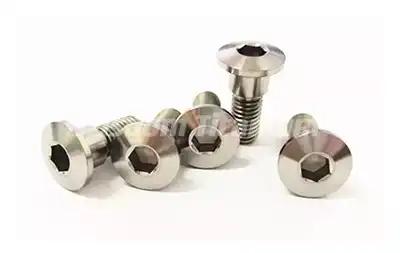
Titanium disc brake bolts are precision-engineered fasteners made from Grade 5 titanium alloy (Ti-6Al-4V) that secure brake rotors to wheel hubs on bicycles and motorcycles. Unlike standard steel hardware, these bolts deliver a tensile strength of 900–1,050 MPa while weighing roughly 45% less than equivalent steel fasteners. For high-end road, gravel, and mountain bike builds where every gram appears on a weight sheet, swapping six to twelve rotor bolts to titanium produces measurable, marketable weight savings without sacrificing structural integrity. That combination of verified data and visual appeal is exactly why premium component brands list them on their spec pages.
Understanding Titanium Disc Brake Bolts
What They Are and What They Do
Many times, the brakes are used. A rotor bolt goes into the wheel hub and keeps the brake disk in place. When the rider puts all the brakes on, each bolt fights against torque and shear forces at the same time. Because its yield strength is close to 870 MPa, Grade 5 titanium can handle that load. This is high enough to meet or beat OEM steel standards while only carrying a small amount of weight.
Common Misconceptions About Titanium Fasteners
Many people who buy titanium bolts think they are weak or odd. In fact, Ti-6Al-4V is stronger than most industrial steels in terms of its specific strength. The fear is not of being strong, but of being insulted. Ti threads can cold-weld under high pressure if they are left to dry. So, using a good anti-seize product is always a part of setting up something.
Why Weight Data Matters at the Product Level
Grade 5 titanium is usually 15–25 grams lighter than steel for a set of titanium disc brake bolts. That might not seem important, but the amount of spinning mass that is not sprung affects both how the suspension works and how the rider feels. For a business that sells high-end bolt kits, that gram count backs up what they say in their ads. They can charge 3–5¢ more than steel gear because they know that much about it.
Titanium vs. Other Materials: Making the Right Choice
Titanium vs. Steel
As cheap and easy to find as steel bolts are, they get heavy and rust when they're on salty roads. Because titanium doesn't need to be treated, it doesn't rust in the air. It also makes bolt sets about half as heavy. Brands that sell in wet places, like Northern Europe, will have fewer repair calls and guaranty returns over the life of a product if it doesn't have cracks caused by rust.
Titanium vs. Aluminum
Bolts made of aluminum are light, but they're not as strong as others. Most metal disk brake fasteners have tensile strengths of less than 500 MPa, which is not strong enough for hard stops. Grade 5 titanium is stronger than aluminum by more than twice as much and only a little heavier. It is the only metal that is safe enough to use for brake disks and doesn't weigh too much.
Titanium vs. Stainless Steel
Even though titanium is lighter than stainless steel and doesn't rust as easily as carbon steel, stainless steel still weighs about 7.9 g/cm³. When it comes to weight, titanium is the only way for a small bike company to go when they're making a whole set of titanium gear. Another thing that can't be done to stainless steel is anodizing. Titanium bolts can have black, gold, rainbow, purple, or burned blue finishes.
Procurement Insights for Titanium Disc Brake Bolts
Verifying Material Authenticity
Check the Ti-6Al-4V composition with an XRF (X-Ray Fluorescence) report before you place a bulk order. Companies that make titanium disc brake bolts that you can trust give mill certificates that can be used to find the raw bar stock. The standard for figuring out what a bar-shaped titanium metal is made of is ASTM B348.
MOQ, Mixed-Color Batching, and Packaging
The minimum order quantity is a common problem when people want to buy something. A lot of merchandise is being put on brands that have five anodised colors with different MOQs. To get 200 titanium disk brake bolts, you should be able to mix and match different sizes and colors. Wisdom Titanium's MOQ right now is 200 pieces, and for those 200 pieces, it can handle multi-color combos for both M6 and M8 sizes.
Before committing to a seller, these are the main things that buying teams should check:
- Material certification: Mill cert + XRF report confirming Ti-6Al-4V (Gr5) chemistry.
- Thread standard: Rolled threads to ISO metric pitch; Go/No-Go gauge inspection records available.
- Color consistency: Anodizing batch color cards supplied with each order; rainbow and burnt-blue gradient samples provided before production.
- Compliance documents: REACH and RoHS declarations available on request for EU market entry.
- Packaging options: Per-bike-model kit packing, custom barcode labeling, and multilingual instruction sheets supported.
Installation of Titanium Disc Brake Bolts
Torque Specifications and Anti-Seize Protocol
Most M8 bolts have a torque of 6–8 Nm, and most M6 bolts have a torque of 4–6 Nm. To find the right number, always look at the service instructions that came with the hub or rotor. Cover the threads with a thin layer of an anti-seize compound that works with titanium before you put it together.
Tools and Installation Tips
Even though titanium doesn't rust, you should still check it every so often. Every time you do a major service, look for thread elongation, head deformation, and any signs of fretting at the point where the rotor meets the shaft. The drive recess should be round or a bolt should be bent. If you can see this, you should get a new one. Grade 5 titanium bolts can be used again, but stretch bolts can't as long as they stay within the given sizes.
Why Titanium Disc Brake Bolts Are the Preferred Solution for B2B Clients
Performance That Supports a Premium Price Tag
When a brand sells titanium disc brake bolts for three to five times the price of steel ones, they should be clear about how much they cost. They use grade 5 titanium, which has a tensile strength of 900 to 1,050 MPa, a density of 4.43 g/cm³, a body that has been fully CNC cut, and threads that have been rolled. Every single one of those numbers can be checked and shared with the public.
Anodized Color Options as a Differentiation Tool
You can get an anodized finish in black, gold, rainbow, purple, or burned blue. These allow component makers to make kits and match the colors of the rotor parts to the frames. This color doesn't chip or peel off when the brakes are hot because it is part of the oxide layer. You can expect color cards to match from batch to batch, and a good provider will give you reference samples before you approve production.
Supply Chain Confidence for Seasonal Markets
The fourth quarter is when most European bike brands finish specifying their parts. By the end of February, the hardware needs to be in the warehouse. The titanium production line in Baoji, China, is one of the busiest in the world. To meet those deadlines, a seller can use nearby bar stock, CNC machines in-house, and partners who do anodizing.
Conclusion
Titanium disc brake bolts made of Grade 5 Ti-6Al-4V have low mass, high tensile strength, corrosion resistance, and a variety of anodized colors that steel and aluminum hardware can't match. People who sell or buy high-end bike parts for other businesses can use the material's 900–1,050 MPa strength, <45% lighter weight than steel, and five stable anodized colors to make product claims that can be sold and set fair prices. The procurement case is easy to make if you can find a supplier that can meet those needs, deliver before the spring sales season, let you mix colors, and requires a minimum order of 200 pieces.
FAQs
Can titanium rotor bolts handle the same torque as OEM steel bolts?
Yes. Grade 5 titanium yield strength (~870 MPa) meets or exceeds standard OEM steel bolt specifications. Always follow the hub or rotor manufacturer's torque figure and apply anti-seize compound to prevent galling.
Why does anodized color vary between batches?
Anodizing titanium is an electrochemical process sensitive to bath chemistry, temperature, and voltage. Gradient finishes like rainbow and burnt blue are especially variable. A quality supplier provides a reference color card and approves production samples before full-batch processing.
What is the minimum order for mixed colors and sizes?
At Wisdom Titanium, the MOQ is 200 pcs total, and that order can be split across M6 and M8 sizes and multiple anodized colors — reducing per-color inventory pressure for boutique brands.
Do these bolts require REACH documentation for EU sales?
Yes. EU market entry requires REACH and RoHS compliance declarations. Request these documents during supplier qualification, alongside the mill certificate and XRF material report.
Are titanium rotor bolts reusable after a rotor swap?
They are reusable if they pass a visual and dimensional inspection — check for thread elongation and head deformation. Unlike single-use stretch bolts, Grade 5 titanium does not plastically deform under normal torque, so reuse is acceptable when the fastener remains within spec.
Partner With Wisdom Titanium — Your Trusted Titanium Disc Brake Bolt Manufacturer
Baoji Titanium Valley in Shaanxi Province makes titanium fasteners that Wisdom Titanium has bought since 2016. These fasteners are approved by ISO 9001. The threads on our Grade 5 titanium disk brake bolts are rolled and they are made entirely with a CNC machine. They come in five anodized colors and two sizes, M6 and M8. You can mix and match colors when you place an order for at least 200 pieces. Mill certificates, XRF reports, and REACH declarations are all things we offer as standard. Send an email with your color needs or a spec sheet to sales@wisdomtitanium.com, or go to www.wisdomtitanium.com to get samples.
References
- ASTM International. ASTM B348: Standard Specification for Titanium and Titanium Alloy Bars and Billets. ASTM International, 2019.
- Boyer, R., Welsch, G., & Collings, E. W. Materials Properties Handbook: Titanium Alloys. ASM International, 1994.
- Donachie, M. J. Titanium: A Technical Guide, 2nd ed. ASM International, 2000.
- ISO. ISO 898-1: Mechanical Properties of Fasteners Made of Carbon Steel and Alloy Steel. International Organization for Standardization, 2013.
- Schutz, R. W., & Watkins, H. B. "Recent Developments in Titanium Alloy Application in the Energy Industry." Materials Science and Engineering A, 1998.
- Lampman, S. (Ed.). Wrought Titanium and Titanium Alloys — Properties and Selection: Nonferrous Alloys and Special-Purpose Materials. ASM Handbook Vol. 2, ASM International, 1990.