
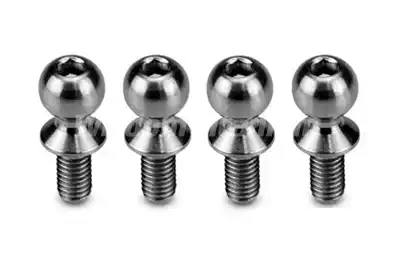
A titanium ball stud is a precision-engineered fixing part made of high-grade titanium alloys like Grade 5 (Ti-6Al-4V) and has a spherical head attached to a threaded shaft. These specialized fasteners are made to give challenging mechanical systems great strength-to-weight performance, resistance to corrosion, and fatigue endurance. These studs are commonly used in racing applications, robotics, and precision machinery, as well as in automotive suspension systems. They allow for movement and load transfer while keeping the structure's integrity in harsh environments with high vibration, temperature cycling, and corrosive environments.
Titanium Ball Studs: Definition and Properties
In its most basic form, a titanium ball stud has a spherical bearing surface that lets it rotate and a threaded part that makes mounting safe. This set-up lets suspension linkages, steering mechanisms, and precise adjustment systems move in an angle that can be managed. Compared to regular steel ball studs, titanium versions offer the same or better mechanical performance while being about 45% lighter. This is a major benefit in performance-driven situations where unsprung mass directly affects how the vehicle handles and accelerates.
Material Composition and Alloy Selection
Ti-6Al-4V (Grade 5) is an alpha-beta titanium alloy that is mostly used to make racing titanium ball studs. It has 6% aluminum and 4% vanadium in it. With a density of only 4.43 g/cm³, this mixture has a tensile strength that ranges from 895 MPa to 1000+ MPa, which is higher than many types of stainless steel. The aluminum content makes the solid-solution stronger and more resistant to oxidation. The vanadium content stabilizes the beta phase, which makes it easier to shape and respond better to heat treatment. Different alloys, like Grade 2 (commercially pure titanium), may be used in situations where maximum corrosion protection is more important than final strength. This is especially true in marine or chemical processing settings where chloride is present all the time.
Physical and Mechanical Properties
There are a number of interconnected material qualities that affect how well titanium ball studs work. Ti-6Al-4V has a strength-to-weight ratio of about 25 MPa·cm³/g, which is almost twice as strong as high-strength steel alloys. This lets engineers get the same load-bearing capacity while cutting the mass of each part by 40–45%. This directly improves the power-to-weight ratios of race cars and lowers the mass of suspension systems that move back and forth. Titanium has an elasticity value of 110–120 GPa, which is about half that of steel. This means that it can bend more when it's loaded, which can absorb impact energy and spread out stress in moving parts.
Corrosion resistance comes from a stable, self-healing titanium dioxide (TiO₂) inactive layer that forms on its own and is 1 to 10 nanometers deep. This oxide film stays whole in pH ranges from 3 to 12 and grows back right away when it gets damaged mechanically in oxygenated settings. When exposed to ocean spray, road chemicals, brake fluid, and most organic solvents, titanium ball studs keep their surface integrity. These are all things that quickly break down carbon steel and speed up the pitting process in stainless steel screws.
Manufacturing Process and Quality Control
Titanium rod stock that meets ASTM B348 or AMS 4928 standards is usually the first step in making racing titanium ball studs. Precision CNC cutting or cold heading is used to make the spherical head. The surface finish specs are kept within Ra 0.4–0.8 μm to ensure smooth movement and reduce wear. You can cut or roll thread profiles to get Class 6g accuracy grades. The profiles are based on ISO or metric standards. Anodized coats are often used to make the surface harder, easier to identify, and less likely to gall when being put together, which is a common problem with titanium-to-titanium or titanium-to-aluminum contacts.
Coordinate measuring tools (CMM) are used to check the dimensions, surface hardness is tested (usually 32–38 HRC for Ti-6Al-4V), and the pull-out strength is confirmed. Batch traceability makes sure that material certificates can be linked to the original mill test records that list the chemical make-up, tensile strength, and heat treatment conditions. Getting ISO 9001 approval means that a factory manages quality in a planned way, from inspecting the raw materials that come in to making sure the end packaging and shipping paperwork are correct.
Advantages and Applications of Titanium Ball Studs in B2B Industries
Ball studs made of titanium meet important performance standards in many industries, especially where regular materials make it hard to do the job. When you combine low mass, high specific strength, and environmental longevity, you can make system-level changes that go beyond just switching out parts.
Core Performance Advantages
In car and motorcycle uses, the main gain is less unsprung mass. Every kilogram that is taken away from suspension parts makes the tire contact patch more consistent on uneven surfaces, which improves turning precision and grip limits. Professional racing teams that compete in endurance events or time-attack competitions value this edge because it allows them to cut lap times by 0.5 to 1.5 seconds on average per lap. Lower moving and rotational masses also lower bearing loads and make it possible for bushings and joints to last longer between repairs.
Industry-Specific Applications
Control arms, steering tie rods, and adjustable suspension links are all made of titanium ball studs in the setting of car racing and vehicle modification. Manufacturers of high-end sports cars choose these parts for limited-production models where brand differentiation depends on speed benefits that can be measured. Racing events that have minimum weight standards encourage teams to use titanium fasteners all over the frame, which saves 15 to 30 kg on full car builds. The higher cost is supported by benefits in the market and fewer times when parts need to be replaced.
Miniature titanium ball studs are used in articulated links and adjustment systems in robotics and precision automation equipment. Because it isn't magnetic, it doesn't mess up sensitive gadgets or magnetic tracking systems. When it comes to battery-powered driverless systems, lightweight actuators are especially useful because they have shorter turn times and use less power. Corrosion resistance is useful in places like food processing and pharmaceutical production where steel parts would quickly break down if they were washed down too often with acidic cleaning agents.
Customization Options for OEM Requirements
The main parameter for customization is the ball diameter, which can be anywhere from 6mm to 25mm for standard car uses and below 4mm for micro-mechanisms in aerospace-specific versions. Thread standards include metric sizes M6, M8, M10, and M12. Custom pitch choices are also available for certain torque-preload relationships. The length and shape of the shank can be changed to fit the limitations of the package and give the best engagement depth for mounting structures made of metal or composite materials.
Anodized finishes let you change both how something works and how it looks. Type II anodizing, which usually has a thickness of 5–25 μm, adds a little extra hardness to the metal to 200–250 HV and colors the parts to make them easier to identify. Type III hard anodizing (50–100 μm) makes the surface much harder (400–600 HV), which makes it more resistant to wear in high-cycle situations. You can choose from natural gray, black, blue, gold, and purple. These colors are made by letting the dye soak in during the anodizing process before finishing.
Titanium Ball Studs vs. Alternative Materials: A Rational Choice Analysis
When choosing a material for ball studs, you have to weigh the performance needs against the cost and ease of production. Each option has different pros and cons that affect how well it works in certain situations.
Titanium Compared to Stainless Steel
For ball screws that won't rust, stainless steel types like 316 or 17-4PH are usually the best choice. Although 17-4PH precipitation-hardened stainless steel has a tensile strength about the same as Ti-6Al-4V (around 1000–1100 MPa in H900 state), it is much denser (7.8 g/cm³ compared to 4.43 g/cm³ for titanium). Weight-reduction goals in performance uses are thrown out by this 76% higher mass. The higher modulus (190-200 GPa) of stainless steel makes it more rigid, but it also makes stress densities higher at breaks, which could shorten its wear life when loaded in different ways.
Alternative High-Performance Materials
Ceramic ball studs made from zirconia or silicon nitride are very hard and don't break down easily. They can also have pressure forces of more than 3000 MPa. But because it is weak and easily damaged by impact, it can only be used in low-shock settings. It is much harder to make and costs a lot more than titanium, so it can only be used in medical or military equipment that need it. Ceramics still have a much lower tensile strength than metals, which means they can break under bending or twisting loads.
Conclusion
Titanium ball studs are a unique way to hold things together that have measured performance benefits in settings that are heavy, under a lot of stress, or corrosive. Ti-6Al-4V's high strength-to-weight ratio, resistance to corrosion, and resistance to wear make it a good option to steel and aluminum, which have their own problems. Reduced unsprung mass, longer maintenance intervals, and better reliability in harsh working conditions are all benefits that can be seen in car races, motorbike performance systems, and precision machinery. For successful procurement, you need to look at what the provider can do, make sure the materials are certified, and know what customization options are available to make sure that the specs of the parts meet the needs of the operation. Using the right repair methods and inspecting things on a regular basis can make things last longer and keep their performance. The higher original cost is supported by lower lifecycle costs, benefits in the market, and the elimination of risks of premature failure in demanding applications.
Partner with Wisdom Titanium for Premium Racing Ball Studs
Wisdom Titanium makes racing titanium ball studs that are precisely designed to meet the high standards of performance car experts, racing teams, and original equipment makers. Our ISO 9001-certified factory in Baoji Titanium Valley, which is the world's largest titanium production hub, makes sure that all of our materials can be tracked all the way from the titanium sponge to the finished parts. We are experts at making unique ball diameters, metric thread standards, and anodized finishes that fit your exact needs. Our in-house CNC machining keeps errors to within ±0.01mm. Our experienced research and development (R&D) team works with clients on application engineering, material optimization, and prototype development. They also keep a full store of raw materials to keep prices fixed and normal configuration wait times at two to three weeks. To talk about your titanium ball stud needs, email our sourcing experts at sales@wisdomtitanium.com. As a reliable titanium ball stud supplier that has been working with the automobile, motorbike, and precision machinery industries since 2016, we offer full technical support from the initial specification stage through delivery, ensuring seamless integration into your performance assemblies and modification projects.
FAQ
Why do titanium ball studs outperform steel alternatives in racing applications?
Titanium ball studs are 40–45% lighter than steel ones while keeping the same or higher tensile strength. This directly lowers the amount of unsprung mass in suspension systems. This extra weight makes tire contact more consistent, turning response better, and movement faster. Corrosion resistance stops surface degradation that leads to binding and faster wear, and better fatigue qualities under cyclic loading make service life longer than 10 million cycles, which is often twice as long as steel parts in race conditions.
Can titanium ball studs be interchanged with steel components in existing automotive assemblies?
Dimensional compatibility lets you directly replace current parts when the thread specs and ball diameters match. But because titanium has a smaller modulus and different friction properties, torque requirements may need to be changed. To stop galling, anti-seize products made for titanium surfaces should be used. Check that the parts that fit together (control arms, tie rods) can handle the flexible nature of titanium without causing too much play or stiffness in the range of motion.
What verification steps ensure titanium ball stud quality before purchase?
Ask for material certificates that list the alloy's makeup (which is usually Ti-6Al-4V according to ASTM B348), its tensile properties (895+ MPa), and the parameters for its heat treatment. Reports from dimensional inspections should confirm the limits for thread pitch, ball diameter, and surface finish. Getting ISO 9001 certification means that you handle quality in an organized way. Before committing to production numbers, conformance is checked by using go/no-go thread sizes on samples and hardness tests (32–38 HRC for Ti-6Al-4V).
References
1. American Society for Testing and Materials. (2021). ASTM B348: Standard Specification for Titanium and Titanium Alloy Bars and Billets. West Conshohocken, PA: ASTM International.
2. Boyer, R., Welsch, G., & Collings, E.W. (1994). Materials Properties Handbook: Titanium Alloys. Materials Park, OH: ASM International.
3. Donachie, M.J. (2000). Titanium: A Technical Guide (2nd ed.). Materials Park, OH: ASM International.
4. Lutjering, G., & Williams, J.C. (2007). Titanium (2nd ed.). Berlin: Springer-Verlag.
5. Peters, M., Kumpfert, J., Ward, C.H., & Leyens, C. (2003). Titanium Alloys for Aerospace Applications. Advanced Engineering Materials, 5(6), 419-427.
6. Schutz, R.W., & Watkins, H.B. (1998). Recent developments in titanium alloy application in the energy industry. Materials Science and Engineering A, 243(1-2), 305-315.