
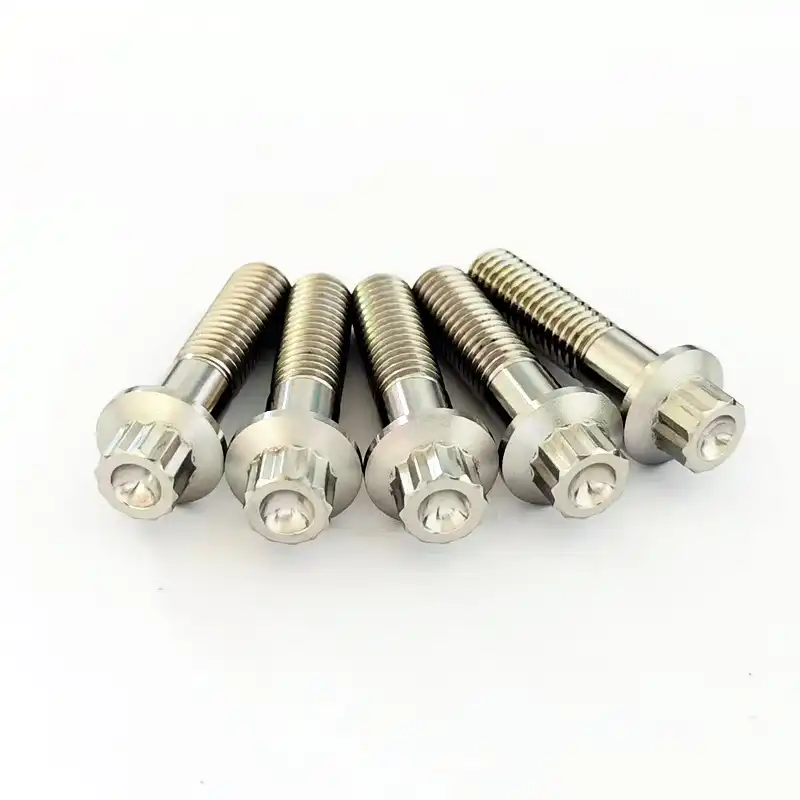
Titanium 12 point bolts are commonly referred to as 12-point flange bolts, bi-hex bolts, or double-hex fasteners. These specialized fasteners feature a head with twelve engagement points instead of the traditional six found on standard hex bolts. The multi-point design allows for easier tool engagement at various angles, making installation and removal faster and more efficient in tight spaces. Manufactured from aerospace-grade titanium alloys like Grade 5 (Ti-6Al-4V), these bolts deliver exceptional strength-to-weight ratios, making them indispensable in automotive modifications, motorcycle racing applications, and high-performance bicycle builds.
Titanium 12 Point Bolts: Names, Basics, and Design
The words used to describe these fasteners show how they are designed and how well they work. In the automobile and racing industries, "12-point flange bolts" is still the most common name for these parts, but procurement workers may come across other names based on area standards and the needs of the job.
Industry Naming Conventions and Terminology
Different industries use different names for these bolts. Aerospace experts may call them "12-spline head bolts," which can be confusing with real spline-drive fasteners. Racing teams often call them "multi-point titanium bolts" or "bi-hex titanium fasteners." The word "12-point flanged bolts" is often used by European makers to stress the washer flange that spreads the clamping force. Understanding these differences helps procurement teams speak clearly across foreign supply lines and makes sure that parts are correctly identified when they are being sourced.
Extra care should be taken with the lip part. This built-in wide base spreads pressure over a larger surface area, acting like a built-in cleaner. This design lowers the chance of damage to parts and keeps them from coming loose when they vibrate, which is very important for brake pads, wheel hubs, and engine parts that are put through a lot of stress during use.
The Anatomy of 12 Point Bolt Design
The shape of titanium 12 point bolts was chosen on purpose by engineers. Instead of having contact surfaces spaced every 60 degrees like normal hex bolts, each 12-point head has them spaced every 30 degrees. This tighter angular positioning allows for wrench or socket contact in twice as many places, which makes assembly areas much easier to get to.
The Grade 5 titanium metal (Ti-6Al-4V) that is used in high-end 12 point bolts has clear benefits. With a tensile strength of over 950 MPa and a yield strength of over 880 MPa, these bolts are stronger than many steel options and weigh about 45% less. The 36 HRC hardness grade means that it will last through multiple torque cycles, and the 18% elongation at break ensures that it won't break in a catastrophic way.
Material Standards and Grade Specifications
Ti-6Al-4V, which has about 6% aluminum and 4% vanadium, is the most common titanium metal used to make fasteners. This mixture is the best combination of strength, resistance to rust, and ease of machining. The aluminum part raises the tensile strength and lowers the density, and the vanadium part stabilizes the beta phase, which makes the material harder and better for hot working.
Thread sizes are usually between M5 and M14, which is large enough for most car, motorbike, and bike functions. The M5 and M6 sizes are good for fitting body panels and accessories, while the M8 and M10 sizes are best for putting together brake calipers and suspension parts. When maximum clamping force is needed, bigger M12 and M14 12 point bolts are used to join wheel hubs and mount the drivetrain.
You can choose from polished, anodized, and PVD paint finishes for the surface. Polished finishes make apps that will be seen on custom builds look better. Anodized treatments add protective metal layers that make things less likely to rust and let you change the color to make them stand out for branding purposes. PVD coats put down ceramic materials that make things even more resistant to wear and make installation easier by reducing friction.
Key Uses and Benefits of Titanium 12 Point Bolts in Industry
There are businesses that focus on performance that use these fasteners as standard parts because they solve certain technical problems that normal materials can't.
Primary Industrial Applications
Modification shops for cars use titanium 12 point bolts for weight loss programs aimed at supercars and track-day cars. Changing steel wheel nut bolts to titanium ones can save 200 to 300 grams per corner, which doesn't seem like much until you add it up for the whole car. This decrease in unsprung weight directly enhances the reaction of the suspension, speed, and stopping power. Titanium's high strength and thermal stability make it a great material for brake caliper fixing bolts because they keep the clamp load even when temperatures change quickly during active driving.
Motorcycle race teams use 12 point bolts on important parts like back axle assemblies, brake disc mounting gear, banjo bolts, and sprocket nuts. In places with a lot of shaking, titanium 12 point bolts need to be able to keep their tightness while also reducing the rotational mass. Titanium doesn't easily wear down, so it can keep working well during race seasons that can have hundreds of heat cycles and thousands of miles at competition speeds.
Premium bike makers use titanium multi-point nuts on all of their top-of-the-line bikes. Every gram saved helps road race bikes stay under the UCI weight limit, and rust resistance against mud, water, and trail debris is good for mountain bikes. Custom frame makers like that the material can be used with titanium, carbon fiber, and aluminum parts, so there aren't any galvanic corrosion problems that can happen with units made of different materials.
Advantages Compared to Alternative Materials
The ratio of strength to weight shows why performance uses are worth titanium's higher starting cost. Grade 5 titanium has tensile strengths that are about the same as heat-treated alloy steel, but it is 43% lighter. This means that parts can meet the needs of the structure while lowering mass by a large amount. Titanium has about twice the tensile strength of aluminum options. This means it doesn't pull threads or break early in high-stress situations.
Durability is more than just a number of power units. The material's fatigue limit is about 50% of its ultimate tensile strength. This is the stress level below which it can possibly be loaded and unloaded an infinite number of times. Because of this trait, titanium 12 point bolts that are properly torqued and part of well-designed systems should never fail from fatigue under normal use. Stress corrosion splitting can happen to steel bolts in corrosive settings, but this can't happen to titanium.
Lifecycle cost savings are directly linked to resistance to environmental damage. Racing teams that used to have to change their steel brake caliper bolts every year because they rusted can expect their titanium replacements to last for more than one season. Bicycle parts that are exposed to salt spray near the coast will always look good and work properly, instead of needing to be replaced every so often.
Torque Capabilities and Performance Metrics
To do a proper fitting, you need to know the torque specs. A normal M10x1.5 Grade 5 titanium bolt might need 40–45 Nm of torque to put a brake caliper on a car, while a Grade 8.8 steel bolt would need 50–55 Nm. This decrease takes into account the unique rubbing properties of titanium and stops overtorquing, which could damage threads or parts.
Best practices for installation include using torque wrenches that have been measured and adding torque in several steps rather than all at once. The friction ratings will stay the same if the threads are clean and dry. Many race groups don't allow anti-seize compounds on titanium bolts because lubricants can change the way friction works in unpredictable ways, which could lead to incorrect torque settings even when the wrench is set correctly.
The 12-point design makes it easier to shift power. The bigger contact area between the tool and the fastener head spreads the force out more widely, which makes it less likely that the head will round off or the tool will slip. This is especially helpful when taking something apart because rust or thread-locking chemicals make the breakaway force higher.
Trusted Brands and Suppliers of Titanium 12 Point Bolts
Forming relationships with dependable makers guarantees a steady flow of high-quality titanium 12 point bolts that meet strict performance requirements.
Leading Manufacturers and Their Capabilities
Companies that have been making aircraft fasteners for a long time bring decades of metalworking knowledge and quality processes to the commercial market. Their goods are very expensive, but they are very consistent and can be tracked. Racing teams getting ready for big events often choose these names so that the dependability of the fasteners isn't a factor that could cause them to fail.
Specialized racing providers work only with the performance markets for cars and motorcycles. Their catalogs have a huge selection of fasteners that are best for common repair tasks, along with thorough installation tips and torque specs. Technicians with real-world racing experience are often part of customer service teams and can give help that is specific to an application.
New companies that come from places that make titanium offer low prices and better quality control methods. This group is shown by Baoji Wisdom Titanium Industry and Trading Co., Ltd. The company was established in 2016 and is ISO 9001 approved. Its headquarters are in Baoji Titanium Valley in Shaanxi Province, which is China's biggest titanium industry center and one of the most important titanium production bases in the world. This place gives you direct access to the whole titanium supply chain, from making sponges and ingots to making bars, plates, tubes, and forgings. This connected environment lets you keep an eye on quality from the time you get the raw materials to the time you check and machine the finished product.
Why Material Source and Manufacturing Location Matter
Baoji has a complete titanium system that supports stable material quality and low prices. Full production chains are located in the area, with facilities for titanium sponge reduction, vacuum arc remelting, and specialty forging. With this vertical merger, there are no middlemen that add value but cost money.
Specialization helps people become experts in their fields. Facilities that only make titanium fasteners learn how to do things in a way that regular machine shops can't. The way a product is thread-rolled, heated, and finished on the outside all affect how well it works in the end. Manufacturers with years of experience have learned how to best use these factors over time.
Building Reliable Supply Partnerships
Both buyers and sellers gain from ties that last a long time. Manufacturers can keep inventory levels high and shipping plans in order when they have consistent volume promises. Buyers get stable prices, access to expert help, and quick service when they need it most.
There should be ways for both sales contacts and expert staff to talk to each other. For complex systems, you may need help from a tech that goes beyond what the sales team can do. When suppliers care about their customers' success, they offer thorough product paperwork, application guides, and quick problem-solving when issues appear.
Conclusion
Titanium 12 point bolts, also known as bi-hex fasteners, multi-point bolts, or 12-point flange bolts, are a high-tech engineering answer that meets specific performance needs. Their special head shape makes it easier for tools to connect, and the Grade 5 titanium metal gives them great strength-to-weight ratios, resistance to corrosion, and heat stability. These fasteners are used by shops that modify cars, motorcycle race teams, and high-end bicycle makers to cut down on weight without sacrificing strength or dependability. When purchasing these parts, procurement professionals should look at the total lifecycle costs instead of just the initial purchase prices. They should also know that titanium's durability and performance benefits often justify higher prices for critical applications where the material's properties directly affect safety and performance outcomes.
Partner with Wisdom Titanium for Premium Multi-Point Fastener Solutions
Wisdom Titanium makes aerospace-grade titanium 12 point bolts that are designed to work in tough car, motorbike, and custom bicycle settings. Our factory in Baoji Titanium Valley is ISO 9001-certified and uses China's most complete titanium production environment. This makes sure that all of our materials can be tracked from the raw titanium sponge to the precise CNC cutting. We can give you full details for fasteners with thread sizes from M5 to M14 and surface finishes like polished, anodized, and PVD coating that meet your exact needs. Our skilled technical team is here to help you from the first specification to delivery, whether you need regular catalog items or solutions that are specifically designed for your needs. For your next high-performance project, contact our titanium 12 point bolts supply team at sales@wisdomtitanium.com to talk about buying in bulk and getting specific material certifications.
FAQs
What makes titanium 12 point bolts different from regular hex bolts?
The main change is in the shape of the heads. Standard hex bolts have six engagement points that are spread out every 60 degrees. Twelve-point designs, on the other hand, have contact surfaces every 30 degrees. This doubled contact frequency makes it easier to get to tight spots and lowers the chance that the tool will slip while it's being installed. Titanium building adds material benefits, such as a weight decrease of about 45% compared to steel while keeping strength levels the same or higher.
Can titanium fasteners be safely reused after removal?
When handled correctly, grade 5 titanium nuts can usually handle being installed more than once. Before using, carefully check the threads for damage or warping. When thread-locking chemicals or high temperatures are used, they may put too much stress on the threads for them to be safely reused. Racing groups often require that important parts like wheel hub nuts only be used once, even if they look like they're in good shape. This is because they put safety ahead of the cost of the part.
How does titanium perform in high-temperature brake system applications?
From -200°C to 400°C, titanium keeps its mechanical qualities. This makes it perfect for brake caliper mounting and rotor parts. Titanium always does its job, unlike aluminum metals that soften at high temperatures or steel bolts that rust faster when they are heated and cooled many times. The low thermal conductivity of the material also stops heat from moving to other parts nearby.
References
- Donachie, Matthew J. "Titanium: A Technical Guide, 2nd Edition." ASM International, 2000.
- Boyer, R., Welsch, G., and Collings, E.W. "Materials Properties Handbook: Titanium Alloys." ASM International, 1994.
- Bickford, John H. "Introduction to the Design and Behavior of Bolted Joints, 4th Edition." CRC Press, 2007.
- Schutz, R.W. and Watkins, H.B. "Recent Developments in Titanium Alloy Application in the Energy Industry." Materials Science and Engineering A, 1998.
- Campbell, F.C. "Elements of Metallurgy and Engineering Alloys." ASM International, 2008.
- Society of Automotive Engineers. "SAE J1199: Mechanical and Material Requirements for Metric Externally Threaded Steel Fasteners." SAE International Standards, 2018.